Blake seeks to provide the Golden String which can lead us through the labyrinth of our experience or his own poetry.

Thursday, January 13, 2022

ALBION'S ANGUISH

 First posted Jan 2010

This post follows the thread in these two posts related to Plate 62 of Jerusalem:

ALBION & LOS
SEVEN EYES OF GOD

Perhaps Plate 62 of Jerusalem is an attempted summation of Blake's myth up to that point. Putting all of the Old Testament and New Testament allusions in the text, as well as connecting the picture to text on Plate 33 that falls much earlier in the story, points toward an amalgamation of various threads.

COLORED IMAGE: Jerusalem, Plate 62, Albion and Los
Library of Congress

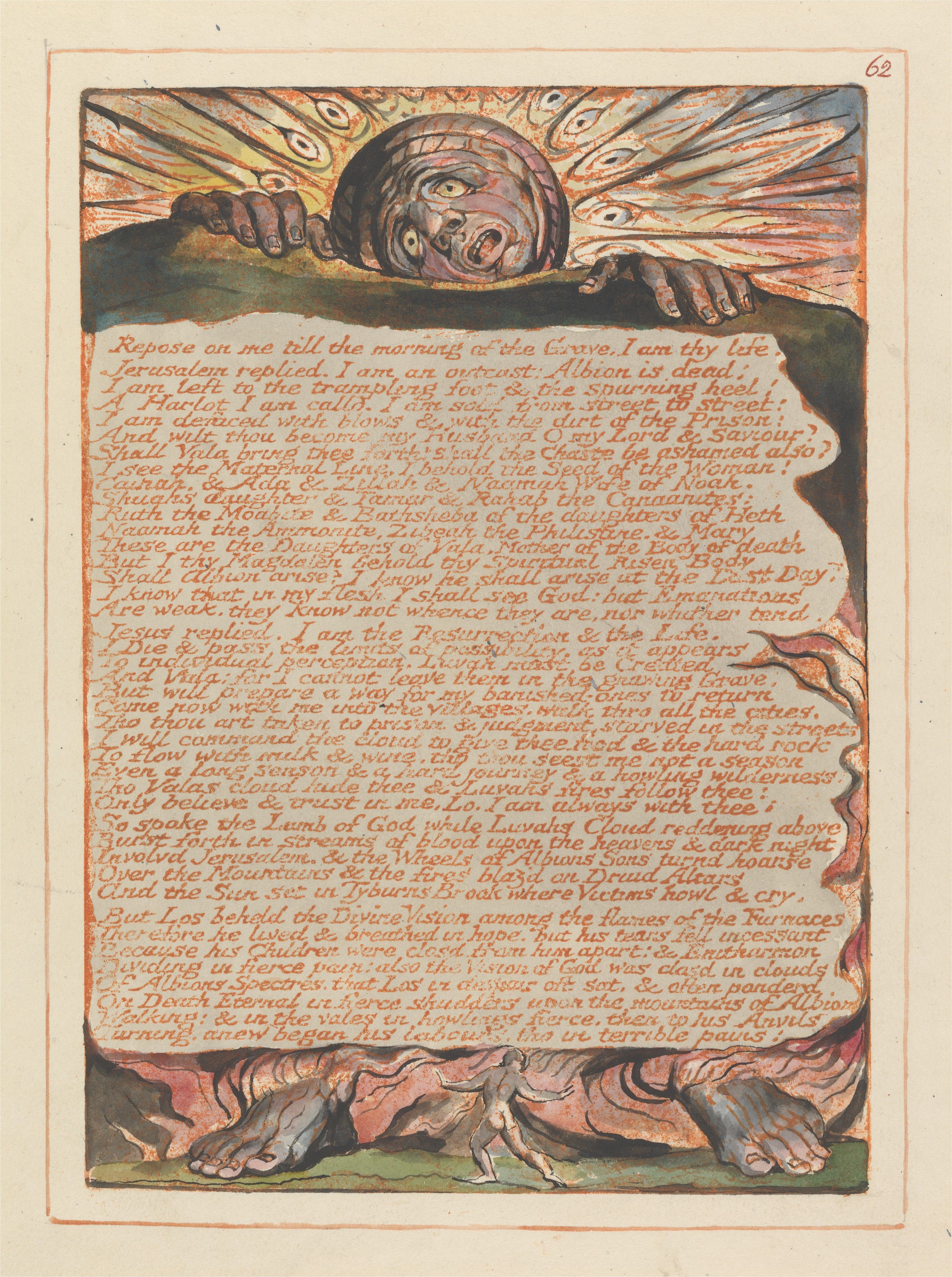
In the Illumination on Plate 62, we have an example of how Blake presents the explicit and implicit simultaneously. The explicit is invariably the lessor of his communications. Although the seven spots direct us to the Eyes of God, there is a suggestion of twelve spots. The implied twelve suggests the Zodiac and other instances of twelve entities for which we may seek associations. 

The picture itself goes beyond the stated imagery of the text on either Plate 62 or Plate 33. In the introduction to William Blake's Circle of Destiny, Percival presents the overall theme of his book: that when the long cycle comes to an end, it renews (repeats) itself if error is not cast off, or it reaches the Last Judgment which ends all temporal things. Percival sees Blake presenting the whole of the cycle: from the undifferentiated status of Eternity to the Apocalypse where time ends - in all its aspects of politics, science, history, sociology, psychology and religion.

Through the images incorporated in this picture of Albion, Blake may be suggesting a turning point in cosmic events. The ouroboros (seen as a snake around Albion's head) as a representation of cyclical experience reminds us that Albion may break the cycle or repeat it. The peacock feathers surrounding the head remind us that this is a point of transition. The Eyes of God tell us that Albion is under the protection of the Eternals though he has not returned from the world of time. The twelve eyes point to the Zodiac, another image of cyclical movement. (Percival is able to correlate the stages traversed in Blake's myth with passage through the signs of the Zodiac in Chapter VIII of his book.)

Using alchemical symbolism, Percival makes this observation: "The feminine mercury passes from black to white through an intermediate stage in which all the colors assert themselves. The symbol of this stage is the peacock's tail. The appearance of this symbol is a good omen; it means that the fire is doing its work, that death is awakening into life, or, as Paracelsus puts it alchemically, 'it showeth the workings of the philosopher's mercury on the vulgar mercury."' (
Page 206)

Just as Blake wanted us to think of the events of the Old and New Testaments as we read the words of the text, in the illumination he is calling to our minds the seven days of creation, the twelve tribes of Israel, and whatever associations with the numbers seven and twelve which we may have from our reading of history, literature and numerology. The feet, cold to the point of blue death, are surrounded by the fires of destruction and redemption. And what about how Albion grasps the stone tenaciously? The face of fear, anguish and confusion suggests an agonizing decision making process like that undergone by Jesus in the Garden.

Jerusalem, Plate 33 [37], (E 179)
"And One stood forth from the Divine Family &,said    

I feel my Spectre rising upon me! Albion! arouze thyself!
Why dost thou thunder with frozen Spectrous wrath against us?
The Spectre is, in Giant Man; insane, and most deform'd.
Thou wilt certainly provoke my Spectre against thine in fury!    
He has a Sepulcher hewn out of a Rock ready for thee:
And a Death of Eight thousand years forg'd by thyself, upon
The point of his Spear! if thou persistest to forbid with Laws
Our Emanations, and to attack our secret supreme delights

So Los spoke: But when he saw blue death in Albions feet,   
Again he join'd the Divine Body, following merciful;
While Albion fled more indignant! revengeful covering"

Blake bombards us with images, as he makes us ask the question, "Which direction will Albion choose?"

Thanks to Jim and Mark for ideas included in this post.


Wednesday, January 12, 2022

JESUS & JERUSALEM

First posted Oct. 2011

Yale Center for British Arts
Paul Mellon Collection
Jerusalem, Plate 62


Frequently Blake used a shorthand to present his ideas. He quoted words or phrases from his sources to evoke larger bodies of ideas without stating them explicitly.

On Plate 62 of Jerusalem he points our attention to various Biblical passages to expand the context of the statements he is making about Jesus and about his own developing myth. To facilitate a more complete understanding of part of Plate 62, here are some Biblical passages which incorporated phrases from Blake's poem.

John 20:
11-12 - But Mary [Maglalen] stood just outside the tomb, and she was crying. And as she cried, she looked into the tomb and saw two angels in white who sat, one at the head and the other at the foot of the place where the body of Jesus had lain.

20:13 - The angels spoke to her, "Why are you crying?" they asked. "Because they have taken away my Lord, and I don't know where they have put him!" she said.
20:14 - Then she turned and noticed Jesus standing there, without realising that it was Jesus.
20:15 - "Why are you crying?" said Jesus to her. "Who are you looking for?" She, supposing that he was the gardener, said, "Oh, sir, if you have carried him away, please tell me where you have put him and I will take him away."
20:16 - Jesus said to her, "Mary!" At this she turned right round and said to him, in Hebrew, "Master!"

Mark 1:
2 - just as the prophet Isaiah had written: "Look, I am sending my messenger ahead of you, and he will prepare your way.


Numbers 10:
12 - and the sons of Israel set out on their journeys from the wilderness of Sinai. Then the cloud settled down in the wilderness of Paran.

Nehemiah 9:
19 - You, in Your great compassion, Did not forsake them in the wilderness; The pillar of cloud did not leave them by day, To guide them on their way, Nor the pillar of fire by night, to light for them the way in which they were to go

Exodus 17:
5-6 -
The Lord answered Moses, “Walk on ahead of the people. Take with you some of the elders of Israel and take in your hand the staff with which you struck the Nile, and go. I will stand there before you by the rock at Horeb. Strike the rock, and water will come out of it for the people to drink.” So Moses did this in the sight of the elders of Israel.


Exodus 16:
4 Then the LORD said to Moses, "Behold, I will rain bread from heaven for you; and the people shall go out and gather a day's portion every day, that I may test them, whether or not they will walk in My instruction.

 
John 11:
24 - "I know," said Martha, "that he [her brother Lazarus]

will rise again in the resurrection at the last day."
25-26 - "I myself am the resurrection and the life," Jesus
told her. "The man who believes in me will live even though he
dies, and anyone who is alive and believes in me will never die
at all. Can you believe that?"

John 14:28 - You have heard me say, 'I am going away and I am
coming back to you. ' If you really loved me, you would be glad
because I am going to my Father, for my Father is greater than I.
And I have told you of it now, before it happens, so that when
it does happen, your faith in me will not be shaken.

Revelation 14:20 - And the wine press was trodden outside the city, and blood came out from the wine press, up to the horses' bridles, for a distance of two hundred miles.

This may seem like a lot of Biblical references for one short passage but with some effort you can find even more.

Jerusalem, Plate 62, (E 213)
[Jerusalem speaking:]
"These are the Daughters of Vala, Mother of the Body of death
But I thy Magdalen behold thy Spiritual Risen Body
Shall Albion arise? I know he shall arise at the Last Day!
I know that in my flesh I shall see God: but Emanations
Are weak. they know not whence they are, nor whither tend.

Jesus replied. I am the Resurrection & the Life.
I Die & pass the limits of possibility, as it appears
To individual perception. Luvah must be Created
And Vala; for I cannot leave them in the gnawing Grave.
But will prepare a way for my banished-ones to return
Come now with me into the villages. walk thro all the cities.
Tho thou art taken to prison & judgment, starved in the streets
I will command the cloud to give thee food & the hard rock
To flow with milk & wine, tho thou seest me not a season
Even a long season & a hard journey & a howling wilderness!
Tho Valas cloud hide thee & Luvahs fires follow thee!
Only believe & trust in me, Lo. I am always with thee!

So spoke the Lamb of God while Luvahs Cloud reddening above
Burst forth in streams of blood upon the heavens & dark night
Involvd Jerusalem. & the Wheels of Albions Sons turnd hoarse
Over the Mountains & the fires blaz'd on Druid Altars
And the Sun set in Tyburns Brook where Victims howl & cry.

But Los beheld the Divine Vision among the flames of the Furnaces
Therefore he lived & breathed in hope."

As you may gather after viewing these quotes, Blake is attempting to convey much more in this Plate than has been suggested in this post.


Tuesday, January 11, 2022

Albion

First Posted October 2015

Albion has a composite character second to none. It means (originally) England, but at a deeper level it means the cosmos, which is a man!. (In this Blake agrees with the Adam Kadmon of the Kabbalah, the Heavenly Man of Philo, St. Paul's heavenly man, the second Adam, and the cosmic man of Jung's psychology, and the Hindu god, Krishna.)
       
Blake's Albion, the eternal man, fell asleep into mortality in Beulah. We read at the beginning of Night 2 of the Four Zoas these ominous words:
    "Rising upon his Couch of Death Albion beheld his Sons
    Turning his Eyes outward to Self, losing the Divine Vision. Albion called Urizen & said:
    "Take thou possession! take this Scepter! go forth in my might
    For I am weary, & must sleep in the dark sleep of Death."
He divides and divides into four parts, the four zoas (strangely similar to the four functions promulgated more than a hundred years later by Carl Jung).
 
       This dissolution of the cosmic man is described at the beginning of the Four Zoas. He passes through the Circle of Destiny, and at the end of the Four Zoas he awakens from his mortal sleep and resumes his place in Eternity. That in essence is a thumbnail account of Blake's myth: descent from Eternity, struggle, and eventually return.
Wikipedia Commons
Jerusalem
Plate 76, Copy A
Albion     Jesus
 
*****************************************************************
From Wikipedia, the free encyclopedia
This article is about the archaic name for Great Britain. For other uses, see Albion (disambiguation).
Not to be confused with Alban.

The White Cliffs of Dover may have given rise to the name Albion


Albion (Ancient Greek: Ἀλβίων) is the oldest known name of the island of Great Britain. Today, it is still sometimes used poetically to refer to the island. The name for Scotland in the Celtic languages is related to Albion: Alba in Scottish Gaelic, Alba (genitive Alban, dative Albain)in Irish, Nalbin in Manx and Alban in Welsh,Cornish and Breton. These names were later Latinised as Albania and Anglicised as Albany, which were once alternative names for Scotland.
New Albion and Albionoria ("Albion of the North") were briefly suggested as names of Canada during the period of the Canadian Confederation.[1][2] Captain Arthur Phillip originally named the Sydney Cove "New Albion", but for uncertain reasons the colony acquired the name "Sydney."
 

Monday, January 10, 2022

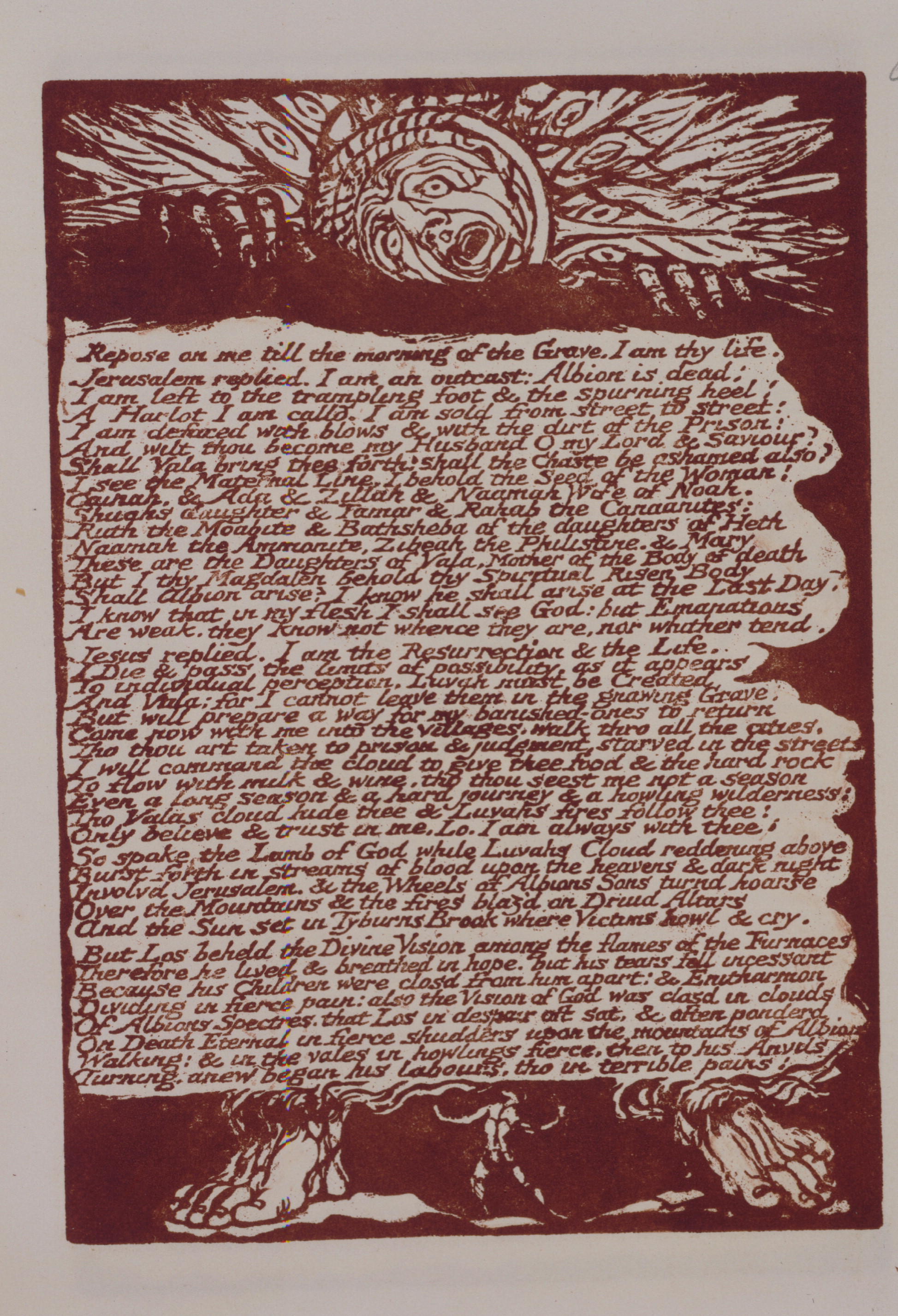
Plate 62

First posted April 2012

Trianon Press
Jerusalem
Plate 62

Jerusalem, Plate 62, (E 212)
"Repose on me till the morning of the Grave. I am thy life.

Jerusalem replied. I am an outcast: Albion is dead!
I am left to the trampling foot & the spurning heel!
A Harlot I am calld. I am sold from street to street!
I am defaced with blows & with the dirt of the Prison!  
And wilt thou become my Husband O my Lord & Saviour?
Shall Vala bring thee forth! shall the Chaste be ashamed also?
I see the Maternal Line, I behold the Seed of the Woman!
Cainah, & Ada & Zillah & Naamah Wife of Noah.
Shuahs daughter & Tamar & Rahab the Canaanites:         
Ruth the Moabite & Bathsheba of the daughters of Heth
Naamah the Ammonite, Zibeah the Philistine, & Mary
These are the Daughters of Vala, Mother of the Body of death
But I thy Magdalen behold thy Spiritual Risen Body
Shall Albion arise? I know he shall arise at the Last Day!
I know that in my flesh I shall see God: but Emanations
Are weak.
they know not whence they are, nor whither tend.

Jesus replied. I am the Resurrection & the Life.
I Die & pass the limits of possibility, as it appears
To individual perception. Luvah must be Created         
And Vala; for I cannot leave them in the gnawing Grave.
But will prepare a way for my banished-ones to return
Come now with me into the villages. walk thro all the cities.
Tho thou art taken to prison & judgment, starved in the streets
I will command the cloud to give thee food & the hard rock
To flow with milk & wine, tho thou seest me not a season
Even a long season & a hard journey & a howling wilderness!
Tho Valas cloud hide thee & Luvahs fires follow thee!
Only believe & trust in me, Lo. I am always with thee!
So spoke the Lamb of God while Luvahs Cloud reddening above
Burst forth in streams of blood upon the heavens & dark night
Involvd Jerusalem. & the Wheels of Albions Sons turnd hoarse
Over the Mountains & the fires blaz'd on Druid Altars
And the Sun set in Tyburns Brook where Victims howl & cry.

But Los beheld the Divine Vision among the flames of the Furnaces
Therefore he lived & breathed in hope. but his tears fell incessant
Because his Children were closd from him apart: & Enitharmon
Dividing in fierce pain: also the Vision of God was closd in clouds
Of Albions Spectres, that Los in despair oft sat, & often ponderd
On Death Eternal in fierce shudders upon the mountains of Albion
Walking: & in the vales in howlings fierce, then to his Anvils
Turning, anew began his labours, tho in terrible pains!"

Notes: 

The Plate begins with an echo of the Mary/Joseph/Jesus account from the previous plate, followed by the maternal line found in one of the gospels-- from Cainah to Mary, which he calls the daughters of Vala.

There follows a triumphant echo of Job: “in my flesh I shall see God”.

But emanations are weak.  We understand that only Blake’s men can achieve Eternity, while their emanations sleep in Beulah.  But 'Blake's men" may be of either gender.

But Jesus replies with “I am the Resurrection and the Life”......."Only believe & trust in me, Lo. I am always with thee” (solid gospel words); so spoke the Lamb of God. 

Although fallen activity continues, "Los ......":  read the last paragraph; you should find it completely explanatory.

Sunday, January 9, 2022

GIANT ALBION

 First posted Sept 2017

Yale Center for British Art
Jerusalem
Plate 62

Damon writes in A Blake Dictionary that "Giants symbolize the great primeval powers within us..." the totality of which is symbolized by the giant Albion who is represented by all of Britain. More expansively Albion includes all of mankind in one body.

In this passage in Milton we read of Albion as a giant body stretching over the British landscape. He is attempting to rise from his dreadful sleep on the Couch of Death. The anguish he experienced is portrayed in the face of Albion on plate 62 of Jerusalem. Blake includes a small figure between Albion's feet to indicate the scale of the forces incorporated in Albion - his symbol of Man.

Milton, Plate 39 [44] (E 140)
"Awake Albion awake! reclaim thy Reasoning Spectre. Subdue        

Him to the Divine Mercy, Cast him down into the Lake
Of Los, that ever burneth with fire, ever & ever Amen!
Let the Four Zoa's awake from Slumbers of Six Thousand Years

Then loud the Furnaces of Los were heard! & seen as Seven heavens
Stretching from south to north over the mountains of Albion"     

Milton, Plate 39 [44]
"Then Albion rose up in the Night of Beulah on his Couch
Of dread repose seen by the visionary eye; his face is toward
The east, toward Jerusalems Gates: groaning he sat above
His rocks. London & Bath & Legions & Edinburgh                   
Are the four pillars of his Throne; his left foot near London
Covers the shades of Tyburn: his instep from Windsor
To Primrose Hill stretching to Highgate & Holloway
London is between his knees: its basements fourfold 
His right foot stretches to the sea on Dover cliffs, his heel  
On Canterburys ruins; his right hand covers lofty Wales
His left Scotland; his bosom girt with gold involves
York, Edinburgh, Durham & Carlisle & on the front
Bath, Oxford, Cambridge Norwich; his right elbow
Leans on the Rocks of Erins Land, Ireland ancient nation[,]      
His head bends over London: he sees his embodied Spectre
Trembling before him with exceeding great trembling & fear
He views Jerusalem & Babylon, his tears flow down
He movd his right foot to Cornwall, his left to the Rocks of Bognor
He strove to rise to walk into the Deep. but strength failing    
Forbad & down with dreadful groans he sunk upon his Couch
In moony Beulah. Los his strong Guard walks round beneath the Moon

Romans 12 
[4] For as we have many members in one body, and all members have not the same office: 
[5] So we, being many, are one body in Christ, and every one members one of another.
[6] Having then gifts differing according to the grace that is given to us, whether prophecy, let us prophesy according to the proportion of faith; 
[7] Or ministry, let us wait on our ministering: or he that teacheth, on teaching; 
[8] Or he that exhorteth, on exhortation: he that giveth, let him do it with simplicity; he that ruleth, with diligence; he that sheweth mercy, with cheerfulness.

 First Corinthians 12 
[12] For as the body is one, and hath many members, and all the members of that one body, being many, are one body: so also is Christ. 
[13] For by one Spirit are we all baptized into one body, whether we be Jews or Gentiles, whether we be bond or free; and have been all made to drink into one Spirit.

Saturday, January 8, 2022

ANCIENT BRITONS

First posted April 2010

When Blake moved back to London from Felpham he opened for a time an exhibit of his paintings in the shop of his brother James. He wrote an extended Descriptive Catalogue of the works he was exhibiting. The quotes about Albion and Arthur in a previous post were from that catalogue. A picture which has been lost was the subject of the comments Blake made about Albion and Arthur.

Blake's picture according to his description was of three ancient Britons who were the sole survivors of a battle against the Romans. 

Descriptive Catalogue, NUMBER 5, (E 542-5)

" THE ANCIENT BRITONS--Three Ancient Britons overthrowing the Army of armed Romans; the Figures full as
large as Life--From the Welch Triades.
In the last Battle that Arthur fought, the most Beautiful was one
That return'd, and the most Strong another: with them also return'd
The most Ugly, and no other beside return'd from the bloody Field.

The most Beautiful, the Roman Warriors trembled before and worshipped:
The most Strong, they melted before him and dissolved in his presence:
The most Ugly they fled with outcries and contortion of their Limbs."

To Blake:

"The Strong man represents the human sublime. The Beautiful man represents the human pathetic, which was
in the wars of Eden divided into male and female. The Ugly man represents the human reason. They were originally one man, who was fourfold; he was self-divided, and his real humanity slain on the stems of generation, and the form of the fourth was like the Son of God. How he became divided is a subject of great sublimity and pathos. The Artist has written it under inspiration, and will, if God please, publish it; it is voluminous, and contains the ancient history of Britain, and the world of Satan and of Adam. In the mean time he has painted this Picture,"
...
"It will be necessary for the Painter to say something concerning his ideas of Beauty, Strength and Ugliness.
The Beauty that is annexed and appended to folly, is a lamentable accident and error of the mortal and perishing life; it does but seldom happen; but with this unnatural mixture the sublime Artist can have nothing to do; it is fit for the burlesque. The Beauty proper for sublime art, is lineaments, or forms and features that are capable of being the receptacles of intellect; accordingly the Painter has given in his beautiful man, his own idea of intellectual Beauty. The face and limbs that deviates or alters least, from infancy to old age, is the face and limbs of greatest Beauty and perfection.
The Ugly likewise, when accompanied and annexed to imbecility and disease, is a subject for burlesque and not for historical grandeur; the Artist has imagined his Ugly man; one approaching to the beast in features and form, his forehead small, without frontals; his jaws large; his nose high on the ridge, and narrow; his chest and he stamina of his make, comparatively little, and his joints and his extremities large; his eyes with scarce any whites, narrow and cunning, and every thing tending toward what is truly Ugly; the incapability of intellect.
The Artist has considered his strong Man as a receptacle of Wisdom, a sublime energizer; his features and limbs do not spindle out into length, without strength, nor are they too large and unwieldy for his brain and bosom. Strength consists in accumulation of power to the principal seat, and from thence a regular gradation and subordination; strength is compactness, not extent nor bulk.
The strong Man acts from conscious superiority, and marches on in fearless dependance on the divine decrees, raging with the inspirations of a prophetic mind. The Beautiful Man acts from duty, and anxious solicitude for the fates of those for whom he combats. The Ugly Man acts from love of carnage, and delight in the savage barbarities of war, rushing with sportive precipitation into the very teeth of the affrighted enemy."

Although there is no exact correlation between the three survivors and the Four Zoas, it is worth looking for some resemblances. The Strong Man is most like Tharmas, the physical body and source of man's energy. The Beautiful Man resembles Luvah who incorporates all the emotions and in his Eternal form is referred to a 'beauteous'. The Ugly man is Urizen who has become ugly through his hate, cruelty, and vengeance. The fourth man is like to the Son of God as was the fourth man in Daniel's fiery furnace. Los plays that role in Blake's myth since he is the force that initiates reunification.

Since the original picture is lost, I have tried to find images which may resemble the three men Blake describes and the Son of God from Daniel's furnace.

Strong - 'inspirations of a prophetic mind'

 
Ugly - 'incapability of intellect'


Son of God - 'great sublimity and pathos'


 Beautiful - 'receptacles of intellect'

 
All Images are from the Book of Urizen.
 

Thursday, January 6, 2022

SLEEP OF ALBION

First posted April 2010

THE SLEEP OF ALBION is a chapter in Kathleen Raine's book, Golgoonoza: City of Imagination. In it Raine explores the relationship between King Arthur and Albion (the oldest name for Great Britain) in the mind of the British. She shows how Blake's Albion partakes of the legends surrounding King Arthur. As the legends of King Arthur end, he is entombed but not dead, sleeping until he is called to return to 'restore just rule to his kingdom and repel its enemies'. Blake writes: 

Descriptive Catalogue, Number V, (E 543)

 "The giant Albion, was Patriarch of the Atlantic, he is the Atlas of the Greeks, one of those the Greeks called Titans. The stories of Arthur are the acts of Albion, applied to a Prince of the fifth century, who conquered Europe, and held the Empire of the world in the dark age, which the Romans never again recovered." 

Quotes from Golgoonoza: City of Imagination:

 In Jerusalem, it is the Giant Albion who is "imagined in the similitude of Arthur". Albion's sleep is the sleep of Arthur. Raine says, "in recounting the 'acts of Albion' [Blake] considered himself to be recounting the sacred history - the inner history of the British nation from ancient times, with prophetic foresight of that future when Albion, like Arthur, is to wake from sleep." 

To Raine the 'sleep' of Albion "is conceived by Blake not as the mere passage of time but as a state of apathy, of lowering of consciousness, of forgetfulness of higher things...

"Blake tells the story of how the nation has come to lapse into spiritual ignorance and forgetfulness... 

"Blake is quite specific in his diagnosis of England's national disease: it is precisely that secular materialism ... upon which modern Western civilization is founded... 

"Our society is forever thinking in terms of changing our circumstances; Blake's revolution will come when we change ourselves. From inner awakenings outer changes will follow... 

"When Albion awakens he will find himself in his lost kingdom restored to its former glory; for the kingdom is ourselves... 

"Paradise is not a place but a state of being, the lost kingdom to which the sleepers of Albion must someday awake." 

Descriptive Catalogue, NUMBER V, (E 542) 

The Ancient Britons: 

"In the last Battle of King Arthur only Three Britons escaped, these were the Strongest Man, the Beautifullest Man, and the Ugliest Man; these three marched through the field unsubdued, as Gods, and the Sun of Britain s[e]t, but shall arise again with tenfold splendor when Arthur shall awake from sleep, and resume his dominion over earth and ocean."  

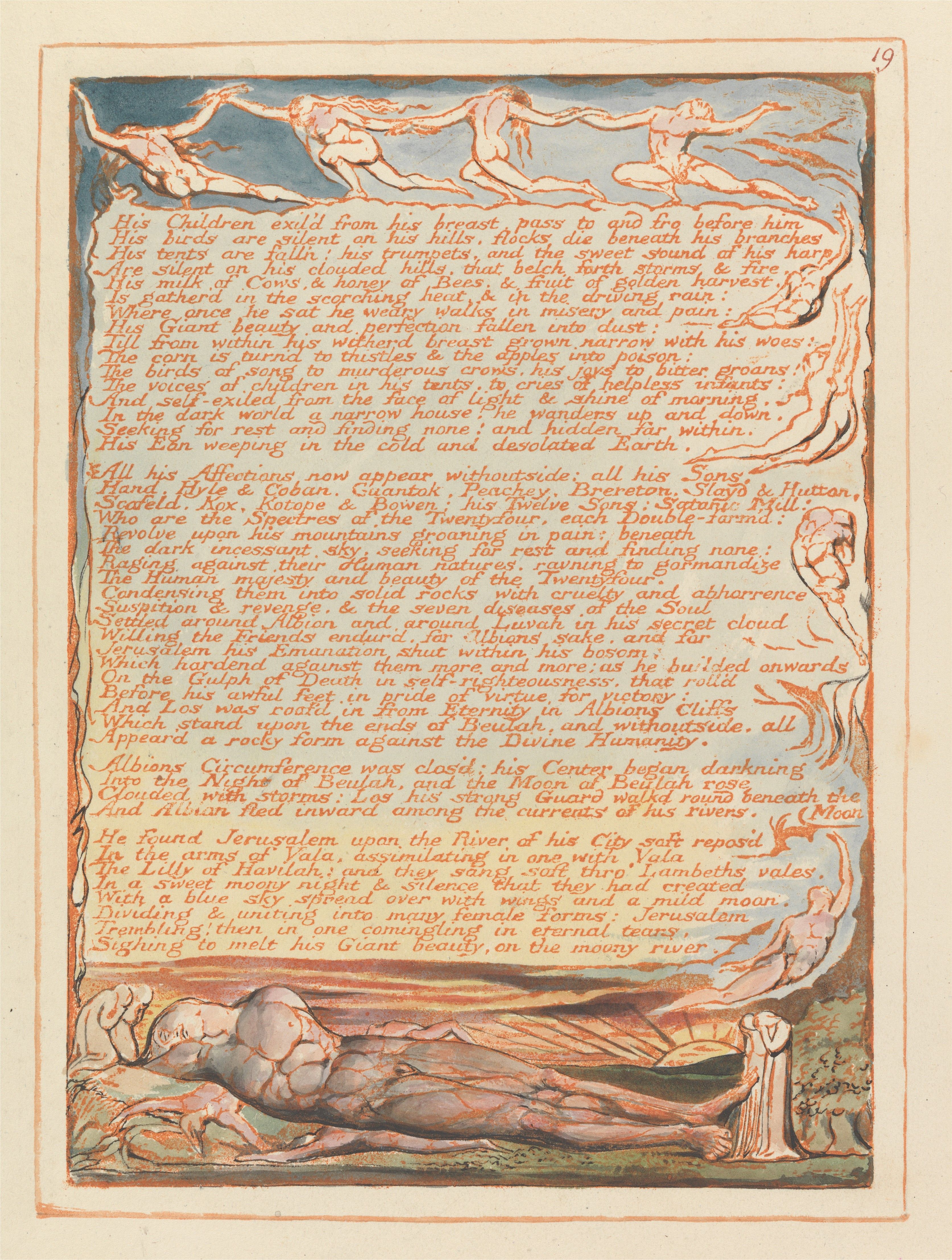
Jerusalem, Plate19, Albion 'in pain & tears'

Yale Center for British Art
Jerusalem
Plate 19