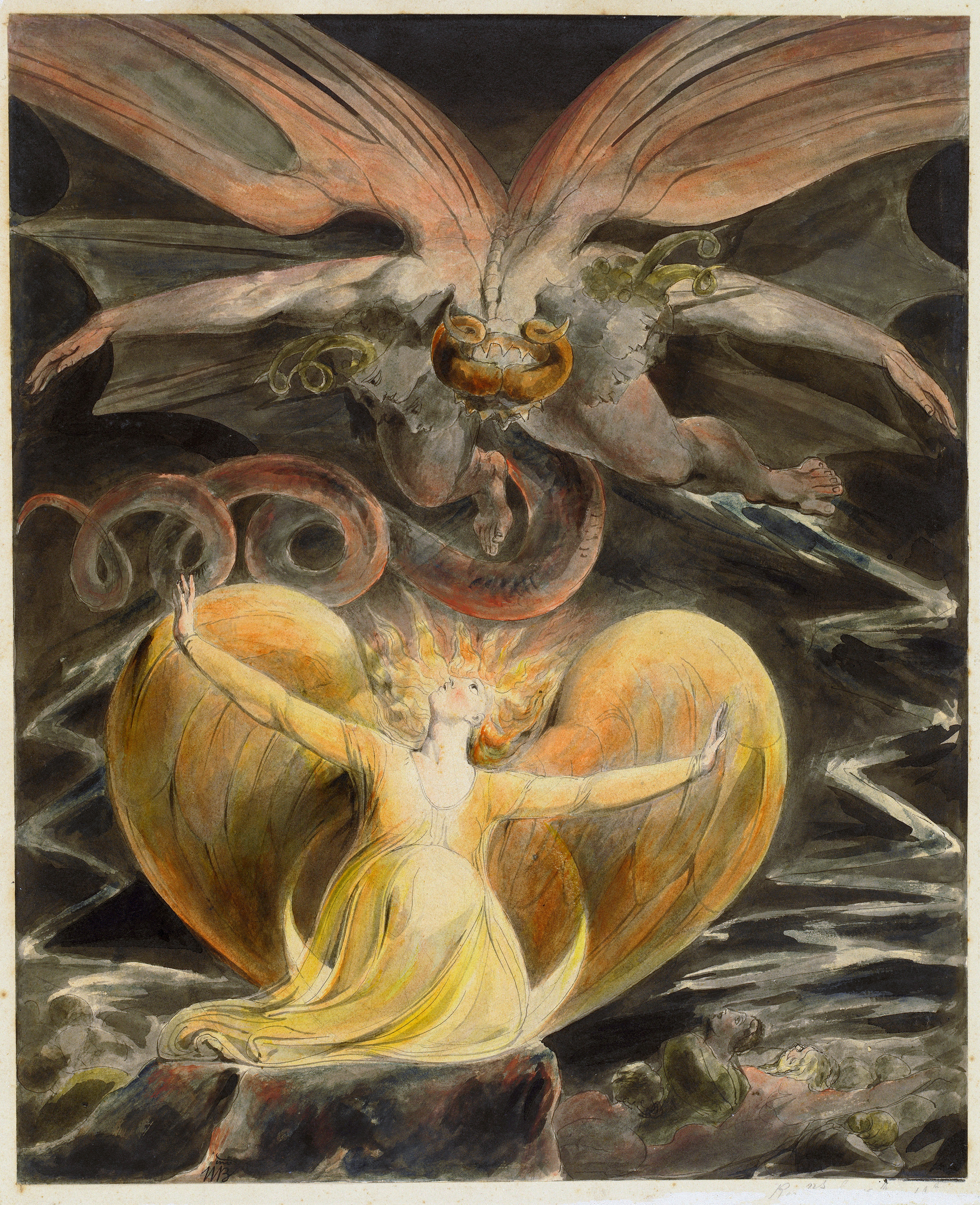
Blake seeks to provide the Golden String which can lead us through the labyrinth of our experience or his own poetry.

Monday, March 21, 2022

Building a System

Wikipedia Commons
Book of Thel
Plate 1 

       Early in his life Blake and his wife joined a new church of Swedenborgians, but he soon outgrew that 'system'. He had a contemptuous opinion of organized religion in England from early days and throughout his life.        

He read omnivorously and seemed to retain (and use) everything that came into his mind. Some of his most influential reading was the Bible, Plato, the Egyptians, the Neoplatonists, Paracelsus and Boehme. He assembled all this ancient and medieval wisdom (discarded by Western culture with the Enlightenment) into his system, what we call his myth.      

Most of the literature and art of special interest to Blake expressed the almost universal concept of metaphysical reality from the days of the earliest Mesopotamians and Egyptians to the present.  Blake drew on these symbols everywhere along the spectrum of time. 

Blake's friend Thomas Taylor had translated Sallust's On the Gods and the World giving Blake access to Sallust's ideas on the types of myths or fables current in the ancient world. 

In On the Gods and the World, Section IV Sallust taught that the Species of Myth are Five: Myths are natural (physical), metaphysical (theological), psychic (psychological), and material (literal); some are a combination. To these we might add the moral or ethical. Blake's myth is definitely a combination of all of them.


All of these various elements add up to a reality that exists in two spheres: upper and lower, above and below, Eternity and Time, spiritual and material, Heavenly and Worldly, dry and moist souls, good and evil. But at the deepest level these pairs belong to one another and God is in all ("as above so below"). These are all ways of looking at the fundamental metaphysical reality of life.        

The kernel of meaning in all this wisdom and in all of Blake's system was the myth of the descent of the soul into generation (this fallen world), her extensive travail here and eventual return to the fount of life from which she came.        

Blake drew on the earliest and latest examples of poetry and philosophy to elaborate his myth. Kathleen Raine in her little book, Blake and Antiquity, provides a very good means of elucidating the meanings that Blake intended in all his works. Perhaps the most common trap to avoid is assuming that his symbols connote literal or physical matters rather than psychological or metaphysical one.      

Blake had thorough familiarity with British poetry, where he found the same "kernel of meaning" as in every kind of literature.  For example Blake knew and loved Spenser (Queen Elizabeth's poet laureate who wrote The Faerie Queen).  Raine on page 18 provided examples from Spenser of the oldest myth central to Blake's poetry, namely the descent of the soul and eventual return:

Nevertheless with the Enlightenment this sort of idea had fallen into disrepute in most of the materialistic and rational minds of England. Bacon, Newton, and Locke were the primary exponents of rationalism in Blake's day. This meant in reality that no one was interested in the kind of poetry and philosophy that interested Blake.  
Jerusalem, Plate 10, (E 153)
"Therefore Los stands in London building Golgonooza
Compelling his Spectre to labours mighty; trembling in fear
The Spectre weeps, but Los unmovd by tears or threats remains

I must Create a System, or be enslav'd by another Mans           
I will not Reason & Compare: my business is to Create"

Sunday, March 20, 2022

Two Kinds of Language

Wikipedia Commons
Songs of Innocence
Plate 7
Echoing Green
 
Posted by Larry to:
Reflections of a Happy Old Man
Sunday, July 02, 2006

Two Kinds of Language

Literal and figurative!
"Proper language" and "poetry"

In college I studied Science, majoring in Biology and Chemistry. Then I spent a year in Medical School; later I worked for three years as a research chemist.

In seminary I found that language was used very differently.

Science used precise terms, each with one definite, exclusive meaning. In contrast religion used metaphors - pointing toward the ineffable.

Among the characteristics of metaphors is that they often mean two (or more) things, sometimes directly opposite. Take fire for example: in the Bible we read about both divine and demonic fire. Another characteristic of metaphors is that they are in a sense optional: among the many connotations of fire very different metaphors may serve the same purpose.

"Everyone shall be salted with fire". When you read that, if you have any curiosity about what it might mean, you begin to try to interpret it, that is, you cast about in your mind other metaphors! that might serve to make the meaning clear.

Metaphors are allusive, suggestive; they imply rather than specify as scientific terms do.

In the seminary I soon learned that to attempt to describe spiritual values precisely was unrewarding, unless, that is, one lived with a purely material consciousness. In that case it was the only recourse.

Our culture has been deeply affected by scientific learning and influence. People in general (unfortunately) have an almost purely materialistic consciousness; few people are comfortable talking about spiritual categories, often because they just don't have the mental equipment).

So we have a materialistic culture: things that can be observed with the senses, measured, weighed, evaluated in physical terms; these are what people talk about almost exclusively.

This is unfortunately true of religious discourse. So we talk about abortion, gay marriage, flag burning, etc. etc. and never say a word about love or integrity or honor, much less about purity, meekness, gentleness, and faithfulness.

A purely literal interpretation of the Bible condemns one to a purely material viewpoint about God. But God is not matter; God is Spirit! 
___________________________________________
THERE is NO NATURAL RELIGION, (E 2)
  "VII The desire of Man being Infinite the possession is Infinite
& himself Infinite
     Conclusion,   If it were not for the Poetic or Prophetic
character. the Philosophic & Experimental would soon be at the
ratio of all things & stand still, unable to do other than repeat
the same dull round over again
     Application.   He who sees the Infinite in all things sees
God.  He who sees the Ratio only sees himself only.

Therefore God becomes as we are, that we may be as he is"


Wednesday, March 16, 2022

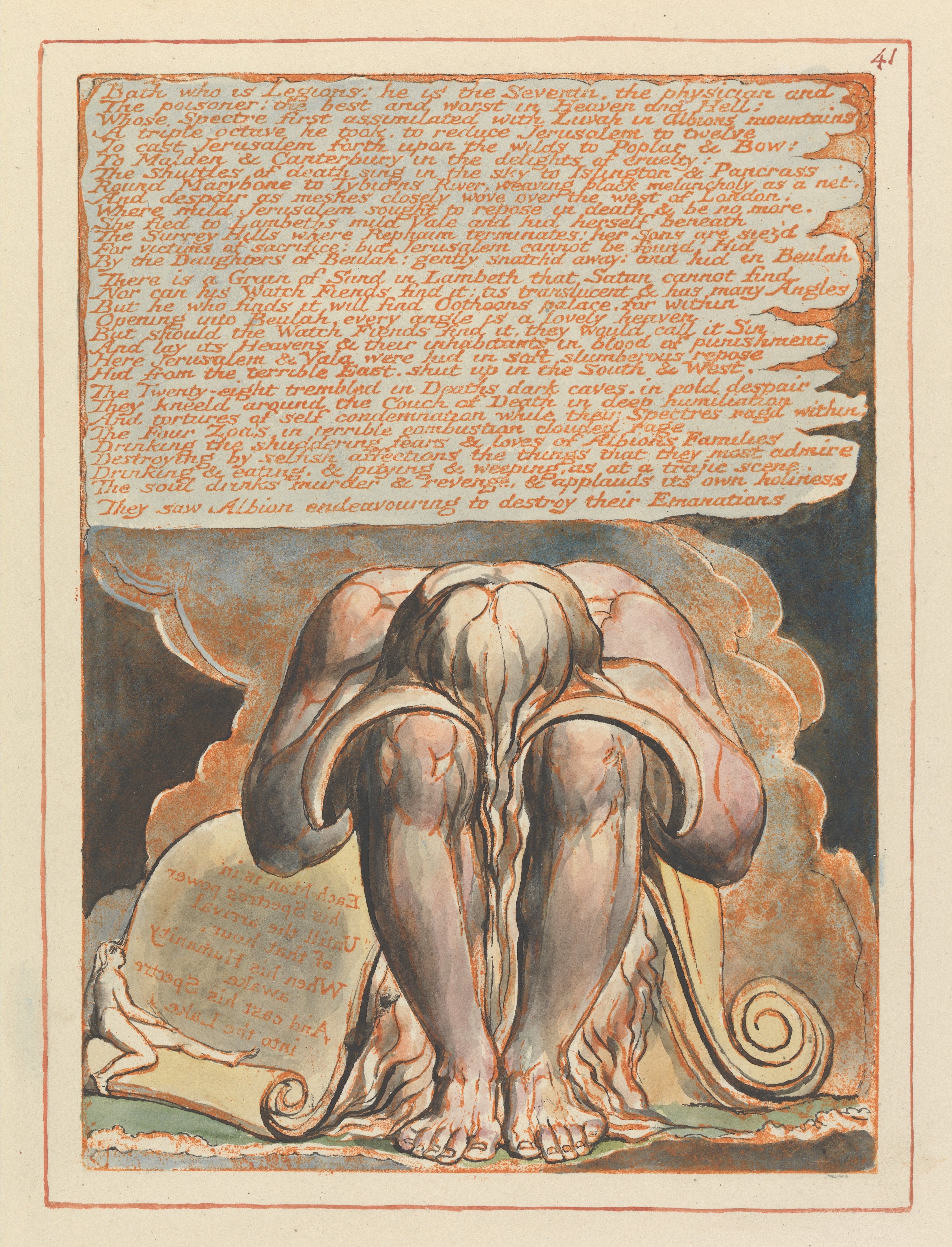
SEEING THROUGH

Yale Center for British Art
Jerusalem
Plate 41

There is a finite world - the material world of time and space. Humans receive physical bodies capable of living in the physical world of matter, time and space. But there is another world - the Infinite World - the Spiritual world of Eternity and Infinity. Humans are given Spiritual Bodies which live both in the physical and in the eternal worlds. The Spiritual Body is capable of perceiving the Divine Vision which is opaque to the corporeal body.

When Albion fell from his Unifying Form by closing himself off from the Divine Vision and following his own Selfhood, the delicate balance in the Human psyche lost its ability to function in the Spiritual world. We can think of the Natural World as a filter which separates us from the world which is not perceived by our natural senses. Even though the Natural World is a gift to be used and enjoyed in this life, it obscures the underlying import of the activity of Spiritual Reality. Blake tells us to look not at the world but 'thro' the world, not at the filter but at truths that underlie and give definition to what the senses perceive.

If we, like Albion, cannot discern the workings on the Spirit in ourselves and in the Natural World we cannot see the Divine Hand at work. Without Vision we find ourselves in the Furnace of Affliction until that hour when we awake.  

Proverbs 29
[18] Where there is no vision, the people perish: but he that keepeth the law, happy is he.

Jerusalem, Plate 37 [41], (E 184) 
[illustration, with inscription, reversed:]
"Each Man is in
his Spectre's power
Untill the arrival
of that hour,
When his Humanity
awake
And cast his Spectre
into the Lake"

Vision of Last Judgment, (E 566)
"I question not my Corporeal or Vegetative Eye any more than I would Question a Window concerning a Sight I look thro it & not with it." 
 

Friday, March 11, 2022

MORAVIAN MOTHER 6

Wikipedia Commons
Illustrations to Blair's The Grave
The Soul Hovering over the Body

It took me a long time to realize how much William Blake's attitude toward death had been shaped by his mother's Moravian connection. William Blake must have learned early that the end of physical life is a stage on the journey of the the soul to his eternal home. His mother had lost her first husband while they were both members of the Moravian Meeting in Fetters Lane. Her first husband Thomas Armitage died in 1751, the first year that the Moravians buried members in God's Acre in London. The term God's Acre was chosen to indicate the continuity of the congregation where those who were called home were buried using identical flat stones marking the location. Burials were not in biological family groups but with others of the same gender and marital status indicating that their primary loyalty was to the continuing life of the community of believers.

In 1787 William lost his beloved younger brother Robert to tuberculous, the same disease which had taken his mother's first husband. Robert died at age nineteen representing an enormous loss to his brother. However William was able to continue his relationship with Robert on a spiritual level. Because William's spiritual sensation was acute he continued to converse with his brother, receive advice and instruction from him and enjoy the feeling that Robert's 'Mortal loss' was 'Immortal Gain.'

Being conscious that there is a physical world and a spiritual world, also that there is a physical life and a spiritual life, enables one to distinguish between the body which is transient and the spirit which continues after the body ceases to support physical life. Among Moravians exit from the physical world by the Immortal Spirit is thought of as a home-going, as the return of the soul to its Eternal Home.

Here are a few quotes from Adelaide Fries's book The Road to Salem, an account to the settlement of the Moravians in North Carolina.

"I had long since learned not to use the word 'death' in connection with the departure of one of our members, that term being reserved for cases of outsiders of whose spiritual condition the Brethern knew little or too much." Page 158

"On  August 29th a messenger came to Friedland telling us that a little before ten o'clock in the morning his soul had gone home, leaving his mortal remains to rest in peace." Page 263

 "Once he whispered, 'O Thou, dear Savior,' but about seven o'clock he quietly and blessedly fell asleep. He had spoken of the beauty of a quick home-going, and it was granted to him." Page 266

Anna Catharina (Antes) Ernst, on whose diary The Road to Salem is based, wrote this after the death of her beloved first husband who was the community doctor:

"No light pierced my gloom until one day when the Lord sent a friend to show me a poem which had been written by our surveyor, Christian Reuter, as he was recovering from a serious attack of the dread fever. The lines set forth a dream he had had, in which two angels stood beside his bed, but passed him by because he was not yet ripe for the heavenly harvest; and a second dream in which he saw the Lord looking down upon sorely tried Bethabara, and heard Him say:

'This hundred-thousand-acre field
Now truly consecrate shall be,
Therefore the angel reapers come
And bear the first fruits home to me
.'

So that was what God's Acre meant! Not a place of burial, not even a measure of land consecrated to God, but a field in which the bodies of believers were laid awaiting the glories of the resurrection! I knew that, of course, but I had never realized what it could mean to one whose best beloved lay there. How sweet it was to think of my Martin, one of the pioneers in this hundred-thousand-acre field that we call Wachovia, now one of the first-fruits standing in that glorious presence, his labors accepted, his soul ripe for the harvest. Humbly I accepted the comfort which the Saviour gave me, and the last lines of Brother Reuter's poem became my prayer:

'Lord Jesus Christ,
Thou art so true,
Thou art so merciful to all,
I pray for grace Thy will to do,
To trust Thy love whate'er befall.'


It is no wonder that the Moravian influence can be seen is the poetry Blake wrote when he was young. This poem is from Poetical Sketches the book of his youthful poems published by his friends in 1783. The poems were written between his twelveth and twenty-first years. The dying young man in the poem, after meditating on his own sinfullness, receives a vision of his soul joyfully entering eternity. Later when his younger brother Robert died, William is reported to have seen his brother's 'released spirit ascend heavenward.'

Poetical Sketches, THE COUCH OF DEATH, (E 440-441)
"if I lift up
my head, sin covers me as a cloak! O my dear friends, pray ye for
me! Stretch forth your hands, that my helper may come! Through
the void space I walk between the sinful world and eternity! 
...
The youth lay silent--his mother's arm was
under his head; he was like a cloud tossed by the winds, till the
sun shine, and the drops of rain glisten, the yellow harvest
breathes, and the thankful eyes of the villagers are turned up in
smiles.  The traveller that hath taken shelter under an oak, eyes
the distant country with joy!  Such smiles were seen upon the
face of the youth! a visionary hand wiped away his tears, and a
ray of light beamed around his head!  All was still.  The moon
hung not out her lamp, and the stars faintly glimmered in the
summer sky; the breath of night slept among the leaves of the
forest; the bosom of the lofty hill drank in the silent dew,
while on his majestic brow the voice of Angels is heard, and
stringed sounds ride upon the wings of night.  The sorrowful pair
lift up their heads, hovering Angels are around them, voices of
comfort are heard over the Couch of Death, and the youth breathes
out his soul with joy into eternity." 

In his own voice Blake revealed his attitude toward death when he wrote letters to his dearest friends.

Letters, To Hayley, (E 705)

"Thirteen years ago.  I lost a
brother & with his spirit I  converse daily & hourly in the
Spirit.  & See him in my remembrance in the  regions of my
Imagination.  I hear his advice & even now write from his
Dictate--Forgive me for expressing to you my Enthusiasm which I
wish all to  partake of Since it is to me a Source of Immortal
Joy even in this world by it  I am the companion of Angels.  May
you continue to be so more & more & to  be more & more perswaded. 
that every Mortal loss is an Immortal Gain.  The  Ruins of Time
builds Mansions in Eternity."
Letters, To Linnell, (E 774)
"I verily believe it Every Death is an improvement of the State of
the Departed."
Letters, To Cumberland. (E 783) 
 "I have been very near the Gates of Death & have returned
very weak & an Old Man feeble & tottering, but not in Spirit &
Life not in The Real Man The Imagination which Liveth for Ever.
In that I am stronger & stronger as this Foolish Body decays." 
 Letters, To Linnell, (E 784)
    "Flaxman is Gone & we must All soon follow every one to his
Own Eternal House Leaving the Delusive Goddess Nature & her Laws
to get into Freedom from all Law of the Members into The Mind in
which every one is King & Priest in his own House  God Send it so
on Earth as it is in Heaven"
Gates of Paradise, The Keys of the Gates, (E 269) 
"13 But when once I did descry
      The Immortal Man that cannot Die
14 Thro evening shades I haste away
     To close the Labours of my Day"


Gospel of John (Phillips Translation)

12:23-26 - Jesus told them, "The time has come for the Son of Man to be glorified. I tell you truly that unless a grain of wheat falls into the earth and dies, it remains a single grain of wheat; but if it does, it brings a good harvest. The man who loves his own life will destroy it, and the man who hates his life in this world will preserve it for eternal life. If a man wants to enter my service, he must follow my way; and where I am, my servant will also be. And my Father will honour every man who enters my service.


Wednesday, March 2, 2022

JESUS AND REPROBATES

First posted July 2010

Luke 7:44-47
"Exactly," replied Jesus, and then turning to the woman, he said to Simon, "You can see this woman? I came into your house but you provided no water to wash my feet. But she has washed my feet with her tears and dried them with her hair. There was no warmth in your greeting, but she, from the moment I came in, has not stopped covering my feet with kisses. You gave me no oil for my head, but she has put perfume on my feet. That is why I tell you, Simon, that her sins, many as they are, are forgiven; for she has shown me so much love. But the man who has little to be forgiven has only a little love to give."

Of the three classes of men, the reprobate is the one Blake associated with Jesus.


Jerusalem, Plate 31 [35], (E 177)
"And the appearance of a Man was seen in the Furnaces;
Saving those who have sinned from the punishment of the Law,
(In pity of the punisher whose state is eternal death,)
And keeping them from Sin by the mild counsels of his love."

Here we have Jesus saving the reprobate (sinners) from punishment of the law, and thereby saving the elect (accusers) from administering punishment. The love of Jesus keeps both classes from sin. But a question remained: why were the innocent condemned for the guilty?

Milton, Plate 11 [12], (E 105)
"And it was enquir'd: Why in a Great Solemn Assembly
The Innocent should be condemn'd for the Guilty? Then an Eternal rose
Saying. If the Guilty should be condemn'd, he must be an Eternal Death
And one must die for another throughout all Eternity.
Satan is fall'n from his station & never can be redeem'd
But must be new created continually moment by moment
And therefore the Class of Satan shall be calld the Elect, & those
Of Rintrah. the Reprobate, & those of Palamabron the Redeem'd
For he is redeem'd from Satans Law, the wrath falling on Rintrah,
And therefore Palamabron dared not to call a solemn Assembly
Till Satan had assum'd Rintrahs wrath in the day of mourning
In a feminine delusion of false pride self-deciev'd."
 

The guilty in this case was Satan (the Elect) but the guilt fell upon Rintrah (the Reprobate). The representative of the Eternals answers that it is to avoid sending the guilty to Eternal Death.
 

Milton, Plate 7, (E 101)
"[Palamabron says] prophetic I behold
His future course thro' darkness and despair to eternal death
But we must not be tyrants also! he hath assum'd my place
For one whole day, under pretence of pity and love to me:
My horses hath he maddend! and my fellow servants injur'd:
How should he[,] he[,] know the duties of another? O foolish
forbearance
Would I had told Los, all my heart! but patience O my friends.
All may be well: silent remain, while I call Los and Satan."

Palamabron is confident that a solution will be found. The solution turns out to be that the Lamb of God take on the sin and guilt among the reprobates.

There Is No Natural Religion, (E 3)
"Therefore God becomes as we are, that we may be as he is"

Milton, Plate 13 [14], (E107)
"For then the Body of Death was perfected in hypocritic holiness,
Around the Lamb, a Female Tabernacle woven in Cathedrons Looms
He died as a Reprobate. he was Punish'd as a Transgressor!
Glory! Glory! Glory! to the Holy Lamb of God
I touch the heavens as an instrument to glorify the Lord!

The Elect shall meet the Redeem'd. on Albions rocks they shall meet
Astonish'd at the Transgressor, in him beholding the Saviour.
And the Elect shall say to the Redeemd. We behold it is of Divine
Mercy alone! of Free Gift and Election that we live.
Our Virtues & Cruel Goodnesses, have deserv'd Eternal Death.
Thus they weep upon the fatal Brook of Albions River."

The Body of death forms around the Lamb of God. The Elect and Redeemed are given to see the Savior in the Transgressor.

Milton, 32 [35], (E 132)
"Distinguish therefore States from Individuals in those States.
States Change: but Individual Identities never change nor cease:
You cannot go to Eternal Death in that which can never Die.
Satan & Adam are States Created into Twenty-seven Churches
And thou O Milton art a State about to be Created
Called Eternal Annihilation that none but the Living shall
Dare to enter: & they shall enter triumphant over Death
And Hell & the Grave! States that are not, but ah! Seem to be."

The Elect, Redeemed and Reprobates are not the true identities of man but states which can be terminated. The Individual Identity never dies.

Milton, Plate 14, (E 108)
"I in my Selfhood am that Satan: I am that Evil One!
He is my Spectre! in my obedience to loose him from my Hells
To claim the Hells, my Furnaces, I go to Eternal Death.

And Milton said. I go to Eternal Death! Eternity shudder'd
For he took the outside course, among the graves of the dead
A mournful shade. Eternity shudderd at the image of eternal death"

Recognizing the state as a psychological condition to which we ourselves give reality, we are in a position to forgive and annihilate it.

Milton, PLATE 38 [43],(E 139)
"Satan! my Spectre! I know my power thee to annihilate
And be a greater in thy place, & be thy Tabernacle
A covering for thee to do thy will, till one greater comes
And smites me as I smote thee & becomes my covering.
Such are the Laws of thy false Heavns! but Laws of Eternity
Are not such: know thou: I come to Self Annihilation
Such are the Laws of Eternity that each shall mutually
Annihilate himself for others good, as I for thee".

If the reprobate were not an inner reality in each man, Jesus, the God within, would have no cause to associate with him. If there were no darkness within man, there would not be no need for the light.

Harvard Art Museum
 The Body of Abel found by Adam and Eve - Cain Fleeing


Saturday, February 26, 2022

Church 6

From Larry's Blake Primer
 
National Gallery

Blake suffered intensely from the subtle forms of economic oppression and railed against them. His anger sparked the most searching critique of the restrictive structures of society and of the psychic attributes associated with those structures.

Wesley lacked Blake's prophetic mind, but he had a concern for souls that led his converts first to an elevation of character and soon to an elevation of economic station. In the simplest natural terms Wesley's converts replaced drinking and gambling with praying and singing hymns--and became prosperous, just as the Quakers had done in earlier generations.

Wesley held extremely conservative political views, but unlike most Tories he loved the poor. He devoted his life to helping them raise their circumstances, all of course a byproduct of his concern for their souls! While Blake denounced and railed against the social evils of the day, Wesley picked up one by one the fallen members of the underclass and instilled in them a means of lifting themselves up into the middle class.

He taught them for example to "gain all you can, save all you can, give all you can". The admonition won sufficient adherents to make a tremendous contribution to the humanitarian movement. Blake wrote about the prisons of the mind; Wesley systematically visited real prisons his entire life and organized helping institutions to address the needs of prisoners and to ameliorate their distress.

Wesley had a life changing message and organizational genius as well. Through his religious message and his Methodist societies he contributed significantly to the relief of economic distress and oppression. In contrast Blake's message was virtually incomprehensible to the kinds of people most responsive to Wesley's. In fact it is incomprehensible to most people today because it requires a level of  consciousness impossible for the materially minded.

Wesley and Blake may have been the two greatest men produced by England in the 18th Century. The work of Wesley and his fellow evangelists had immediate and far reaching consequences in the life of the world. For example his preachers exercised a great civilizing influence on the American frontier. The Methodist Church today represents the best of the American way, theologically and socially enlightened beyond the generality of the population.

Blake's work in contrast was far ahead of his time. It had no immediate visible influence, yet it offers the best hope of the future for the English speaking world to break out of the strait jacket of dead materialism. The present age needs a spiritual revival as desperately as did Wesley's.

But the Wesleyan style of revival has less to offer the modern mind than it did to the 18th Century underclass. The Blakean vision has a great deal to offer to the best minds of this century, the relatively few minds capable of an individual form of spiritual creativity. The mind of Blake offers the strongest possible protection against the mindless conformity that threatens the human race.

Although Blake did have a copy of a Wesleyan hymnbook, we lack evidence of direct first hand experience with a Methodist group. Most certainly he would have found the discipline distasteful. But Methodism was one of the rare forms of English religious life that Blake had good words for.

In the prose introduction to Chapter Three of 'Jerusalem' he defended Methodists and Monks against what he deemed to be the hypocritical attacks of Voltaire and the other philosophies. He named Wesley and Whitefield as the two witnesses of Revelation 11.3, the archetypal image of the rejected and despised prophet of God (cf Milton 22:61; Erdman 118). He grouped Whitefield with St. Teresa and other gentle souls "who guide the great Wine press of Love".

Jerusalem, Plate 72, (E 227)
"And the Four Gates of Los surround the Universe Within and
Without; & whatever is visible in the Vegetable Earth, the same
Is visible in the Mundane Shell; reversd in mountain & vale
And a Son of Eden was set over each Daughter of Beulah to guard
In Albions Tomb the wondrous Creation: & the Four-fold Gate
Towards Beulah is to the South[.] Fenelon, Guion, Teresa,
Whitefield & Hervey, guard that Gate; with all the gentle Souls
Who guide the great Wine-press of Love; Four precious stones that Gate:"

To  the best of our knowledge Blake belonged to no organized church. We do know of two groups which might generically qualify as churches, using the word its broadest possible sense. The first gathered around the radical publisher, Joseph Johnson, Blake's primary employer and the friend of Mary Wollstonecraft, Joseph Priestly, Richard Price, Thomas Paine and other radical intellectuals. While the conventional church exists as a primary bulwark of the status quo, Joseph Johnson's group by and large conceived of Christ as a revolutionary. Dissenters of a variety of persuasions, they were united by their awareness of the need for social and political change. They considered this the primary agenda of any truly spiritual communion.
     

Wikimedia Commons
Illustrations to Blair's The Grave

Blake was in accord with these ideas. The Johnson group nurtured him and provided the communal support which we generally associate with church groups. The second group gathered around Blake in his last decade. It was made up of young artists, some of them devout. They looked to Blake for aesthetic and spiritual guidance and provided him the communal support that lent grace to his last years.

       After Blake's Moment of Grace around 1800 he might have joined a church could have found one whose primary doctrine was the forgiveness of sins. But like Milton before him and Lincoln after him he never discovered a church that met his qualifications.

       Anyone who loves Blake and has had a happier experience of the church could wish for him more in the way of community. Alienated from the worshiping community by its partial theology and partial practice, he was confined to his own visions and the nurture he could find at the outer fringes of the church. In addition he learned from the Christian classics of the ages, particularly the off beat ones. St. Teresa was a favorite.   We know little or nothing of how the Ranter tradition came down to him.

All of these are elements of the Universal Church upon which Blake drew and to which he belonged. Blessed with a worshiping fellowship beyond that of his wife, his lot might have been happier and his witness plainer to others.

      Even so the church is fortunate to have his contribution. Isaiah and Jeremiah, not to mention Jesus, also suffered alienation from their communities. At the deepest level none of the four men rejected the church, but rather the church rejected them. Blake was too deeply attached to the priesthood of the believer to be able to  submit to any spiritual authority politically assigned: Let every man be "King and Priest in his own house". In the words of Foster Damon "The Church Universal was the only church that Blake recognized. Its doctrine is the Everlasting Gospel, its congregation the Brotherhood of Man, its symbol the Woman in the Wilderness (which he pictured), its architecture Gothic."


Thursday, February 24, 2022

MORAVIAN MOTHER 5

Wikipedia Commons
Joseph of Arimathea preaching to the inhabitants of Britain
 
 Luke 24 (Phillips Translation) 
45-47 - Then he opened their minds so that they could understand the scriptures, and added, "That is how it was written, and that is why it was inevitable that Christ should suffer, and rise from the dead on the third day. So must the change of heart which leads to the forgiveness of sins be proclaimed in his name to all nations, beginning at Jerusalem."


Blake's mother was surely aware of the missionary activities of the Moravians who aimed to bring the Gospel to people in far flung locations. They experienced the joy and satisfaction of living in community under the guidance of the spirit and wanted to share it.

"They sent out the first missionaries when there were only 300 inhabitants in Herrnhut. Within 30 years, the church sent hundreds of Christian missionaries to many parts of the world, including the Caribbean, North and South America , the Arctic, Africa, and the Far East."

Arthur Freeman wrote this for the Center for Moravian Studies:

"A third mark of the Gemeine was mission. Christ had given his church a mission. Each one of the Gospels concludes with some equivalent of a commissioning of his disciples. In John Jesus sends his disciples as his Father had sent him (e.g. John 17:18). Both the life and activity of the Gemeine carry out this mission.Its life expresses the very relationship which Christ calls the church to facilitate for others and which gives those exploring the Gospel an experiential referent. In I John 1:3 others were invited into the fellowship with the Father and the Son which constitutes the life and fellowship of the community.

Hence for Moravians a crucial step in mission was always the planting of a Gemeine where the life with Christ was lived out and could be experienced by others. The mission as action was going where Christ would have the Gemeine go, keeping in mind that mission and evangelism was God’s business. One had to discern, follow, and participate in what God was doing. What then began as preaching excursions into areas surrounding Herrnhut, following the spiritual experience of 1727, in a few years brought Moravians to the West Indies and North America and then to many other parts of the world to “win souls for the Lamb.” Within ten years Moravians had gone also to Greenland, Surinam, South Africa, the Gold Coast, Algeria, Arctic Russia, and Ceylon."

From the beginning to the end of his career Blake saw that the nations of the world were one people joined by one spirit which spoke to all according to their various means of reception. Albion was Blake's symbol for undivided mankind. All nations were contained and expressed by Albion or by the 'Poetic Genius' as stated in Blake's earliest Illuminated Book. 

ALL RELIGIONS are ONE (E 1)

"PRINCIPLE. 5. The Religions of all Nations are derived from
each Nations different reception of the Poetic Genius which is
every where call'd the Spirit of Prophecy."

Blake's prophetic message was taken from the book of Numbers and quoted on the first plate of Milton. Damon tells us that prophets do not predict the future but reveal Eternal Truths. To spread such truth to all nations Blake accepted as his mission 'awaking to Eternal Life' all those who sleep in the 'land of shadows.'

Milton, Plate 1, (E 95)
 "I will not cease from Mental Fight,
     Nor shall my Sword sleep in my hand:
     Till we have built Jerusalem,                     
     In Englands green & pleasant Land.

Would to God that all the Lords people were Prophets.
                                        Numbers XI. ch 29 v."

Jerusalem, Plate 4, (E 146)
"Of the Sleep of Ulro! and of the passage through
Eternal Death! and of the awaking to Eternal Life.

This theme calls me in sleep night after night, & ev'ry morn
Awakes me at sun-rise, then I see the Saviour over me
Spreading his beams of love, & dictating the words of this mild song.  

Awake! awake O sleeper of the land of shadows, wake! expand!
I am in you and you in me, mutual in love divine:"

Blake is specific in naming nations to make it clear that Albion is inclusive and that his prophetic words are appropriate for everyone, everywhere.

Milton, Plate 31 [34],(E130)
"And all Nations wept in affliction Family by Family
Germany wept towards France & Italy: England wept & trembled
Towards America: India rose up from his golden bed:
As one awakend in the night: they saw the Lord coming            
In the Clouds of Ololon with Power & Great Glory!"

Jerusalem, Plate 24, (E 170)
"Thy Sons came to Jerusalem with gifts, she sent them away
With blessings on their hands & on their feet, blessings of gold,
And pearl & diamond: thy Daughters sang in her Courts:           
They came up to Jerusalem; they walked before Albion
In the Exchanges of London every Nation walkd
And London walkd in every Nation mutual in love & harmony
Albion coverd the whole Earth, England encompassd the Nations,
Mutual each within others bosom in Visions of Regeneration;      
Jerusalem coverd the Atlantic Mountains & the Erythrean,
From bright Japan & China to Hesperia France & England.
Mount Zion lifted his head in every Nation under heaven:
And the Mount of Olives was beheld over the whole Earth:
The footsteps of the Lamb of God were there: but now no more     
No more shall I behold him, he is closd in Luvahs Sepulcher."

Jerusalem, Plate 72, (E 227)
"These are the Land of Erin

All these Center in London & in Golgonooza. from whence
They are Created continually East & West & North & South
And from them are Created all the Nations of the Earth           
Europe & Asia & Africa & America, in fury Fourfold! 
[Legend on image] 
Continually Building. Continually Decaying because of
Love & Jealousy

And Thirty-two the Nations: to dwell in Jerusalems Gates
O Come ye Nations Come ye People Come up to Jerusalem
Return Jerusalem & dwell together as of old! Return
Return! O Albion let Jerusalem overspread all Nations            
As in the times of old! O Albion awake! Reuben wanders
The Nations wait for Jerusalem. they look up for the Bride

France Spain Italy Germany Poland Russia Sweden Turkey
Arabia Palestine Persia Hindostan China Tartary Siberia
Egypt Lybia Ethiopia Guinea Caffraria Negroland Morocco          
Congo Zaara Canada Greenland Carolina Mexico
Peru Patagonia Amazonia Brazil. Thirty-two Nations
And under these Thirty-two Classes of Islands in the Ocean
All the Nations Peoples & Tongues throughout all the Earth

And the Four Gates of Los surround the Universe Within and       
Without; & whatever is visible in the Vegetable Earth, the same
Is visible in the Mundane Shell; reversd in mountain & vale"

Jerusalem, Plate 97, (E 256)
"Awake! Awake Jerusalem! O lovely Emanation of Albion
Awake and overspread all Nations as in Ancient Time
For lo! the Night of Death is past and the Eternal Day
Appears upon our Hills: Awake Jerusalem, and come away

So spake the Vision of Albion & in him so spake in my hearing   
The Universal Father. Then Albion stretchd his hand into Infinitude."

Inscriptions, (E 671)                  
     "Albion rose from where he labourd at the Mill with Slaves
     Giving himself for the Nations he danc'd the dance of Eternal Death"

Revelation 22
[1] And he shewed me a pure river of water of life, clear as crystal, proceeding out of the throne of God and of the Lamb.
[2] In the midst of the street of it, and on either side of the river, was there the tree of life, which bare twelve manner of fruits, and yielded her fruit every month: and the leaves of the tree were for the healing of the nations.
[3] And there shall be no more curse: but the throne of God and of the Lamb shall be in it; and his servants shall serve him:
[4] And they shall see his face; and his name shall be in their foreheads.
[5] And there shall be no night there; and they need no candle, neither light of the sun; for the Lord God giveth them light: and they shall reign for ever and ever.