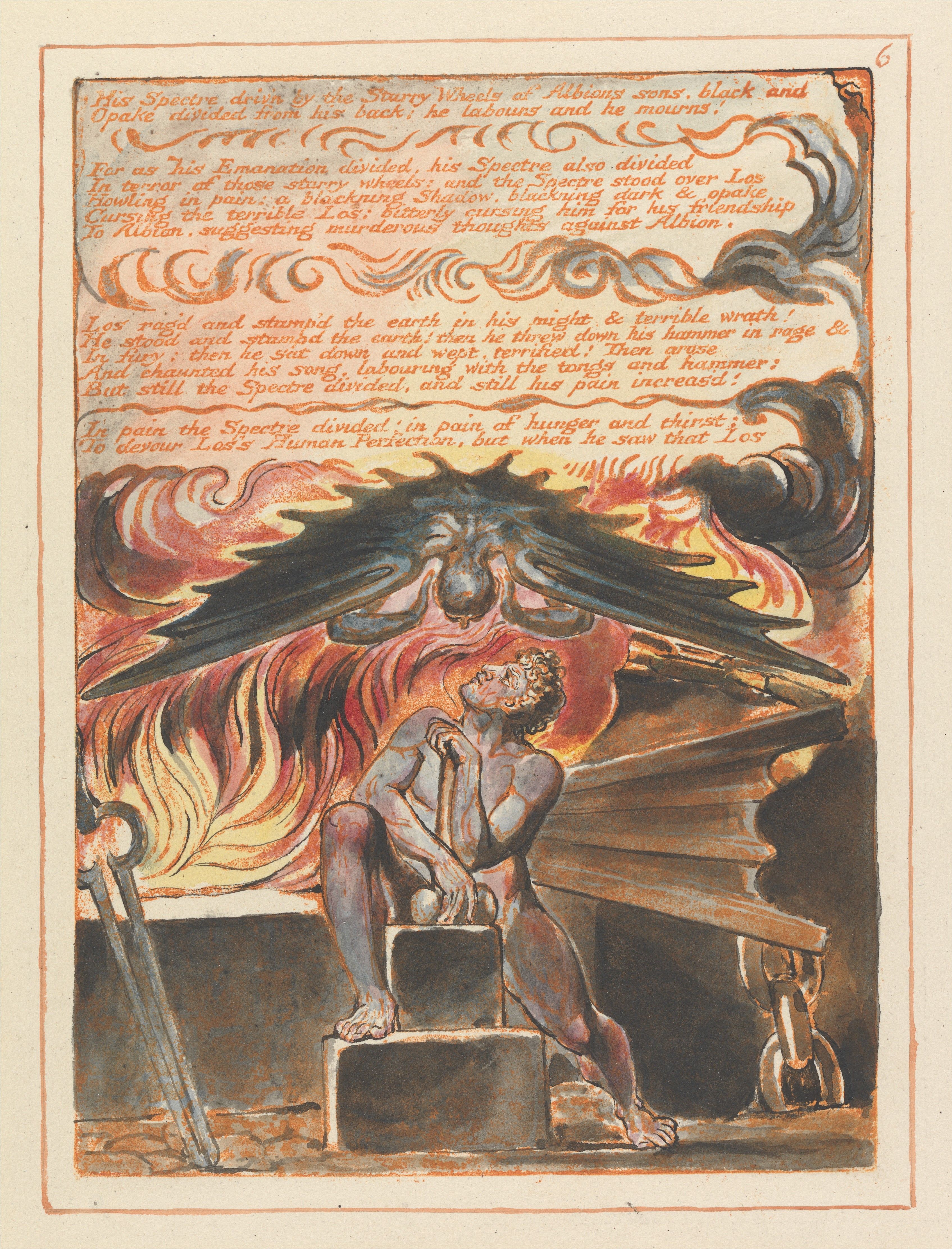
Blake seeks to provide the Golden String which can lead us through the labyrinth of our experience or his own poetry.

Wednesday, May 10, 2023

Destination


First posted April 2019.

This is an extract from Chapter Five (GOD) of Ram Horn'd With Gold by Larry Clayton.
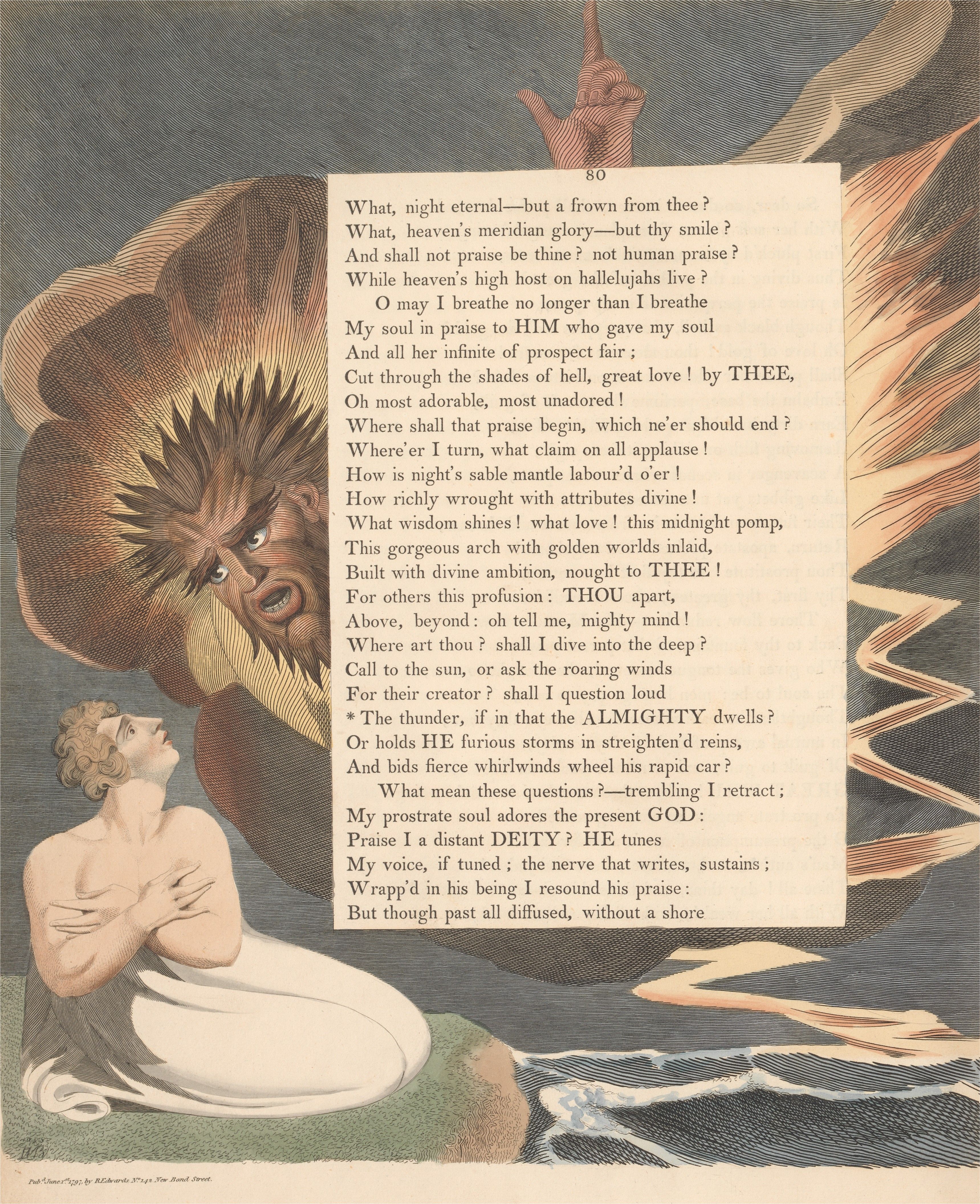
Yale Center for British Art
Illustrations to Young's Night Thoughts


The Divine Vision

Throughout this chapter we have followed Blake as he encountered, faced, studied, named, and denounced the false God in the many guises in which he appears to man. This enterprise occupied the first half of his adult life. But during this time he was always aware of something real behind the shadow. As a child he had loved the Lamb:

Songs of Innocence, Song 8, (E 9)
"Little Lamb, who made thee?
Dost thou know who made thee?
Gave thee life, and bid thee feed
By the stream and o'er the mead;

Gave thee clothing of delight,
Softest clothing, wooly, bright;
Gave thee such a tender voice
Making all the vales rejoice?
Little Lamb, who made thee?
Dost thou know who made thee?

Little Lamb, I'll tell thee,
Little Lamb, I'll tell thee:
He is called by thy name,
For he calls himself a Lamb.
He is meek, and he is mild;
He became a little child.
I a child, and thou a lamb,
We are called by his name.
Little Lamb, God bless thee!
Little Lamb, God bless thee!"

As a youth Blake's mind came to be overshadowed by the Tyger. Some interpreters believe that at a certain point he began to see Jesus as misguided: in the 'Song of Los' he wrote that Jesus "received a Gospel from wretched Theotormon". Theotormon symbolizes the legalistic repression of impulse. If Blake did turn away from Jesus, it was by no means an uncommon stage of life for a young man.

Blake always put an ultimate trust in the imaginative power that gave him visions of infinite joy. But at the age of 24 through a failure of consciousness he had chosen a measure of satanic power with a consequent loss of spiritual perception; the Divine Vision faded. There followed the years of struggle with the God of this World, and as we have seen, his experience at Felpham (his "first Vision of Light") led to his definite rejection of the Tempter. In 1803 he returned to London, having prepared himself for an additional grace which shortly fell upon him. In a letter to Hayley dated Oct. 23, 1804 he gave an account of an awesome change that had come into his life:

Letters, To William Hayley, (E 756)
"Suddenly on the day after visiting the Truchsessian Gallery of pictures, I was again enlightened with the light I enjoyed in my youth, and which has for exactly twenty years been closed from me as by a door and by window-shutters."

It's doubtful that he expected Hayley to understand this fully, but we are eternally indebted to both of them for passing it down to us. It marks in a most objective way the return of the Divine Vision, who had been overshadowed by Blake's preoccupation with the God of this World.

The progression of Blake's poetry shows the eclipse of Christ through the long struggle of the nineties. Now he proceeded to introduce the Lamb into 4Z with a group of additional lines at strategic places. These images means relatively little to the secular reader, but cause great joy to the Christian.

The Destination

The healing of Los, described in Night vii of 'The Four Zoas', prepares the way for Christ's coming into history. Night viii tells the story of Jesus: the Incarnation, the Crucifixion, and the Resurrection of the spiritual body. It's important to remember that in Blake's mental world and in his poetry these are psychic rather than historical events.

Blake had always worshiped the Divine Vision. In his twenty years in the wilderness the Divine Vision dimmed and lost the immediacy which had informed the beautiful poems of Innocence. Kathleen Raine points to a few lines that describe with peculiar luminosity this dimming of the Divine Vision:

Jerusalem , Plate 66, (E 219)
"And as their eye & ear shrunk, the heavens shrunk away:
The Divine Vision became First a burning flame [Moses], then a column
Of fire [the Exodus],then an awful fiery wheel surrounding earth and heaven [Ezekiel],
And then a globe of blood wandering distant in an unknown night:" [false Christianity]
 
This describes Blake's personal experience and that of Mankind. But at or after Felpham he recovered the Divine Vision and realized that his name is Jesus.

He spent the rest of his life celebrating the momentous event and the Name and proclaiming its reality in a hundred ways. It had happened to him, and it would happen to the world.

With the ensuing works of art Blake gives us a portrait of Jesus in many ways original. It may prove to be the most vital portrait of Jesus for the present age. The quest for the historical Jesus long ago became a vain enterprise. Every worshiper has endowed the Divine Man with his own highest values, and Blake was no exception. His mature or final portrait of Jesus has four salient features. Three of them expressed convictions that he had held for a lifetime and repeatedly expressed poetically and pictorially. The fourth was a new experience, the touch of grace; it irradiated the first three with glory.


Sunday, May 7, 2023

MENTAL TRAVELLER

Wikipedia Commons 

Gates of Paradise - for the Sexes

In the thought of C G Jung the dynamic of individuation involves the ego/self axis which connects the conscious and unconscious functioning of the psyche. The ego, or consciousness, arises from the original state of unconsciousness which is the undifferentiated psyche. Jung calls the total psyche the Self; Blake calls the total psyche Albion.   

Jung and Blake discern that when consciousness develops, the connection between conscious mental processing and the unconscious totality is fractured. This is imaged as the division into the four functions in Jung and into the Four Zoas in Blake. Both men directed their thoughts to the restoration of the psyche as a unified whole which would incorporate the sundered parts and express each without division or competition.

In Blake the Zoa which became dominant was Urizen, the reasoning power of man. In Jung the ego, which acted as the executive of the psyche, was the thinking function. Blake and Jung agree that thought - not emotion, sensation, or intuition - governed the conscious functioning of the psyche.

Blake portrayed the aspects of the psyche which were not dominant as struggling to wrest control from the rational function. This represented a tug of war in the individual as the separate parts sought expression. Luvah, Tharmas and Los battled with Urizen until the Eternal form of Los - Urthona - brought all into a unity as it was in the unconscious before the psyche interacted with the external world.

The parallel process took place in Jung's system. The divided psyche which was under control of the rational mind reconnected with the unified unconscious called the Self. Through the process of individuation the ego experienced that the totality of the psyche was the Self and the ego was drawn back into the greater reality.   

Blake discerned that the ultimate reconciliation restored to man the ability to perceive the Infinite Eternal Divine. Jung expressed the resolution of the process of restoring wholeness to the psyche in terms of the ego gradually subordinating itself to the completeness of the Self which was as close to a God-image as Jung went.

************************************     

Jerusalem, Plate 27, (E 171)
"You have a tradition, that Man anciently containd in his mighty
limbs all things in Heaven & Earth: this you recieved from the
Druids.
  'But now the Starry Heavens are fled from the mighty limbs of
Albion'" 

Milton, Plate 29 [31], (E 127)

"The Sky is an immortal tent built by the Sons of Los
And every Space that a Man views around his dwelling-place:
Standing on his own roof, or in his garden on a mount
Of twenty-five cubits in height, such space is his Universe;
And on its verge the Sun rises & sets. the Clouds bow
To meet the flat Earth & the Sea in such an orderd Space:
The Starry heavens reach no further but here bend and set        
On all sides & the two Poles turn on their valves of gold:
And if he move his dwelling-place, his heavens also move.
Wher'eer he goes & all his neighbourhood bewail his loss:
Such are the Spaces called Earth & such its dimension:
As to that false appearance which appears to the reasoner,       
As of a Globe rolling thro Voidness, it is a delusion of Ulro
The Microscope knows not of this nor the Telescope. they alter
The ratio of the Spectators Organs but leave Objects untouchd
For every Space larger than a red Globule of Mans blood.
Is visionary: and is created by the Hammer of Los                
And every Space smaller than a Globule of Mans blood. opens
Into Eternity of which this vegetable Earth is but a shadow:
The red Globule is the unwearied Sun by Los created
To measure Time and Space to mortal Men. every morning.
Four Zoas, Night IX, Page 121,(E 391) 
"And the Eternal Man Said Hear my words O Prince of Light  
PAGE 122 
Behold Jerusalem in whose bosom the Lamb of God
Is seen tho slain before her Gates he self renewd remains
Eternal & I thro him awake to life from deaths dark vale
The times revolve the time is coming when all these delights
Shall be renewd & all these Elements that now consume            
Shall reflourish. Then bright Ahania shall awake from death
A glorious Vision to thine Eyes a Self renewing Vision" 
Four Zoas, Night IX, Page 133, (E 402)
"Not for ourselves but for the Eternal family we live
Man liveth not by Self alone but in his brothers face            
Each shall behold the Eternal Father & love & joy abound

So spoke the Eternal at the Feast they embracd the New born Man
Calling him Brother image of the Eternal Father. they sat down
At the immortal tables sounding loud their instruments of joy
Calling the Morning into Beulah the Eternal Man rejoicd   
Four Zoas, Night IX, Page 136, (E 404)
"This dreadful Non Existence is worse than pains of Eternal Birth  
Eternal Death who can Endure. let us consume in fires
In waters stifling or in air corroding or in earth shut up
The Pangs of Eternal birth are better than the Pangs of Eternal Death"
 

Thursday, May 4, 2023

Death

Wikipedia Commons 
Illustrations to The Grave
Designed by Blake engraved by Schiavonetti
 
First posted March 2019
 
This is an extract from Chapter Two of Ram Horn'd With Gold by Larry Clayton. 
 
 If its visions of love express the quality of a culture, so also does the face which it presents to death. Our society expends enormous sums on the professional removal of all evidence of death from our consciousness, even in the teeth of the stark reality. Ernest Becker, in The Denial of Death, showed the ubiquity of this impulse in American culture. His title, a poetic term, can just as easily mean one thing as the other. Like all symbols of value we encounter good denials of death and bad ones.
  
The poetry of Walt Whitman expresses one of the best. Like our poet Whitman was so sure of Eternity that the end of natural life had no terrors for him. He gained first hand experience with death as a hospital volunteer during the Civil War. Exceptionally memorable is his address to a dying soldier, "I don't commiserate, I congratulate you". Here is the exact opposite of the forms of denial most often exercised by the mortician, who simply does all he can to encourage us not to think about it.

In one of his earliest writings Blake explored the meaning of death to an ordinary young man and his loved ones. The Couch of Death (Erdman 441) voices the common fears of humanity but moves to the faithful reality that Blake possessed throughout his days, ending "and the youth breathes out his soul with joy into eternity".
Couch of Death 
"...Sorrow linked them together,
leaning on one another's necks alternately--like lilies, dropping
tears in each other's bosom, they stood by the bed like reeds
bending over a lake, when the evening drops trickle down.  His
voice was low as the whisperings of the woods when the wind is
asleep, and the visions of Heaven unfold their visitation. 
Parting is hard, and death is terrible; I seem to walk through a
deep valley, far from the light of day, alone and comfortless!
The damps of death fall thick upon me! Horrors stare me in the
face! I look behind, there is no returning; Death follows after
me; I walk in regions of Death, where no tree is; without a
lantern to direct my steps, without a staff to support me."  
Blake's idealism found expression in the simple inversion of death, an idea that goes back as far as Heraclitus, who speaking of the Eternals said, "we live their death, and we die their life". The thought comes down to us through Euripides, Plato, and many others as late as Thomas Wolfe.
 
Most often when Blake speaks of "Death Eternal" he expresses the viewpoint of the Eternals; they meant by the term "this mortal life". Three times in Plate 14 of Milton the poet in Heaven, having heard the "Bard's Song" about Satan and recognizing Satan as his own Self- hood, says, "I go to Eternal Death!". He clearly means to return to this world, reenacting the kenosis (self emptying) of Christ.

Otherwise Blake used the word 'death' more straightforwardly than he had used 'love' and in two general senses. In fairly common parlance death is the opposite of the creative. Speaking of the Law in 'Jerusalem' the Divine Voice says:
"No individual can keep these Laws, for they are death To every energy of man and forbid the springs of life."

If you read Paul's epistles, you will discover that he used 'death' in the same ways. For example "And you hath he quickened, who were dead in trespasses and sins" (Ephesians 2:1). Paul is always reminding the Christian that he participates in the death and resurrection of Christ.

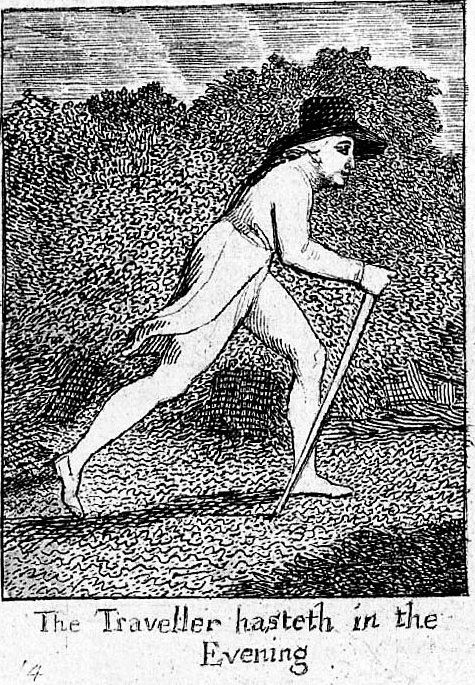
Secondly, Blake used 'death' in its most proper sense as the end of mortal life, but whenever he touched this subject, he always denied the materialistic viewpoint that death is the end. A clear example comes in Gates of Paradise, a short synoptic and pictorial description of Blake's myth of life:
" But when once I did descry The Immortal Man that cannot Die, Thro' evening shades I haste away To close the Labours of my Day."

Though he lived intensely, the love of the Ideal and his life long visions of Eternity led Blake to yearn for the Beyond and to depreciate material existence. Like the apostle Paul he had a "desire to depart, and to be with Christ; which is far better". Blake made a deliberate attempt through the aid of the doctrine of correspondences to live each moment of earthly life in the eternal realm, "to see a World in a Grain of Sand". Expressed negatively:
"I assert for My Self that I do not behold the outward Creation & that to me it is hindrance & not Action; it is as the Dirt upon my feet, No part of Me."

And as stated in CHAPTER ONE he died with a song of praise on his lips. His life and all his art provide a convincing testimony for the reality of the Beyond. It was really Death that was "Dirt upon his feet".

Finally Blake used 'death' in the uniquely Christian context of self giving. At the end of 'Jerusalem' Jesus explains to Albion the meaning of his own death and its significance as a universal form of relationship:
      "...Fear not Albion: unless I die thou canst not live;
But if I die I shall arise again & thou with me.
This is Friendship & Brotherhood: without it Man is Not. ...
....Wouldest thou love one who never died
For thee, or ever die for one who had not died for thee?
And if God dieth not for Man & giveth not himself
Eternally for Man, Man could not exist; for Man is Love
As God is Love; every kindness to another is a little Death 
In the Divine Image, nor can Man exist but by Brotherhood."

*************************************
     These explorations of 'love' and 'death' may help the reader to grasp some of the poetic meanings attached to Blake's other terms of value, words like heaven and hell, good and evil, truth and error. Always watch for irony, for the other point of view, the reverse side of the coin. In such ways Blake continually provokes the intellect. He delights the person who enjoys an intellectual challenge--and frustrates others. He intimated as much in a letter to Dr. Trusler, who likely belonged to the second category:
" But you ought to know that What is Grand is necessarily
obscure to Weak men. That which can be made Explicit to
the Idiot is not worth my care. The wisest of the Ancients
consider'd what is not too Explicit as the fittest for
Instruction, because it rouzes the faculties to act. I
name Moses, Solomon, Esop, Homer, Plato."
  

Monday, May 1, 2023

10 QUOTES EIGHTH

Yale Center for British Art
Jerusalem
Plate 6

 *

I have Mental Joy & Mental Health
And Mental Friends & Mental wealth     
Ive a Wife I love & that loves me
Ive all But Riches Bodily

"I am not a God afar off, I am a brother and friend;
Within your bosoms I reside, and you reside in me:

"I am in Gods presence night & day    
And he never turns his face away"

Seek Love in the Pity of others' Woe,
In the gentle relief of another's care,
In the darkness of night & the winter's snow,
In the naked & outcast, Seek Love there!"
 

*
And all must love the human form,
In heathen, turk or jew.
Where Mercy, Love & Pity dwell,
There God is dwelling too  
*
I must Create a System, or be enslav'd by another Mans           
I will not Reason & Compare: my business is to Create 
*
Giving a body to Falshood that it may be cast off for ever.
*
One Error not remov'd, will destroy a human Soul
Repose in Beulahs night, till the Error is remov'd 
* 
What are all the Gifts of the
Spirit but Mental Gifts whenever any Individual Rejects Error &
Embraces Truth a Last Judgment passes upon that Individual
*
When the Sun rises  do  you  not  see  a  round 
Disk of fire somewhat like a Guinea   O no no I see an Innumerable
company of the Heavenly host crying Holy Holy Holy is the Lord
God Almighty 
*


Friday, April 28, 2023

BRAIN

Wikipedia Commons
Marriage of Heaven and Hell
Plate 10, Detail

Although Blake thought long and deeply about the human brain he didn't have the technology to study it that is now available. David Eagleman, a neuroscientist who teaches at Stanford University, has been studying the "way parts [of the brain] unceasingly reweave themselves in an electric, living fabric." Blake did however realize that the mind perceives more than what the five traditional sense organs discern. 

An additional sense that Blake recognized was 'spiritual sensation' or the Imagination. Through this sense Blake has access to a visionary world which revealed a dimension of reality 'closed to the senses five.' 

From Livewired, by David Eagleman, Page 54:

"The key to understanding this requires diving one level deeper: your three pounds of brain tissue are not directly hearing or seeing any of the world around you. Instead, your brain is locked in a crypt of silence and darkness inside your skull. All it ever sees are electro-chemical signals that stream along different data cables. That's all it has to work with."

"In ways we are still working to understand, the brain is stunningly gifted in taking these signals and extracting patterns. To these patterns we assign meaning. With the meaning you have subjective experience. The brain is an organ that converts sparks in the dark into the picture show of your world. All the hues and aromas and emotions and sensations in your life are encoded in trillions of signals zipping in blackness, just as a beautiful screen saver on your computer is fundamentally build of zeros and ones."

Page 61 

"In evolutionary time, random mutations introduce strange new sensors, and the recipient brains simply figure out how to exploit them. Once the principles of brain operation have been established, nature can simply worry about designing new sensors. 

"This perspective allows a lesson to come into focus: the devices we come to the table with - eyes, noses, ears, tongues, fingertips - are not the only collection of instruments we could have had. These are simply what we have inherited from a lengthy and complex road of evolution.

But that particular collection of sensors may not be what we have to stick with." ___________________________________________________________

Four Zoas, Night II ,Page 34, (E 322)
"For Los & Enitharmon walkd forth on the dewy Earth     
Contracting or expanding their all flexible senses               
At will to murmur in the flowers small as the honey bee
At will to stretch across the heavens & step from star to star
Or standing on the Earth erect, or on the stormy waves
Driving the storms before them or delighting in sunny beams
While round their heads the Elemental Gods kept harmony"    
Book of Urizen, Plate 3, (E 71)
"1. Earth was not: nor globes of attraction
The will of the Immortal expanded
Or contracted his all flexible senses.
Death was not, but eternal life sprung"
Book of Urizen, Plate 4 (E 92)
"7: Many ages of groans: till there grew
Branchy forms. organizing the Human
Into finite inflexible organs."
Marriage of Heaven and Hell, Plate 5, (E 35)   
"How do you know but ev'ry Bird that cuts the airy way,
   Is an immense world of delight, clos'd by your senses five?"

THERE is NO NATURAL RELIGION [a],(E 2)

 "IV  None could have other than natural or organic thoughts if
he had none but organic perceptions"
THERE is NO NATURAL RELIGION [b], (E 2) 
 "I  Mans perceptions are not bounded by organs of perception. he
percieves more than sense (tho' ever so acute) can discover."
Marriage of Heaven and Hell, Plate 4, (E 34) 
 "1 Man has no Body distinct from his Soul for that calld Body is
a portion of Soul discernd by the five Senses. the chief inlets
of Soul in this age" 
Jerusalem, Plate 71, (E 225) 
"as in your own Bosom you bear your Heaven
And Earth, & all you behold, tho it appears Without it is Within
In your Imagination of which this World of Mortality is but a Shadow." 
Songs of Experience, The Tyger, (E 24)
 
"What the hammer? what the chain, 
In what furnace was thy brain?
What the anvil? what dread grasp,     
Dare its deadly terrors clasp!" 
Songs of Experience, The Human Abstract, (27) 
"The Gods of the earth and sea,
Sought thro' Nature to find this Tree
But their search was all in vain:
There grows one in the Human Brain" 

Visions of Daughters of Albion, Plate 2, (E 47)

"The lark does rustle in the ripe corn, and the Eagle returns     
From nightly prey, and lifts his golden beak to the pure east;
Shaking the dust from his immortal pinions to awake
The sun that sleeps too long. Arise my Theotormon I am pure.
Because the night is gone that clos'd me in its deadly black.
They told me that the night & day were all that I could see;     
They told me that I had five senses to inclose me up.
And they inclos'd my infinite brain into a narrow circle,
And sunk my heart into the Abyss, a red round globe hot burning
Till all from life I was obliterated and erased.
Instead of morn arises a bright shadow, like an eye              
In the eastern cloud: instead of night a sickly charnel house;
That Theotormon hears me not! to him the night and morn
Are both alike: a night of sighs, a morning of fresh tears"
Milton, Plate 2 (E 96) 
"Come into my hand    
By your mild power; descending down the Nerves of my right arm
From out the Portals of my Brain, where by your ministry
The Eternal Great Humanity Divine. planted his Paradise,
And in it caus'd the Spectres of the Dead to take sweet forms
In likeness of himself." 
French Revolution, Page 10, (E 294)
"But go, merciless man! enter into the infinite labyrinth of another's brain
Ere thou measure the circle that he shall run. Go, thou cold recluse,into the fires
Of another's high flaming rich bosom, and return unconsum'd, and write laws.
If thou canst not do this, doubt thy theories, learn to consider all men as thy equals,
Thy brethren, and not as thy foot or thy hand, unless thou first fearest to hurt them."

Four Zoas, Night I, Page 11, (E 306)
"Tho in the Brain of Man we live, & in his circling Nerves.       
Tho' this bright world of all our joy is in the Human Brain.
Where Urizen & all his Hosts hang their immortal lamps"
Letters, To Flaxman, (E 710) 
 "And Now Begins a New life. because another
covering of Earth is shaken off.  I am more famed in Heaven for
my works than I could well concieve   In my Brain are studies &
Chambers filld with books & pictures of old which I wrote &
painted in ages of Eternity. before my mortal life & whose works
are the delight & Study of Archangels.  Why then should I be
anxious about the riches or fame of mortality."

Letters, To Trusler, (E 702) 

"Why is the Bible more

Entertaining & Instructive than any other book. Is it not because they are addressed to the Imagination which is Spiritual Sensation & but mediately to the Understanding or Reason Such is True Painting and such alone valued by the Greeks & the best modern Artists. Consider what Lord Bacon says "Sense sends over to Imagination before Reason have judged & Reason sends over to Imagination before the Decree can be acted." See Advancemt of Learning Part 2 P 47 of first Edition But I am happy to find a Great Majority of Fellow Mortals who can Elucidate My Visions & Particularly they have been Elucidated by Children who have taken a greater delight in contemplating my Pictures than I even hoped. Neither Youth nor Childhood is Folly or Incapacity Some Children are Fools & so are some Old Men. But There is a vast Majority on the side of Imagination or Spiritual Sensation"

Milton, Plate 32 [35], (E 132) 
"The Imagination is not a State: it is the Human Existence itself
Affection or Love becomes a State, when divided from Imagination
The Memory is a State always, & the Reason is a State
Created to be Annihilated & a new Ratio Created                  
Whatever can be Created can be Annihilated Forms cannot
The Oak is cut down by the Ax, the Lamb falls by the Knife
But their Forms Eternal Exist, For-ever. Amen Halle[l]ujah
__________________________________________________________________ 

Eagleman writes that his long-range goal is "to understand how neural signals processed by different brain regions come together for a temporally unified picture of the world".


Sunday, April 23, 2023

MAKING OF MYTH

Wikimedia Commons
Mercy and Truth Are Met Together

First posted Feb 2019

Although when we read Blake's poetry we may be most aware of the particular characters and images which we encounter, that is not all there is to it. The minutiae may be thought of as the instrumentality which serves the myth as a whole. But the myth itself also means more, for like all myth, it is pointing beyond itself to truth that cannot be expressed in words. Although we may wish that Blake's thoughts should be unequivocally stated so that we could read Jerusalem in the way that we read the newspaper, that is impossible. It is up to the reader to make his own intuitive contribution by fitting the parts into a whole which may be elusive.  

Kathleen Raine on page 135 of Defending Ancient Springs expresses the artistry of the poet who has the gift of being a vehicle for presenting the moment when eternity penetrates time and renovates the whole:

"So for Yeats the vision of what lies behind the veil came in glimpses, seldom in whole symbolic episodes, still less in myths which unfold like those of Blake, into great epic drama enacted in an interior country within whose spaces we move freely. The unit of such poetry is not the symbol. Myths are not built by adding piece by piece, they are not the sum of symbolic parts. The unit of the myth is the whole enactment, and all its figures; each symbol exists as a part within that imaginative unity, from which it is inseparable, and by which it is determined; as a sentence determines words, and is not merely their sum.
...in every turbulent encounter with the mighty form of his Zoas, we recognize parts within a great whole whose harmony is implicit. The ability to handle the units of myth - which might be defined as dynamic symbol, symbol in transformation - ought to be recognized as the supreme poetic gift. In such poetry the symbolic parts are inseparable from the imaginative configuration and constellations within which they appear...we do not think of these as separate symbols but as parts of the world in which the poem moves, as we move in nature. Yer considered separately each symbol is used with the precision of words in a language of which the poet has perfect mastery."


Milton, Plate 5, (E 98) 
"While the Females prepare the Victims. the Males at Furnaces 
And Anvils dance the dance of tears & pain. loud lightnings
Lash on their limbs as they turn the whirlwinds loose upon
The Furnaces, lamenting around the Anvils & this their Song

Ah weak & wide astray! Ah shut in narrow doleful form
Creeping in reptile flesh upon the bosom of the ground      
The Eye of Man a little narrow orb closd up & dark
Scarcely beholding the great light conversing with the Void
The Ear, a little shell in small volutions shutting out
All melodies & comprehending only Discord and Harmony
The Tongue a little moisture fills, a little food it cloys  
A little sound it utters & its cries are faintly heard
Then brings forth Moral Virtue the cruel Virgin Babylon

Can such an Eye judge of the stars? & looking thro its tubes
Measure the sunny rays that point their spears on Udanadan
Can such an Ear filld with the vapours of the yawning pit.  
Judge of the pure melodious harp struck by a hand divine?
Can such closed Nostrils feel a joy? or tell of autumn fruits
When grapes & figs burst their covering to the joyful air
Can such a Tongue boast of the living waters? or take in
Ought but the Vegetable Ratio & loathe the faint delight     
Can such gross Lips percieve? alas! folded within themselves
They touch not ought but pallid turn & tremble at every wind

Thus they sing Creating the Three Classes among Druid Rocks    
Charles calls on Milton for Atonement. Cromwell is ready
James calls for fires in Golgonooza. for heaps of smoking ruins  
In the night of prosperity and wantonness which he himself Created
Among the Daughters of Albion among the Rocks of the Druids"

Milton, Plate 31 [34], (E 130)
"Thou hearest the Nightingale begin the Song of Spring;
The Lark sitting upon his earthy bed: just as the morn
Appears; listens silent; then springing from the waving Corn-field! loud
He leads the Choir of Day! trill, trill, trill, trill,
Mounting upon the wings of light into the Great Expanse:
Reecchoing against the lovely blue & shining heavenly Shell:
His little throat labours with inspiration; every feather
On throat & breast & wings vibrates with the effluence Divine    
All Nature listens silent to him & the awful Sun
Stands still upon the Mountain looking on this little Bird

With eyes of soft humility, & wonder love & awe.
Then loud from their green covert all the Birds begin their Song
The Thrush, the Linnet & the Goldfinch, Robin & the Wren         
Awake the Sun from his sweet reverie upon the Mountain:
The Nightingale again assays his song, & thro the day,
And thro the night warbles luxuriant; every Bird of Song
Attending his loud harmony with admiration & love.
This is a Vision of the lamentation of Beulah over Ololon!       

Thou percievest the Flowers put forth their precious Odours!
And none can tell how from so small a center comes such sweets 
Forgetting that within that Center Eternity expands
Its ever during doors, that Og & Anak fiercely guard[.]
First eer the morning breaks joy opens in the flowery bosoms     
Joy even to tears, which the Sun rising dries; first the Wild Thyme
And Meadow-sweet downy & soft waving among the reeds.
Light springing on the air lead the sweet Dance: they wake
The Honeysuckle sleeping on the Oak: the flaunting beauty
Revels along upon the wind; the White-thorn lovely May           
Opens her many lovely eyes: listening the Rose still sleeps    
None dare to wake her. soon she bursts her crimson curtaind bed
And comes forth in the majesty of beauty; every Flower:
The Pink, the Jessamine, the Wall-flower, the Carnation
The Jonquil, the mild Lilly opes her heavens! every Tree,        
And Flower & Herb soon fill the air with an innumerable Dance
Yet all in order sweet & lovely, Men are sick with Love!
Such is a Vision of the lamentation of Beulah over Ololon"

Jerusalem, Plate 3, (E 145)
    "Reader! [lover] of books! [lover] of heaven,
    And of that God from whom [all books are given,]
    Who in mysterious Sinais awful cave
    To Man the wond'rous art of writing gave,
    Again he speaks in thunder and in fire!                
    Thunder of Thought, & flames of fierce desire:
    Even from the depths of Hell his voice I hear,
    Within the unfathomd caverns of my Ear.
    Therefore I print; nor vain my types shall be:
    Heaven, Earth & Hell, henceforth shall live in harmony" 

Poetical Sketches, SONG, (E 413)
"Love and harmony combine,
And around our souls intwine,
While thy branches mix with mine,
And our roots together join.

Joys upon our branches sit,    
Chirping loud, and singing sweet;
Like gentle streams beneath our feet
Innocence and virtue meet.

Thou the golden fruit dost bear,
I am clad in flowers fair;    
Thy sweet boughs perfume the air,
And the turtle buildeth there.

There she sits and feeds her young,
Sweet I hear her mournful song;
And thy lovely leaves among,
There is love: I hear his tongue.   

There his charming nest doth lay,
There he sleeps the night away;
There he sports along the day,
And doth among our branches play." 

Annotations to Reynolds, (E 659)
 "Demonstration Similitude & Harmony are Objects of Reasoning 
Invention Identity & Melody are Objects of Intuition" 
 

Monday, April 17, 2023

ZOAS AS ARCHETYPES

First posted in May 2011
 
Blake used the Zoas as a means of presenting the aspects of the psyche which he saw internally and recognized as the structure of the human mind. Early in Blake's life he recognized that there were internal divisions within himself. Reason, desire, imagination and sensation - each tried to claim the uppermost position in the allocation of his time and resources. Blake personified these abstractions as the 'Four Mighty Ones in Every Man.'

The beginning of the Four Zoas brings to our attention the four mighty ones who do battle:
 
Four Zoas, Night I, Page 3, (E 300)
"The Song of the Aged Mother which shook the heavens with wrath
Hearing the march of long resounding strong heroic Verse
Marshalld in order for the day of Intellectual Battle

Four Mighty Ones are in every Man;"

Later Blake identified the Four Zoas and their positions in the Eternal World.

Four Zoas, Night VII, Page 74, (E 351)
"But in Eternal times the Seat of Urizen is in the South
Urthona in the North Luvah in East Tharmas in West"

Laurens van der Post, in Jung and the Story of Our Time, speaking of Jung's observation that the conflict between the conscious and unconscious forces in the mind led to mental illness notes that :

"The trouble started only when the part of the human personality which was conscious behaved as if it were the whole of the man. There was nothing this unconscious world abhorred more than one-sidedness. When one extreme of spirit attempted a monopoly for itself another extreme sooner of later rose titanic in the unconscious to overthrow it. That is why the history of man was so much a swing from one opposite of spirit into another as Heraclitus had observed millenniums before." (Page 209)

The trouble started in Blake's myth when the positions of the Zoas were altered by the deal between Urizen and Luvah. The harmonious balance was ruined.

Milton, PLATE 19 [21], (E 112)
"Four Universes round the Mundane Egg remain Chaotic
One to the North, named Urthona: One to the South, named Urizen:
One to the East, named Luvah: One to the West, named Tharmas
They are the Four Zoa's that stood around the Throne Divine!
But when Luvah assum'd the World of Urizen to the South:
And Albion was slain upon his mountains, & in his tent;
All fell towards the Center in dire ruin, sinking down.
And in the South remains a burning fire; in the East a void.
In the West, a world of raging waters; in the North a solid,
Unfathomable! without end. But in the midst of these,
Is built eternally the Universe of Los and Enitharmon:
Towards which Milton went, but Urizen oppos'd his path."

Van der Post wrote of the collective unconscious and archetypes of Jung as the patterns of the mind which organize its form and put to use the psyche's energy.

"He [Jung] revealed how in this collective unconscious of the individual man were infinite resources of energy, organized in definite patterns. Each of these patterns had at its disposal its own form of energy and somewhere located, as it were, in the center, between the unconscious and the conscious, there was a master pattern to which all the others subscribed and all their other energies could be joined in one transcendental orbit. He called these patterns, first of all, 'primordial images,' ... but later changed to 'archetypes,' an idea rediscovered from Saint Augustine, and before him from Hermes Trimegistus, who proclaimed in the Poimandres, 'You have seen in your mind the archetypal image!'" (Page 209)

In Jerusalem we learn the Zoas have lost their original abilities and exemplify the opposite characteristics:

Jerusalem, Plate 38, (E184)
"They [the Four Zoas] saw their Wheels rising up poisonous against Albion
Urizen, cold & scientific: Luvah, pitying & weeping
Tharmas, indolent & sullen: Urthona, doubting & despairing
Victims to one another & dreadfully plotting against each other
To prevent Albion walking about in the Four Complexions."

Jerusalem, Plate 49, (E 199)
"Because the Evil is Created into a State. that Men
May be deliverd time after time evermore. Amen.
Learn therefore O Sisters to distinguish the Eternal Human
That walks about among the stones of fire in bliss & woe
Alternate! from those States or Worlds in which the Spirit travels:
This is the only means to Forgiveness of Enemies"

Blake and Jung both sought consciousness of the internal dynamics of the psyche, awareness of the forces seeking expression or dominance, and recognition of 'the Eternal Human That walks about among the stones of fire in bliss & woe.'


Frontispiece to Bürger's "Leonora" (London, 1796)
Designed by Blake, Engraved by Perry


Van der Post explained Jung's concept of wholeness:
 
"Wholeness was the ultimate of man's conscious and unconscious seeking; indeed consciousness was so important because it was the chosen instrument of the unconscious seeking the abolition of partialities in a harmony of differences that is wholeness." (Page 219)