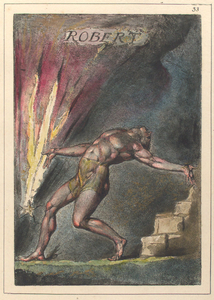
Blake seeks to provide the Golden String which can lead us through the labyrinth of our experience or his own poetry.

Monday, October 10, 2011

ILLUSTRATING MILTON


I
llustrations for Paradise Regained
Image 1
Baptism of Christ


Well before Blake wrote his poem Milton, he was interpreting Milton's works through illustrations. First Blake produced illustrations for Paradise Lost, then Comus, The Ode on the Morning of Christ's Nativity, L'Allegro and Il Penseroso and finally Paradise Regained. Including multiple copies for various patrons, the work spanned the years 1801-1822. Blake is believed to have illustrated Paradise Regained in 1816-18.


Paradise Regained recounts the early life of Jesus especially the temptation incidents in the gospels of Mark, Luke and Matthew, expanding them and giving Satan a leading role. A closer look at Paradise Regained sheds light on Blake's dispute with Milton which is explored in Blake's prophetic poem.

Kay Parkhurst Easson and Roger Easson's commentary on Milton focuses our attention on differences between Milton's and Blake's views on the fall and judgment.

Milton: A Poem by William Blake, Page 165
"John Milton, Blake thought, had seen people as being like sheep, appointed to their respective sheepfolds by the shepherd. Blake's view, in clear contrast is individual; judgment of an individual's merit is the individual's responsibility.
Consequently, Blake disliked the way in which Milton conceived of the fall and judgment of man in Paradise Lost, and his third thematic division of Milton counters that conception by showing that there was no fall and judgment is individual...
While the third division of Milton also concerns a fall, it is a descent made willingly by Ololon, the Eternals, not mortals, and it is a descent of the Family Divine as One Man, united with the Eternals. Thus Blake shows not a punishing, judgmental God managing a fall, but a God who in love and mercy always descends with those who enter 'Death's Door'."

In the opening lines of Paradise Regained we notice the appearance of the doctrine that paradise was lost through the disobedience of one man, and shall be recovered by the obedience of one man.

John Milton
Paradise Regained, Book 1
"I, WHO erewhile the happy Garden sung
By one man's disobedience lost, now sing
Recovered Paradise to all mankind,
By one man's firm obedience fully tried
Through all temptation, and the Tempter foiled
In all his wiles, defeated and repulsed,"

William Blake
Vision of the Last Judgment, (E 555)
"The Last judgment is one of these Stupendous
Visions[.] I have represented it as I saw it[.]
to different People it appears differently as every
thing else does for tho on Earth things seem Permanent they are
less permanent than a Shadow as we all know too well
The Nature of Visionary Fancy or Imagination is very little
Known & the Eternal nature & permanence of its ever Existent
Images is considerd as less permanent than the things of
Vegetative & Generative Nature yet the Oak dies as well as the
Lettuce but Its Eternal Image & Individuality never dies."

Vision of the Last Judgment, (E 562)
"What are all the Gifts of the
Spirit but Mental Gifts whenever any Individual Rejects Error &
Embraces Truth a Last Judgment passes upon that Individual"

Judgment is not for Blake pronounced for all as the result of the acts of Adam and Eve, nor can the one man Jesus absolve the individual from the responsibility of recognizing error.

Milton, Plate 32 [35],(E 132)
"Judge then of thy Own Self: thy Eternal Lineaments explore
What is Eternal & what Changeable? & what Annihilable!"
.

Sunday, October 9, 2011

BLAKE & FORGIVENESS

In the GOSPEL OF MARK we read:

10:17 - As he began to take the road again [after welcoming the children], a man came running up and fell at his feet, and asked him, "Good Master, what must I do to be sure of eternal life?"
10:18-19 - "I wonder why you call me good," returned Jesus. "No one is good - only God"

We learn from Blake too, that 'good and evil' are terms of judgment not forgiveness. Even Jesus did not wish to be called 'good.' Calling him 'good' forces us back into the old system of law and vengeance. The New Testament teaches that the alternative to the law is 'the inspiration of the Holy Spirit' through whom we can love, trust, forgive and hope for the glorious unfolding of God's grace.

Jerusalem, Plate 49, (E 199)
"Because the Evil is Created into a State. that Men
May be deliverd time after time evermore. Amen.
Learn therefore O Sisters to distinguish the Eternal Human
That walks about among the stones of fire in bliss & woe
Alternate! from those States or Worlds in which the Spirit travels:
This is the only means to Forgiveness of Enemies"

In Circle of Destiny Milton Percival explains the beginning of the fall thus:
"The great cosmic break in which the fine relationship of the contraries is destroyed is the work of the Spectre. Blown with pride in his emanative life, he abstracts from it a set of qualities called Good. In his arrogance he believes that these qualities which he admires are due to his own activities; he does not realize that they are but the result of the undisturbed functioning of an harmonious whole."

So partaking of the 'fruit of the tree of good and evil' means naming part of the whole, good and claiming it as one's own. Forgiveness is the reversal of that process. By not claiming good as one's own or as something anyone can possess, we put God who includes all things into the right position. We recognize Evil as a State, not a quality or a human being. Forgiveness loses sight of the State by focusing on the individual as part of the Divine Being.

JERUSALEM Plate 99
Erdman in The Illuminated Blake (Page 378) says of this image: "God does not appear as beams of light to outshine the flames of Hell but as a human father welcoming a lost prodigal."

Saturday, October 8, 2011

BLAKE'S JOURNEY

Yale Center for British Art
Young's Night Thoughts, Page 63
This King of Terrors Is the Prince of Peace

John Middleton Murry, whose book William Blake was published in 1933, approaches Milton not as a scholar but as a student who is learning from Blake's wisdom. He says of Milton:

Page 218
"It is in my opinion, Blake's prophetic masterpiece (if such a word can be used without a kind of sacrilege). And certainly, my love and admiration for it do not stop on this side of idolatry. It is a unique imperishable work: a ladder of angels to the real Eternity."

Murry is interested in following Blake's spiritual journey through the incidents related in the Four Zoas and Milton and in the personal tidbits revealed in his letters. Knowing the contentions Blake experienced in Felpham through the conflicted relationship he developed with Hayley, and through the accusations of Schofield, Murry looks for remnants of Blake's inner struggles in his poetry. First Murry focuses on Night VII of the Four Zoas:

Page 196
"Soon after the moment when, in Night VII, Los is united with the Spectre, 'by Divine Mercy inspired', gives him 'tasks enormous' to fulfill. The two and a half lines which tell of them are a later addition. Originally the lines ran:
[added lines inserted in bold]

Four Zoas , Night VII, Page 87 (E 368)
"But mingling together with his Spectre the Spectre of Urthona
Wondering beheld the Center opend by Divine Mercy inspired

He in his turn Gave Tasks to Los Enormous to destroy
That body he created but in vain for Los performd
Wonders of labour


They Builded Golgonooza"

"The discarding of the previous version of Night VII, and the substitution for it of the Night which this union of Spectres is the culmination, marks the point of change in Blake's total conception of the work. This point of change is marked, psychologically and spiritually, by the union of the Spectre through Los's Self-annihilation; it is marked artistically and creatively, by the building of Golgonnoza. At some time not long afterwards Blake looked back, in the light of new experience and added two lines and a half [as shown above]."

Page 164
"..the psychological meaning is, that by being reconciled to the Spectre within himself, by recognizing and receiving Urizen as a part of his own Self, Los/Blake attains a new understanding, a new synthesis (as we might call it today). Not, of course, an intellectual synthesis; but a real and decisive act of a new spiritual understanding, involving a revolution of the total man - an act of the Self-annihilation which is Imagination. Blake understands now that Urizen is not a separate, demonic power, from whose dominion Blake alone is free; he is in Blake himself, a necessary element of Blake's being."

Page 171
"...I think, in order to understand the quality of Blake's glorious humanity, we need to have known, in the stress of our own small life-experience, what it is, and how far beyond all other achievements it is, at some crucial moment when the unconscious choice lay between the security which is death and the insecurity which is life, to have 'destroyed the Negation, to redeem the contraries.'"

Milton, PLATE 40 [46], (E 142)
"There is a Negation, & there is a Contrary
The Negation must be destroyd to redeem the Contraries
The Negation is the Spectre; the Reasoning Power in Man
This is a false Body: an Incrustation over my Immortal
Spirit; a Selfhood, which must be put off & annihilated alway
To cleanse the Face of my Spirit by Self-examination.
Plate 41 [48]
To bathe in the Waters of Life; to wash off the Not Human
I come in Self-annihilation & the grandeur of Inspiration"

Page 218
"Milton is a re-living, a further exploring, a final deepening of precisely the same actual 'moment' which is differently and more cursorily recorded in Night VII of the Four Zoas."

Friday, October 7, 2011

LAST VINTAGE


Angel of Revelation


Blake managed to remain upbeat in his expectation for the outcome of the grand experiment which we know as life and intelligence. We too, with consciousness and vision, may become aware of the possibility of Eternity becoming manifest in all creation. Milton Percival ( William Blake's Circle of Destiny, Page 248.) outlines Blake's struggle in delineating and living the faith he had in God's wisdom and mercy.

Percival's words:

"It is none too certain, however, that the world will take the path of deliverance. An outward and feminine religion of Mystery challenges the masculine gospel of Christ. But when Mystery is at last stripped of its trappings, and the grinning skeleton of Deism stands revealed, it is time for the Last Judgment. With Deism the wheel of Natural Religion, which began its circuit centuries ago, has swung full circle, and must now submit to Christ or swing round once again. Which will it do? Will the world today, having come to the edge of the abyss over the path of mutual fear, renounce that policy and enter into the ways of peace? Are we purged and pure - true gold - or must we be cast, as dross, once more into the furnaces of affliction? The question haunted Blake, as it haunted Shelley. The prophet in him, especially around the year 1790, filled him with hope of the great renunciation. The Spectre in him pointed out the power of error to renew itself. Where Babylon ends Babylon might begin again. Generation might not be swallowed up in regeneration. This fear is never absent from Los's mind or Blake's. Los's Herculean efforts are necessary, that the "wheel of religion" may disappear in the current of creation." He dare not relinquish his activities, lest the creation itself (the egg-shaped world of Los, and Blake's symbol for what had already been accomplished in a regenerative way) be destroyed. But, though Blake's fear was great, his will to believe was greater. He persuaded himself that man would take the path of Job taken in the Illustrations. He would cast his pride and selfhood (which betrayed him into the cruelty of Natural Religion) into the lake of fire, and be transformed into the likeness of Christ."

Milton, Plate 24 , (E 118)
"But Los dispersd the clouds even as the strong winds of Jehovah,

And Los thus spoke. O noble Sons, be patient yet a little
I have embracd the falling Death, he is become One with me
O Sons we live not by wrath. by mercy alone we live!
I recollect an old Prophecy in Eden recorded in gold; and oft
Sung to the harp: That Milton of the land of Albion.
Should up ascend forward from Felphams Vale & break the Chain
Of jealousy from all its roots; be patient therefore O my Sons
These lovely Females form sweet night and silence and secret
Obscurities to bide from Satans Watch-Fiends. Human loves
And graces; lest they write them in their Books, & in the Scroll
Of mortal life, to condemn the accused: who at Satans Bar
Tremble in Spectrous Bodies continually day and night
While on the Earth they live in sorrowful Vegetations
O when shall we tread our Wine-presses in heaven; and Reap
Our wheat with shoutings of joy, and leave the Earth in peace

Remember how Calvin and Luther in fury premature
Sow'd War and stern division between Papists & Protestants
Let it not be so now! O go not forth in Martyrdoms & Wars
We were plac'd here by the Universal Brotherhood & Mercy
With powers fitted to circumscribe this dark Satanic death
And that the Seven Eyes of God may have space for Redemption.
But how this is as yet we know not, and we cannot know;
Till Albion is arisen; then patient wait a little while,
Six Thousand years are passd away the end approaches fast;
This mighty one is come from Eden, he is of the Elect,
Who died from Earth & he is returnd before the Judgment.
This thing Was never known that one of the holy dead should willing return
Then patient wait a little while till the Last Vintage is over:
"

Percival obviously shared Blake's fears and his faith, as well as his strenuous effort on the part of regeneration.
.

Thursday, October 6, 2011

ETERNAL SPACES

Illusory Spaces are deceptions and continue to be only as long they are held on to out of fear, defensiveness or hate. Created Spaces are provided to us to overcome the limitations of illusion by annihilating error. The third class of Spaces is Eternal Spaces which exist as facets of the eternal, infinite world of spiritual reality: Eden, Beulah and Golgoonoza.

In
Milton: A Poem by William Blake, Kay Parkhurst Easson and Roger Easson refer to the Eternal spaces as archetypal. Eden is the archetype of 'the garden and the harvest'; Beulah of 'revitalization'; Golgonooza of the pattern for all creative works.

"Golgonooza is the only space that Blake considered to be both a created space and an eternal archetypal form. As a created space Golgonooza is any work of art - a book, a poem, a painting... As city and country of art, then it represents the active imagination creating individual eternal identity through works of art, and it represents the imagination - the prophetic, visionary perception, which is the 'Human Existence' itself." (Page 145)

John Middleton Murry in William Blake characterizes Golgonooza as "a symbol of the redemption of the universe of which the individual man is a member, into unity by the Imagination." (Page 199)


Yale Center for British Art
Paul Mellon Collection
Illustration for Night Thoughts
Text by Edward Young


So if Eden is a symbol for the unified condition of man in his active nature, and Beulah is a symbol for the division into a dual perception including passive repose for renewal, Golgonooza is a symbol for awakening; for the transition which accommodates the co-existence of Eden and Beulah.


Milton, PLATE 30 [33], (E 129)
"Beulah is evermore Created around Eternity; appearing
To the Inhabitants of Eden, around them on all sides.
But Beulah to its Inhabitants appears within each district
As the beloved infant in his mothers bosom round incircled
With arms of love & pity & sweet compassion. But to
The Sons of Eden the moony habitations of Beulah,
Are from Great Eternity a mild & pleasant Rest.

And it is thus Created. Lo the Eternal Great Humanity
To whom be Glory & Dominion Evermore Amen
Walks among all his awful Family seen in every face
As the breath of the Almighty. such are the words of man to man
In the great Wars of Eternity, in fury of Poetic Inspiration,
To build the Universe stupendous: Mental forms Creating

But the Emanations trembled exceedingly, nor could they
Live, because the life of Man was too exceeding unbounded
His joy became terrible to them they trembled & wept
Crying with one voice. Give us a habitation & a place
In which we may be hidden under the shadow of wings
For if we who are but for a time, & who pass away in winter
Behold these wonders of Eternity we shall consume
But you O our Fathers & Brothers, remain in Eternity"

Milton, PLATE 35 [39], (E 136)
"Just in this Moment when the morning odours rise abroad
And first from the Wild Thyme, stands a Fountain in a rock
Of crystal flowing into two Streams, one flows thro Golgonooza

And thro Beulah to Eden beneath Los's western Wall
The other flows thro the Aerial Void & all the Churches
Meeting again in Golgonooza beyond Satans Seat"

Milton, PLATE 34 [38], (E 179)
"Fires and clouds of rolling smoke! but mild the Saviour follow'd him,
Displaying the Eternal Vision! the Divine Similitude!
In loves and tears of brothers, sisters, sons, fathers, and
friends
Which if Man ceases to behold, he ceases to exist:

Saying. Albion! Our wars are wars of life, & wounds of love,
With intellectual spears, & long winged arrows of thought:
Mutual in one anothers love and wrath all renewing
We live as One Man; for contracting our infinite senses
We behold multitude; or expanding: we behold as one,
As One Man all the Universal Family; and that One Man
We call Jesus the Christ: and he in us, and we in him,
Live in perfect harmony in Eden the land of life,
Giving, recieving, and forgiving each others trespasses.
He is the Good shepherd, he is the Lord and master:
He is the Shepherd of Albion, he is all in all,
In Eden: in the garden of God: and in heavenly Jerusalem.
If we have offended, forgive us, take not vengeance against us."
.

Wednesday, October 5, 2011

OLOLON

In Plate 31 of Milton, a contrast is seen between the way things appear in the fallen world and in the unfallen world. The first paragraph quoted below concerns Satan and Rahab, Generation, Kingdoms of the Earth, War and Strife. All of the Living Creatures of the Four Elements are wailing in bitter lament. They weep because "they see the Lord coming in the Clouds of Ololon with Power & Great Glory!"
Beulah is said to weep also, but the lamentation of Beulah is seen as a vision of the greatest beauty, joy and hope. The eyes of vision see the loveliest things of the natural world as expressing the culmination which will result from Ololon's sacrificial descent following Milton in his return to the world of matter.

The world of suffering, war, and strife should welcome the prospect of the Lord's arrival, for it will initiate the world of love, and peace and brotherhood. But it is not so. First an open mind, a receptive heart, a gentle hand, and an intuitive soul must grow in man. The vision cannot appear until we have prepared ourselves for it.


Milton, Plate 31 [34], (E 130)
"And all the Living Creatures of the Four Elements, wail'd
With bitter wailing: these in the aggregate are named Satan
And Rahab: they know not of Regeneration, but only of Generation
The Fairies, Nymphs, Gnomes & Genii of the Four Elements
Unforgiving & unalterable: these cannot be Regenerated
But must be Created, for they know only of Generation
These are the Gods of the Kingdoms of the Earth: in contrarious
And cruel opposition: Element against Element, opposed in War
Not Mental, as the Wars of Eternity, but a Corporeal Strife
In Los's Halls continual labouring in the Furnaces of Golgonooza
Orc howls on the Atlantic: Enitharmon trembles: All Beulah weeps

Thou hearest the Nightingale begin the Song of Spring;
The Lark sitting upon his earthy bed: just as the morn
Appears; listens silent; then springing from the waving
Corn-field! loud
He leads the Choir of Day! trill, trill, trill, trill,
Mounting upon the wings of light into the Great Expanse:
Reecchoing against the lovely blue & shining heavenly Shell:
His little throat labours with inspiration; every feather
On throat & breast & wings vibrates with the effluence Divine
All Nature listens silent to him & the awful Sun
Stands still upon the Mountain looking on this little Bird

With eyes of soft humility, & wonder love & awe.
Then loud from their green covert all the Birds begin their Song
The Thrush, the Linnet & the Goldfinch, Robin & the Wren
Awake the Sun from his sweet reverie upon the Mountain:
The Nightingale again assays his song, & thro the day,
And thro the night warbles luxuriant; every Bird of Song
Attending his loud harmony with admiration & love.
This is a Vision of the lamentation of Beulah over Ololon!

Thou percievest the Flowers put forth their precious Odours!
And none can tell how from so small a center comes such sweets
Forgetting that within that Center Eternity expands
Its ever during doors, that Og & Anak fiercely guard[.]
First eer the morning breaks joy opens in the flowery bosoms
Joy even to tears, which the Sun rising dries; first the Wild Thyme
And Meadow-sweet downy & soft waving among the reeds.
Light springing on the air lead the sweet Dance: they wake
The Honeysuckle sleeping on the Oak: the flaunting beauty
Revels along upon the wind; the White-thorn lovely May
Opens her many lovely eyes: listening the Rose still sleeps
None dare to wake her. soon she bursts her crimson curtaind bed
And comes forth in the majesty of beauty; every Flower:
The Pink, the Jessamine, the Wall-flower, the Carnation
The Jonquil, the mild Lilly opes her heavens! every Tree,
And Flower & Herb soon fill the air with an innumerable Dance
Yet all in order sweet & lovely, Men are sick with Love!
Such is a Vision of the lamentation of Beulah over Ololon"

Advice from the apostle Paul:
Philippians
4:6-7 - Don't worry over anything whatever; tell God every detail of your needs in earnest and thankful prayer, and the peace of God which transcends human understanding, will keep constant guard over your hearts and minds as they rest in Christ Jesus.
4:8-9 - Here is a last piece of advice. If you believe in goodness and if you value the approval of God, fix your minds on the things which are holy and right and pure and beautiful and good. Model your conduct on what you have learned from me, on what I have told you and shown you, and you will find the God of peace will be with you.

J. B. Phillips translation of the New Testament
.

Tuesday, October 4, 2011

CREATED SPACES

The post Illusory Spaces concerned the mental constructs which result from the inability to perceive eternity. Kay Parkhurst Easson and Roger Easson, in Milton: A Poem by William Blake, teach about Blake's created spaces as well. The names Blake gives these spaces which have the ability to transform the illusory spaces to spaces of mercy and love are: Allamanda, Bowlahoola and Golgoonooza. Quoting from the Easson book:

Page 140
"But Blake demonstrates consistently in his works that all settings are created by perception. Despite Milton's many settings, therefore, there is only one geography for Blake from which all settings are derived - the human body with its anatomy and physiology of perception."

Page 141
"Blake describes the earth as concave, as a cavern of 'labyrinthine intricacy"; this earth is the human skull or body which, if observed from without, is convex but, if observed from within, is concave."

Page 142
"Blake believes that as a consequence of vision from within, the result of the spiritual journey, the spaces of the 'dull round' (Entuthon Benython, Udan-Adan, and Ulro) are transformed into energizing, formative spaces, wherein all the component parts of the body and its universe may be formed into human lineaments, the contours of an eternal body...Blake calls these spaces Allamanda, Bowlahoola, and Golgonooza."

Page 144
"As Allamanda is the nervous System, Bowlahoola is the system of organs within the body which support the nervous system. And as Allamanda is the plowed ground, Bowlahoola is like the sun and energy which warm it. In addition, Allamanda produces the bread of the eternal body in the harvest, Bowlahoola produces the energizing blood of the body in its winepress...Finally Golgonooza which includes both Allamanda and Bowlohoola is 'named Art & Manufacture.' ...Thus Allamanda and Bowlohoola represent the country which supplies sustenance to the city of Golgoonoza."

What Blake is describing with these three 'spaces' are interrelated processes which operate within the living human. The imagination which operates in Golgoonoza is supported by the activities of the mind and nervous system which he calls Allamanda. In turn Allamanda is supported by systems which the body furnishes to produce energy including the digestive system and the circulatory system, characterized as Bowlohoola.

Image from New York Public Library
Milton
Plate 37


What takes place within the body is manifest as outward experience. Psychologically speaking, a phenomena may appear to be happening in outer relationships when it is triggered by inner conflict or inner peace. What goes on in the outer world can best be dealt with through tending to the interrelated processes in which the body engages internally.


Jerusalem
, PLATE 71, (E 224)
"And above Albions Land was seen the Heavenly Canaan
As the Substance is to the Shadow: and above Albions Twelve Sons
Were seen Jerusalems Sons: and all the Twelve Tribes spreading
Over Albion. As the Soul is to the Body, so Jerusalems Sons,
Are to the Sons of Albion: and Jerusalem is Albions Emanation

What is Above is Within, for every-thing in Eternity is translucent:
The Circumference is Within: Without, is formed the Selfish Center
And the Circumference still expands going forward to Eternity.
And the Center has Eternal States! these States we now explore
...
For all are Men in Eternity. Rivers Mountains Cities Villages,
All are Human & when you enter into their Bosoms you walk
In Heavens & Earths; as in your own Bosom you bear your Heaven
And Earth, & all you behold, tho it appears Without it is Within
In your Imagination of which this World of Mortality is but a Shadow."

Milton, PLATE 37 [41], (E 138)
"From Star to Star, Mountains & Valleys, terrible dimension
Stretchd out, compose the Mundane Shell, a mighty Incrustation
Of Forty-eight deformed Human Wonders of the Almighty
With Caverns whose remotest bottoms meet again beyond
The Mundane Shell in Golgonooza, but the Fires of Los, rage
In the remotest bottoms of the Caves, that none can pass
Into Eternity that way, but all descend to Los
To Bowlahoola & Allamanda & to Entuthon Benython
"
.