Blake seeks to provide the Golden String which can lead us through the labyrinth of our experience or his own poetry.

Saturday, February 4, 2012

COLLAPSE

British Museum
Illustration to Young's Night Thoughts

Jared Diamond's book Collapse attempts to alert the public to the choices made by societies which cause them to collapse. He
primarily identifies issues involving environmental changes which effect the continuation of the conditions which sustain the society.

Page 23, Plan of the Book
"Chapter 14 asks the perplexing question arising from every past society that has ended up by destroying itself, and that will perplex future earthlings if we too end up destroying ourselves: how could a society fail to have seen the dangers that seem so clear in retrospect? Can we say that their end was the inhabitants' own fault, or instead that they were the tragic victims of insoluble problems? How much past environmental damage was unintentional and imperceptible, and how much was perversely wrought by people acting in full awareness of the consequences?"

Blake was interested in the same issues as Diamond but from another perspective. Blake saw the fall of Man from the original garden in Eden as the cause of the symptoms of society expressed in war, tyranny, poverty and oppression. Blake's concern was more with the inner circumstance which led to collapse rather than the outer ones. But Blake's analysis of the mental patterns which would need changing if a just, equitable and sustainable society could emerge are not far from Diamond's understanding of causes of collapse.

Blake's observations of destructive patterns of thought:
1) Being wedded to a rigid paradigm which was opposed to change,

2) Continuing in the same erroneous behavior even when the results were unproductive,

3) Failing to use the imagination to seek resolutions beyond the present options,

4) Neglecting to recognise that brotherhood or cooperation could change outcomes,

5) Inability to perceive the Divine Vision through which mankind could become one body,

6) Looking for outward solutions when inner turmoil was the root of problems,

7) Clinging to the vengefulness of the Selfhood when forgiveness offered a new beginning.

Jerusalem, Plate 36 [40], (E 181)
"Upon the hills & valleys, and the cloudy Oath roll'd far and wide

Albion is sick! said every Valley, every mournful Hill
And every River: our brother Albion is sick to death.
He hath leagued himself with robbers! he hath studied the arts
Of unbelief! Envy hovers over him! his Friends are his abhorrence!
Those who give their lives for him are despised!
Those who devour his soul, are taken into his bosom!
To destroy his Emanation is their intention:
Arise! awake O Friends of the Giant Albion
They have perswaded him of horrible falshoods!
They have sown errors over all his fruitful fields!

The Twenty-four heard! they came trembling on watry chariots.
Borne by the Living Creatures of the third procession
Of Human Majesty, the Living Creatures wept aloud as they
Went along Albions roads, till they arriv'd at Albions House."

Thursday, February 2, 2012

LEVIATHAN & BEHEMOTH

Blake's Illustrations to the Book of Job
Butts Set 1805
From Wikipedia Commons


Northrop Frye gives an explanation of the roles played by Leviathan and Behemoth in the chapter Blake's Reading of the Book of Job in Northrop Frye on Milton and Blake, edited by Angela Esterhammer. On Plate 15 Job is shown the monstrous forms of Leviathan and Behemoth. Frey's key to extricating oneself from the control of these forces is a change of perspective. Accepting the view of the world from within these monsters distorts vision. Seeing them for what they are is achieved by distancing oneself and looking from outside the system at the sources of destruction.

Page 377
... "The next step is to realize that Satan is the enemy of God, that his rule is not inevitable but is to be fought by God's creative power, and that this creative power exists nowhere at present except in man's creative power. At that point we pass into plate 15, where there are only two levels, God and Job united on top, and below them the cycle of nature inhabited by Behemoth and Leviathan.

"These monsters are identical with Satan, except that, being Satan revealed instead of Satan mysterious and disguised as God, they represent, not so much the natural miseries of drought and famine and pestilence, as the social and political miseries symbolized mainly, in the Bible, by Egypt and Babylon, and in the Book of Job itself by the Sabean Raiders. Ezekiel (chapter 29) identifies the Leviathan with the Pharaoh of Egypt, and Daniel (chapter 4) tells how Nebuchadnezzar of Babylon turned into Behemoth, the subject of several Blake pictures. The political aspect of the monsters is brought out in the phrases emphasized by Blake on Plate 15: Behemoth is 'chief of the ways of God' and Leviathan is 'King over all the Children of Pride' [Job 40:19, 41:34]. As the power in man that makes for tyranny rather than civilization, they can be, if not destroyed, at least brought under some measure of control, like the Blatant Beast in Spencer. At the same time the root of tyranny, for Blake, is still natural religion, the establishing of the order of nature, whether theistically or atheistically regarded, as the circumference of human effort (the original meaning of 'Urizen'). Hence we are all born inside the belly of Leviathan, the world of stars and indefinite places, but those who can see Leviathan for what he is have been placed outside him, like Jonah, and like Job in plate 15. After Job has attained this enlightenment, the prophecy of Jesus is fulfilled and Satan falls from heaven (pl. 16)."


Marriage of Heaven & Hell, Plate 17, (E 41)
"So I remaind with him sitting in the twisted [PL 18] root of
an oak. he was suspended in a fungus which hung with the head
downward into the deep:
By degrees we beheld the infinite Abyss, fiery as the smoke
of a burning city; beneath us at an immense distance was the sun,
black but shining[;] round it were fiery tracks on which revolv'd
vast spiders, crawling after their prey; which flew or rather
swum in the infinite deep, in the most terrific shapes of animals
sprung from corruption. & the air was full of them, & seemd
composed of them; these are Devils. and are called Powers of the
air, I now asked my companion which was my eternal lot? he said,
between the black & white spiders
But now, from between the black & white spiders a cloud and
fire burst and rolled thro the deep blackning all beneath, so
that the nether deep grew black as a sea & rolled with a terrible
noise: beneath us was nothing now to be seen but a black tempest,
till looking east between the clouds & the waves, we saw a
cataract of blood mixed with fire and not many stones throw from
us appeard and sunk again the scaly fold of a monstrous serpent.
at last to the east, distant about three degrees appeard a fiery
crest above the waves slowly it reared like a ridge of golden
rocks till we discoverd two globes of crimson fire. from which
the sea fled away in clouds of smoke, and now we saw, it was the
head of Leviathan. his forehead was divided into streaks of green
& purple like those on a tygers forehead: soon we saw his mouth &
red gills hang just above the raging foam tinging the black deep
with beams of blood, advancing toward [PL 19] us with all the
fury of a spiritual existence.
My friend the Angel climb'd up from his station into the mill;
I remain'd alone, & then this appearance was no more, but I found
myself sitting on a pleasant bank beside a river by moon light
hearing a harper who sung to the harp. & his theme was, The man
who never alters his opinion is like standing water, & breeds
reptiles of the mind."
.

Tuesday, January 31, 2012

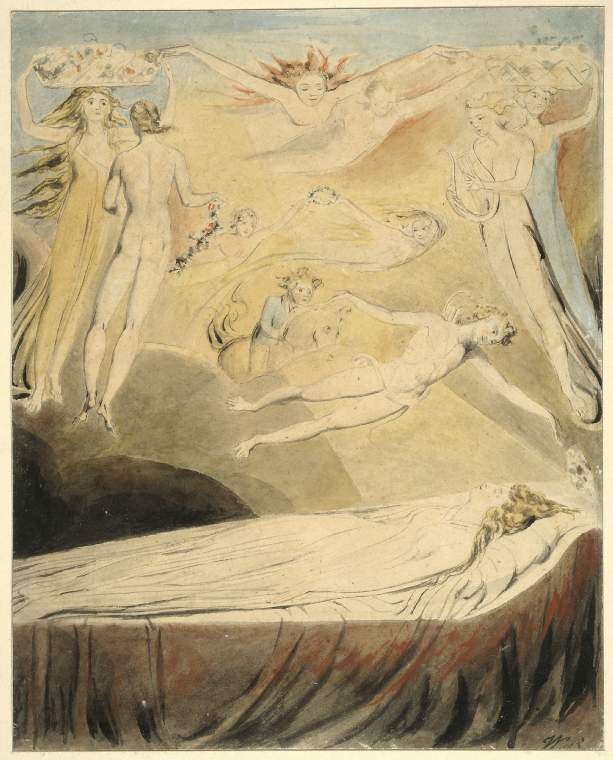
QUEEN KATHARINE'S DREAM

Blake's picture titled Queen Katharine's Dream is an illustration to lines from William Shakespeare's play Henry VII. Blake choose to illustrate lines from the play which echo his own feelings. As Katharine of Aragon the first wife of Henry lies on her deathbed she reports a dream which she had of the glorious world which awaited her.

Henry VIII , Scene IV
"KATHARINE
No? Saw you not, even now, a blessed troop
Invite me to a banquet; whose bright faces
Cast thousand beams upon me, like the sun?
They promised me eternal happiness;
And brought me garlands, Griffith, which I feel
I am not worthy yet to wear: I shall, assuredly.
GRIFFITH
I am most joyful, madam, such good dreams
Possess your fancy."

Blake painted illustrations for this scene at least three times. A earliest image of the scene resides in the Fitzwilliam Museum, Cambridge and is dated between 1783 and 1790. Look for motifs from Visions of the Daughters of Albion, Blake's lithograph of Enoch, and Plate 33 (37) of Jerusalem in this painting. Shown here are the later images.

British Museum, London (dated 1809)..........
National Gallery, Washington (dated 1825)


.

Sunday, January 29, 2012

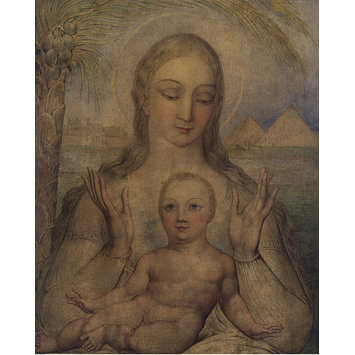
MARY'S SONG


Victoria & Albert Museum, London
Virgin & Child in Egypt
1810


The gospel of Luke records the song Mary sang when her cousin Elizabeth recognised that the Lords's promise of salvation was to be fulfilled through the child Mary was to bear.


Luke 1
[41] And it came to pass, that, when Elisabeth heard the salutation of Mary, the babe leaped in her womb; and Elisabeth was filled with the Holy Ghost:
[42] And she spake out with a loud voice, and said, Blessed art thou among women, and blessed is the fruit of thy womb.
[43] And whence is this to me, that the mother of my Lord should come to me?
[44] For, lo, as soon as the voice of thy salutation sounded in mine ears, the babe leaped in my womb for joy.
[45] And blessed is she that believed: for there shall be a performance of those things which were told her from the Lord.
[46] And Mary said, My soul doth magnify the Lord,
[47] And my spirit hath rejoiced in God my Saviour.
[48] For he hath regarded the low estate of his handmaiden: for, behold, from henceforth all generations shall call me blessed.
[49] For he that is mighty hath done to me great things; and holy is his name.
[50] And his mercy is on them that fear him from generation to generation.
[51] He hath shewed strength with his arm; he hath scattered the proud in the imagination of their hearts.
[52] He hath put down the mighty from their seats, and exalted them of low degree.
[53] He hath filled the hungry with good things; and the rich he hath sent empty away.
[54] He hath holpen his servant Israel, in remembrance of his mercy;
[55] As he spake to our fathers, to Abraham, and to his seed for ever.

In Jerusalem Blake similarly has Mary burst into song but the occasion is the realisation that she is forgiven by God and by Joseph. Blake chooses to have Mary represent the sinner who calls upon God to forgive because it is his nature to forgive.

Jerusalem, Plate 61, (E 212)
"But Jehovahs Salvation
Is without Money & without Price, in the Continual Forgiveness of Sins
In the Perpetual Mutual Sacrifice in Great Eternity! for behold!
There is none that liveth & Sinneth not!"

To Blake to be forgiven was more worthy than to be pure. His Jesus was borne by a Mother who knew that she was not to be glorified. She was made pure through God's mercy. She knew that she could make no claim of virtue. Through mercy she became acquainted with the Divine Humanity, the God of Pity, compassion, and forgiveness.

Jerusalem, Plate 61, (E 212)
"And this is the Covenant
Of Jehovah: If you Forgive one-another, so shall Jehovah Forgive You:
That He Himself may Dwell among You. Fear not then to take
To thee Mary thy Wife, for she is with Child by the Holy Ghost

Then Mary burst forth into a Song! she flowed like a River of
Many Streams in the arms of Joseph & gave forth her tears of joy
Like many waters, and Emanating into gardens & palaces upon
Euphrates & to forests & floods & animals wild & tame from
Gihon to Hiddekel, & to corn fields & villages & inhabitants
Upon Pison & Arnon & Jordan. And I heard the voice among
The Reapers Saying, Am I Jerusalem the lost Adulteress? or am I
Babylon come up to Jerusalem? And another voice answerd Saying

Does the voice of my Lord call me again? am I pure thro his Mercy
And Pity. Am I become lovely as a Virgin in his sight who am
Indeed a Harlot drunken with the Sacrifice of Idols does he
Call her pure as he did in the days of her Infancy when She
Was cast out to the loathing of her person. The Chaldean took
Me from my Cradle. The Amalekite stole me away upon his Camels
Before I had ever beheld with love the Face of Jehovah; or known
That there was a God of Mercy: O Mercy O Divine Humanity!
O Forgiveness & Pity & Compassion! If I were Pure I should never
Have known Thee; If I were Unpolluted I should never have
Glorified thy Holiness, or rejoiced in thy great Salvation.

Mary leaned her side against Jerusalem, Jerusalem recieved
The Infant into her hands in the Visions of Jehovah. Times passed on
Jerusalem fainted over the Cross & Sepulcher She heard the voice
Wilt thou make Rome thy Patriarch Druid & the Kings of Europe his
Horsemen? Man in the Resurrection changes his Sexual Garments at will
Every Harlot was once a Virgin: every Criminal an Infant Love!"

.

Friday, January 27, 2012

CHRISTIAN TRIUMPH


British Museum
'The Christian Triumph'
Illustration to Young's 'Night Thoughts'
Frontispiece to Night the Fourth
1795-1797


Blake seems to have lived through the 7TH and 8TH chapters of Romans. His struggles with the demonic forces in the world as well as his self-condemnation and doubt showed him the wretchedness from which only Christ could release him. Emerging into the Light gave him the strength to continue conquering.

Romans 7
[23] But I see another law in my members, warring against the law of my mind, and bringing me into captivity to the law of sin which is in my members.
[24] O wretched man that I am! who shall deliver me from the body of this death?
[25] I thank God through Jesus Christ our Lord. So then with the mind I myself serve the law of God; but with the flesh the law of sin.

Letters, 22, (E 719)

[To] Mr Butts, Gr Marlborough Street

"Felpham Novr. 22: 18O2
...
But You will justly enquire why I have not written All this
time to you? I answer I have been very Unhappy & could not think
of troubling you about it or any of my real Friends (I have
written many letters to you which I burnd & did not send)
...
And now let me finish with assuring you that Tho I have been
very unhappy I am so no longer I am again Emerged into the light
of Day I still & shall to Eternity Embrace Christianity and Adore
him who is the Express image of God but I have traveld thro
Perils & Darkness not unlike a Champion I have Conquerd and shall
still Go on Conquering Nothing can withstand the fury of my
Course among the Stars of God & in the Abysses of the Accuser My
Enthusiasm is still what it was only Enlarged and confirmd"

Romans 8
[34] Who is he that condemneth? It is Christ that died, yea rather, that is risen again, who is even at the right hand of God, who also maketh intercession for us.
[35] Who shall separate us from the love of Christ? shall tribulation, or distress, or persecution, or famine, or nakedness, or peril, or sword?
[36] As it is written, For thy sake we are killed all the day long; we are accounted as sheep for the slaughter.
[37] Nay, in all these things we are more than conquerors through him that loved us.
[38] For I am persuaded, that neither death, nor life, nor angels, nor principalities, nor powers, nor things present, nor things to come,
[39] Nor height, nor depth, nor any other creature, shall be able to separate us from the love of God, which is in Christ Jesus our Lord.

Post on second part of Blake's letter to Butts (Nov 22, 1802): ON THE WALK TO LAVANT.
.

Wednesday, January 25, 2012

FOUR GATES


Illustrations to the Book of Job
Linnell Set
Picture 14


Blake's famous concept of Fourfold is something of a misnomer. The fourfoldness of Blake's system is repeated at multiple levels. For instance, the Zoas each contained aspects of the three other Zoas. The mathematical concept of fractals may give us a handle on the way Blake keeps dividing his entities into replicas at more minute scales. The information contained at each level of the fractal supplies the information for other levels. Just as the hologram contains all of the information for the entire image in each particular, each iteration of the fractal is a replication of the original. Blake's multiple divisions allow us to examine the repetition of manifestations of archetypical entities as they are visible in multiple situations.

In this passage from Jerusalem, Blake is clearly inviting us to dig deeper as we explore the gates through which transitions are accomplished. I've divided the passage into sections to emphasise the repetition of four within each of the four gates. I've italicised the number four of which there are 17 occurrences.

Jerusalem , Plate 12, (E 156)

"And the
Four Points are thus beheld in Great Eternity
____________

West, the Circumference: South, the Zenith: North,
The Nadir: East, the Center, unapproachable for ever.
These are the
four Faces towards the Four Worlds of Humanity
In every Man. Ezekiel saw them by Chebars flood.
And the Eyes are the South, and the Nostrils are the East.
And the Tongue is the West, and the Ear is the North.

And the North Gate of Golgonooza toward Generation;
Has
four sculpturd Bulls terrible before the Gate of iron.
And iron, the Bulls: and that which looks toward Ulro,
Clay bak'd & enamel'd, eternal glowing as
four furnaces:
Turning upon the Wheels of Albions sons with enormous power.
And that toward Beulah four, gold, silver, brass, & iron:

PLATE 13
And that toward Eden,
four, form'd of gold, silver, brass, &
iron.
_____________

The South, a golden Gate, has
four Lions terrible, living!
That toward Generation,
four, of iron carv'd wondrous:
That toward Ulro,
four, clay bak'd, laborious workmanship
That toward Eden,
four; immortal gold, silver, brass & iron.
_____________

The Western Gate
fourfold, is closd: having four Cherubim
Its guards, living, the work of elemental hands, laborious task!
Like Men, hermaphroditic, each winged with eight wings
That towards Generation, iron; that toward Beulah, stone;
That toward Ulro, clay: that toward Eden, metals.
But all clos'd up till the last day, when the graves shall yield
their dead
_____________

The Eastern Gate, fourfold: terrible & deadly its ornaments:
Taking their forms from the Wheels of Albions sons; as cogs
Are formd in a wheel, to fit the cogs of the adverse wheel.

That toward Eden, eternal ice, frozen in seven folds
Of forms of death: and that toward Beulah, stone:
The seven diseases of the earth are carved terrible.

And that toward Ulro, forms of war: seven enormities:
And that toward Generation, seven generative forms.
____________

And every part of the City is fourfold; & every inhabitant,
fourfold.
And every pot & vessel & garment & utensil of the houses,
And every house,
fourfold; but the third Gate in every one
Is closd as with a threefold curtain of ivory & fine linen &
ermine.
And Luban stands in middle of the City. a moat of fire,
Surrounds Luban, Los's Palace & the golden Looms of Cathedron."
______________

Blake's symbols do not readily yield their content. This is partly because the meaning they convey can be read as viewed from afar or from close-up. We focus our eyes on the object or on a plane to which we want to give attention. Blake has written in such a way that the focus of our attention will allow us to move about his worlds in their infinite variety.

Letters , 16, to Thomas Butts, (E 712)

"Each grain of Sand
 Every Stone on the Land
 Each rock & each hill
 Each fountain & rill
 Each herb & each tree
 Mountain hill Earth & Sea
 Cloud Meteor & Star
 Are Men Seen Afar"

Monday, January 23, 2012

YOUR WORLD

Milton's Mysterious Dream,
Watercolor Illustration to Milton's L'Allegro and Il Penseroso
Wikimedia Commons


Each person creates his own universe according to Blake and he takes it with him wherever he goes. His reasoning mind provides an abstraction of a microscopic or macroscopic world,
but man lives within the cavern of his skull.


Milton, PLATE 29 [31], (E 127)

"The Sky is an immortal tent built by the Sons of Los
And every Space that a Man views around his dwelling-place:
Standing on his own roof, or in his garden on a mount
Of twenty-five cubits in height, such space is his Universe;
And on its verge the Sun rises & sets. the Clouds bow
To meet the flat Earth & the Sea in such an orderd Space:
The Starry heavens reach no further but here bend and set
On all sides & the two Poles turn on their valves of gold:
And if he move his dwelling-place, his heavens also move.
Wher'eer he goes & all his neighbourhood bewail his loss:
Such are the Spaces called Earth & such its dimension:
As to that false appearance which appears to the reasoner,
As of a Globe rolling thro Voidness, it is a delusion of Ulro"

In the Eternal world there is no differentiation among aspects of existence because all belong to one reality and can enter into each other through the means of mind or body. In the limited existence where we dwell, the individuality experiences itself as mind and body, internal and external, oneself and other. The imagination contains the paradigm whose shadow is projected externally and perceived as exterior worlds.

Jerusalem , Plate 71, (E 225)
"For all are Men in Eternity. Rivers Mountains Cities Villages,
All are Human & when you enter into their Bosoms you walk
In Heavens & Earths; as in your own Bosom you bear your Heaven
And Earth, & all you behold, tho it appears Without it is Within
In your Imagination of which this World of Mortality is but a
Shadow."

The confusion between the subjective and objective infects the mind which cannot distinguish between what is internal mental processing and the projected world of mind created images.

Jerusalem , PLATE 32 [36], (E 179)
"As Los bended the Senses of Reuben Reuben is Merlin
Exploring the Three States of Ulro; Creation; Redemption. &
Judgment

And many of the Eternal Ones laughed after their manner

Have you known the judgment that is arisen among the
Zoa's of Albion? where a Man dare hardly to embrace
His own Wife, for the terrors of Chastity that they call
By the name of Morality. their Daughters govern all
In hidden deceit! they are Vegetable only fit for burning
Art & Science cannot exist but by Naked Beauty displayd

Then those in Great Eternity who contemplate on Death
Said thus. What seems to Be: Is: To those to whom
It seems to Be, & is productive of the most dreadful
Consequences to those to whom it seems to Be: even of
Torments, Despair, Eternal Death; but the Divine Mercy
Steps beyond and Redeems Man in the Body of Jesus Amen
And Length Bredth Highth again Obey the Divine Vision Hallelujah"

The distortion of Eternal reality which results from the assumptions made in Ulro (the exclusively material world) is seen to amuse the Eternals. But they realize that the illusions which are thought to be real produce consequences which seem to the individual to be just as real as if they were accurate descriptions of Eternal realities. The undistorted perception is reached through receiving the integration of spirit and matter achieved and made available through Christ.
.