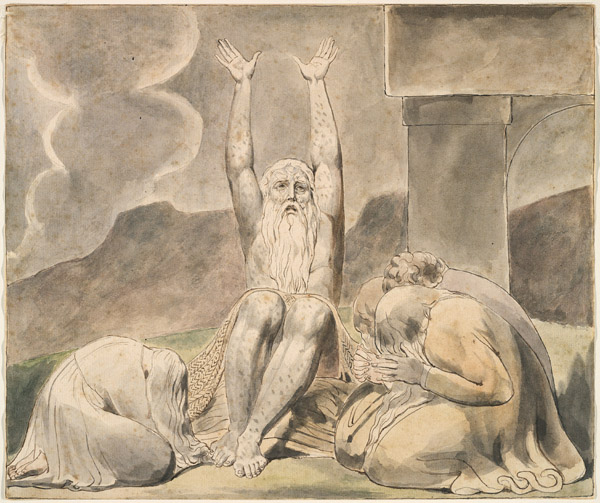
Blake seeks to provide the Golden String which can lead us through the labyrinth of our experience or his own poetry.

Saturday, March 31, 2012

BLAKE'S VALA III

S. Foster Damon's book A Blake Dictionary, is always an excellent source for acquiring a grasp of Blake's idiosyncratic meanings. On Page 295 we read:
"Nature is an external visualizing of the Individual's emotions. Vala (who is Nature) is the Emanation of Luvah (the Emotions). But Vala is now covered with her Veil of matter, which (in another symbol) is the shell of the Mundane Egg, the starry heavens.
...
Blake anticipated the cruel world of Darwin: Nature is 'A Creation that groans, living on Death, where Fish & Bird & Beast & Man & Tree & Metal & Stone live by Devouring, going into Eternal Death continually' (J 50:5; cf. Rom viii:22)."

And on page 344:
"The worldly religions were all derived from Nature. The Deists drew their conclusions by logic from the material world, but before that, the poets had drawn theirs by imaginative insight."

Religion for Blake was either true religion, developed through revelation of the Eternal; or false religion, which came from replicating the operation of the observed natural world using data from the senses. Vala, as the projection of the emotions outwardly, became the progenitor of false religions based on Nature or matter. Just as the Eternal Reason externalized became attached to the material world in Urizen, the Eternal Emotions became attached to the material world as Vala. Both Vala and Urizen engaged in activities which sought to control the outer world and shape it to aggrandise their own self-images. The two weapons in Vala's arsenal were sex and cruelty which she combined in various ways to impose her will.

The religion of the law (Jews), the religion of sacrifice (Druids), the religion of nature (Natural Religion), and the religion of rationalism (Deism) were all schemes of Vala to turn outward the consciousness of man which was in Eden open inward to the Eternal dimension.

Jerusalem, Plate 52, (E 201)
" Man must & will have Some Religion; if he has not the Religion
of Jesus, he will have the Religion of Satan, & will erect the
Synagogue of Satan. calling the Prince of this World, God; and
destroying all who do not worship Satan under the Name of God.
Will any one say: Where are those who worship Satan under the
Name of God! Where are they? Listen! Every Religion that Preaches
Vengeance for Sins the Religion of the Enemy & Avenger; and not
the Forgiver of Sin, and their God is Satan, Named by the Divine
Name Your Religion O Deists: Deism, is the Worship of the God
of this World by the means of what you call Natural Religion and
Natural Philosophy, and of Natural Morality or
Self-Righteousness, the Selfish Virtues of the Natural Heart.

This was the Religion of the Pharisees who murderd Jesus. Deism
is the same & ends in the same."

Jerusalem, Plate 29 [33], (E 175)

Yale Center for British Art
Jerusalem, Plate 63
"Vala replied in clouds of tears Albions garment embracing
I was a City & a Temple built by Albions Children.
I was a Garden planted with beauty I allured on hill & valley
The River of Life to flow against my walls & among my trees
Vala was Albions Bride & Wife in great Eternity
The loveliest of the daughters of Eternity when in day-break

I emanated from Luvah over the Towers of Jerusalem
And in her Courts among her little Children offering up
The Sacrifice of fanatic love! why loved I Jerusalem!
Why was I one with her embracing in the Vision of Jesus
Wherefore did I loving create love, which never yet
Immingled God & Man, when thou & I, hid the Divine Vision
In cloud of secret gloom which behold involve me round about
Know me now Albion: look upon me I alone am Beauty
The Imaginative Human Form is but a breathing of Vala
I breathe him forth into the Heaven from my secret Cave
Born of the Woman to obey the Woman O Albion the mighty
For the Divine appearance is Brotherhood, but I am Love"


Four Zoas, Night III. Page 42, (E 328)
"O Urizen why art thou pale at the visions of Ahania
Listen to her who loves thee lest we also are driven away.

They heard the Voice & fled swift as the winters setting sun
And now the Human Blood foamd high, I saw that Luvah & Vala
Went down the Human Heart where Paradise & its joys abounded
In jealous fears in fury & rage, & flames roll'd round their fervid feet
And the vast form of Nature like a Serpent play'd before them
And as they went in folding fires & thunders of the deep
Vala shrunk in like the dark sea that leaves its slimy banks
And from her bosom Luvah fell far as the east & west
And the vast form of Nature like a Serpent roll'd between.
"

.

Thursday, March 29, 2012

BLAKE'S VALA II

This is a continuation of the post Blake's Vala.

So Vala, the sinless soul in her Eternal form, comes under the influence of Luvah, the God of love. He constructs a beautiful house in her pleasant world which becomes permanent rather than remaining transitory.

Blake was calling into our minds the myth of Psyche and Cupid. Psyche an unblemished virgin attracted the attention of Cupid. Because of a prediction in an oracle that she would marry a monster, her parents left her to die on a mountaintop. She did not die but awoke in a beautiful hidden valley where she entered a house built for her by Cupid the god of love. She disobeyed the god by lighting a candle that she may see his countenance when he visited her in the darkness of night. Thus began her journey of restitution and redemption.

In Blake's myth it is Albion the giant body of the Eternal Man who is enchanted by the beauty of Vala as she is manifest in Nature's 'net of gold and silver twine.' Albion turned away from Jerusalem and embraced Vala. Spiritual beauty had thus been divided from natural beauty. Jerusalem was withdrawn from the bosom of Albion to be joined with Jesus. Vala became united with Albion. Temporarily the arrangement was felicitous, but Vala divided from Jerusalem and Luvah (whose emanation she was) began a decline which we will follow in a later post.

Jerusalem, PLATE 20, (E 165)
"But when they saw Albion fall'n upon mild Lambeths vale:
Astonish'd! Terrified! they hover'd over his Giant limbs.
Then thus Jerusalem spoke, while Vala wove the veil of tears:
Weeping in pleadings of Love, in the web of despair.

Wherefore hast thou shut me into the winter of human life
And clos'd up the sweet regions of youth and virgin innocence:
Where we live, forgetting error, not pondering on evil:
Among my lambs & brooks of water, among my warbling birds:
Where we delight in innocence before the face of the Lamb:
Going in and out before him in his love and sweet affection.

Vala replied weeping & trembling, hiding in her veil.

When winter rends the hungry family and the snow falls:
Upon the ways of men hiding the paths of man and beast,
Then mourns the wanderer: then he repents his wanderings & eyes
The distant forest
; then the slave groans in the dungeon of
stone.
The captive in the mill of the stranger, sold for scanty hire.
They view their former life: they number moments over and over;
Stringing them on their remembrance as on a thread of sorrow.
Thou art my sister and my daughter! thy shame is mine also!
Ask me not of my griefs! thou knowest all my griefs.

Jerusalem answer'd with soft tears over the valleys.

O Vala what is Sin? that thou shudderest and weepest
At sight of thy once lov'd Jerusalem! What is Sin but a little
Error & fault that is soon forgiven; but mercy is not a Sin
Nor pity nor love nor kind forgiveness! O! if I have Sinned
Forgive & pity me! O! unfold thy Veil in mercy & love!
Slay not my little ones, beloved Virgin daughter of Babylon
Slay not my infant loves & graces, beautiful daughter of Moab
I cannot put off the human form I strive but strive in vain
When Albion rent thy beautiful net of gold and silver twine;
Thou hadst woven it with art, thou hadst caught me in the bands
Of love; thou refusedst to let me go
: Albion beheld thy beauty
Beautiful thro' our Love's comeliness, beautiful thro' pity.
The Veil shone with thy brightness in the eyes of Albion,
Because it inclosd pity & love; because we lov'd one-another!
Albion lov'd thee! he rent thy Veil! he embrac'd thee! he lov'd
thee!

Astonish'd at his beauty & perfection, thou forgavest his furious
love:
I redounded from Albions bosom in my virgin loveliness.
The Lamb of God reciev'd me in his arms he smil'd upon us:

He made me his Bride & Wife: he gave thee to Albion.
Then was a time of love: O why is it passed away!"

Blake first gave the title Vala to the poem now called the Four Zoas. He began the poem with these words:

Four Zoas , Night I, Page 3, (E 301)
"VALA
Night the First
The Song of the Aged Mother which shook the heavens with wrath
Hearing the march of long resounding strong heroic Verse
Marshalld in order for the day of Intellectual Battle

Four Mighty Ones are in every Man; a Perfect Unity
Cannot Exist. but from the Universal Brotherhood of Eden
Universal Man. To Whom be Glory Evermore Amen

Los was the fourth immortal starry one, & in the Earth
Of a bright Universe Empery attended day & night
Days & nights of revolving joy, Urthona was his name"

Tuesday, March 27, 2012

BLAKE'S VALA

Four Zoas, Night IX, (E 397) "So spoke the Sinless Soul & laid her head on the downy fleece
Of a curld Ram who stretchd himself in sleep beside his mistress
And soft sleep fell upon her eyelids in the silent noon of day

Then Luvah passed by & saw the sinless Soul
And said Let a pleasant house arise to be the dwelling place
Of this immortal Spirit growing in lower Paradise

He spoke & pillars were builded & walls as white as ivory
The grass she slept upon was pavd with pavement as of pearl
Beneath her rose a downy bed & a cieling coverd all

Vala awoke. When in the pleasant gates of sleep I enterd
I saw my Luvah like a spirit stand in the bright air
Round him stood spirits like me who reard me a bright house
And here I see thee house remain in my most pleasant world

My Luvah smild I kneeled down he laid his hand on my head
And when he laid his hand upon me from the gates of sleep I came
Into this bodily house to tend my flocks in my pleasant garden

So saying she arose & walked round her beautiful house
And then from her white door she lookd to see her bleating lambs
But her flocks were gone up from beneath the trees into the hills

I see the hand that leadeth me doth also lead my flocks
She went up to her flocks & turned oft to see her shining house
She stopd to drink of the clear spring & eat the grapes & apples

She bore the fruits in her lap she gatherd flowers for her bosom
She called to her flocks saying follow me O my flocks

They followd her to the silent vall[e]y beneath the spreading trees
And on the rivers margin she ungirded her golden girdle
She stood in the river & viewd herself within the watry glass
And her bright hair was wet with the waters She rose up from the river
And as she rose her Eyes were opend to the world of waters
She saw Tharmas sitting upon the rocks beside the wavy sea
He strokd the water from his beard & mournd faint thro the summer vales

And Vala stood on the rocks of Tharmas & heard his mournful voice"
British Museum
Jerusalem, Copy a
Plate 46


Her house is Vala's garment of material nature. She enters it as her eyes are opened to a reflected image of the permanent realities of Eternity. She steps into the water of time and space as she assumes a body. Kathleen Raine relates the Neo-platonic idea that the the soul of Nature desired to contemplate herself and so relinquished a part of of herself to externality. But the substance remains the original Eternal Reality. The shadow is the world of matter in which our bodies live as Vala lives in her house of illusion beside the river while Tharmas mourns .


On Page 36 of Golgonooza: City of Imagination, Raine writes:

"Vala's only reality is as the 'shadow' of Jerusalem, a reflection of Soul cast in the 'Vegetable Glass' of nature."

Vision of the Last Judgment, (E 555)
"There Exist
in that Eternal World the Permanent Realities of Every Thing
which we see are reflected in this Vegetable Glass of Nature"

Jerusalem, Plate 11, (E 154)
"Vala is but thy Shadow, O thou loveliest among women!
A shadow animated by thy tears O mournful Jerusalem!
Plate 12
Why wilt thou give to her a Body whose life is but a Shade?.
Her joy and love, a shade: a shade of sweet repose:
But animated and vegetated, she is a devouring worm:
What shall we do for thee O lovely mild Jerusalem?"

.

Sunday, March 25, 2012

BLAKE & WESLEY

A Large Book of Designs
Joseph of Arimathea Preaching to the Inhabitants of Britain

John Wesley was an older contemporary of William Blake. Both lived in London although Wesley travelled widely in Britain. Wesley was a public figure for whom
crowds gathered in the open air to hear his sermons.

A book of 15 hymns called Hymns for the National Fast was published by John's brother Charles Wesley in 1782 in response to King George's call for a day of fasting following the loss of the Battle of Yorktown. Hymns from this book were combined later with a 1781 hymnal. The expanded version of the hymnal containing hymns from both brothers, was published by the Wesley brothers with the title Hymns for the Nation. A copy of this book made its way into the hands of William Blake who retained it until his death.

In the Preface of 1780, Wesley defended his own poetry in much the same way that William Blake felt obliged to defend his poetry.

Preface of 1780
"6. May I be permitted to add a few words with regard to the poetry? Then I will speak to those who are judges thereof, with all freedom and unreserve. To these I may say, without offence, 1. In these hymns there is no doggerel; no botches; nothing put in to patch up the rhyme; no feeble expletives. 2. Here is nothing turgid or bombast, on the one hand, or low and creeping, on the other. 3. Here are no cant expressions; no words without meaning. Those who impute this to us know not what they say. We talk common sense, both in prose and verse, and use no word but in a fixed and determinate sense. 4. Here are, allow me to say, both the purity, the strength, and the elegance of the English language; and, at the same time, the utmost simplicity and plainness, suited to every capacity. Lastly, I desire men of taste to judge, (these are the only competent judges) whether there be not in some of the following hymns the true spirit of poetry, such as cannot be acquired by art and labour, but must be the gift of nature. By labour a man may become a tolerable imitator of Spencer, Shakespeare, or Milton; and may heap together pretty compound epithets, as "pale-eyed," "meek-eyed," and the like; but unless he be born a poet, he will never attain the genuine spirit of poetry."

Wesley himself and his fellow evangelist Whitefield appear in Blake's Milton as two servants who suffer the fate of prophets as they witness to Christ.

Milton, Plate 22 [24], (E 118)
But then I rais'd up Whitefield, Palamabron raisd up Westley,
And these are the cries of the Churches before the two Witnesses[']
Faith in God the dear Saviour who took on the likeness of men:
Becoming obedient to death, even the death of the Cross
The Witnesses lie dead in the Street of the Great City
No Faith is in all the Earth: the Book of God is trodden under Foot:
He sent his two Servants Whitefield & Westley; were they Prophets
Or were they Idiots or Madmen? shew us Miracles!

Plate 23 [25]
Can you have greater Miracles than these? Men who devote

Their lifes whole comfort to intire scorn & injury & death
Awake thou sleeper on the Rock of Eternity Albion awake
The trumpet of Judgment hath twice sounded: all Nations are awake
But thou art still heavy and dull: Awake Albion awake!"

You can learn more about the books Blake read in Blake's Margins: An Interpretive Study of the Annotations by Hazard Adams. Exerts from the book are available at this website.
.

Saturday, March 24, 2012

BLAKE & WHOLENESS

Jerusalem, PLATE 63, (E 213)
"Jehovah stood among the Druids in the Valley of Annandale
When the Four Zoas of Albion, the Four Living Creatures, the Cherubim
Of Albion tremble before the Spectre, in the starry likeness of the Plow
Of Nations. And their Names are Urizen & Luvah & Tharmas & Urthona"

Milton Percival, author of William Blake's Circle of Destiny, was capable of revealing psychological meaning in Blake's poetry and pictures. He understood that Blake was depicting internal dynamics as he presented his Four Mighty Ones in the one giant body of Albion.

On page 20 we read:
"It is in his presentation of the Zoas that much of the power of Blake's myth lies. They are not the bloodless abstractions common to allegory. Blake believed in them. They are in consequence realities of the imagination, with power to terrify us as they terrified their creator. No other poet has given us so profound a sense of the helplessness of man before the primal forces of life; and no other poet, so passionate a denial of that helplessness. He fears these forces, because he sees them as demonic, with power over him; but he takes hope from the fact that these forces are in him - that they are himself. When man shall have brought them again into harmony, they will become his willing servants."

Jung touches on several of the same paradigms of psychic development as does Percival in this passage from his Psychological Commentary in Tibetan Book of the Dead, Edited by W. Y. Evans-Wentz:
"Fear of self-sacrifice lurks deep in every ego, and this fear is often only [of] the precariously controlled demand of the unconscious forces to burst out in full strength. No one who strives for selfhood (individuation) is spared this dangerous passage, for that which is feared also belongs to the wholeness of the self -- the sub-human, or supra-human world of psychic ‘dominants’ (archetypes) from which the ego originally emancipated itself with enormous effort, and then only partially, for the sake of a more or less illusory freedom. This liberation is certainly a very necessary and very heroic undertaking, but it represents nothing final: it is merely the creation of a subject, who, in order to find fulfillment, has still to be confronted by an object. This [object], at first sight, would appear to be the world, which is swelled out with projections for that very purpose. Here we seek and find our difficulties, here we seek and find our enemy, here we seek and find what is dear and precious to us; and it is comforting to know that all evil and all good is to be found out there, in the visible object, where it can be conquered, punished, destroyed, or enjoyed. But nature herself does not allow this paradisal state of innocence to continue for ever. There are, and always have been, those who cannot help but see that the world and its experiences are in the nature of a symbol, and that it really reflects something that lies hidden in the subject himself, in his own trans-subjective reality."
In the beginning of the Book of Urizen Blake expresses a recognition of the disturbance in the psyche which has given power to a force which is 'Obscure, shadowy, void, solitary.' He gladly hears the call to have the 'dark visions of torment' revealed to him.

Urizen, PLATE 2, (E 74)
"PRELUDIUM TO THE [FIRST] BOOK OF URIZEN

Of the primeval Priests assum'd power,
When Eternals spurn'd back his religion;
And gave him a place in the north,
Obscure, shadowy, void, solitary.

Eternals I hear your call gladly,
Dictate swift winged words, & fear not
To unfold your dark visions of torment."

Entering in the dark, unknown aspects of the psyche changes the occupation of the mind to the experience of emotional states which are both pleasant and painful and which appear to be outside of the mind.

Jerusalem, Plate 68, (E 222)
"Sometimes I curse & sometimes bless thy fascinating beauty
Once Man was occupied in intellectual pleasures & energies
But now my soul is harrowd with grief & fear & love & desire
And now I hate & now I love & Intellect is no more:
There is no time for any thing but the torments of love & desire
The Feminine & Masculine Shadows soft, mild & ever varying
In beauty: are Shadows now no more, but Rocks in Horeb"

To be torn asunder, to be under the control of one's own wrath, to experience fury, anguish and terror - these are the 'far worse' things of which Los and Blake know. But they know too that Albion will be made whole.

Jerusalem, Plate 7, (E 150)
"Los answer'd. Altho' I know not this! I know far worse than this:
I know that Albion hath divided me, and that thou O my Spectre,
Hast just cause to be irritated: but look stedfastly upon me:
Comfort thyself in my strength the time will arrive,
When all Albions injuries shall cease, and when we shall
Embrace him tenfold bright, rising from his tomb in immortality.
They have divided themselves by Wrath. they must be united by
Pity: let us therefore take example & warning O my Spectre,
O that I could abstain from wrath! O that the Lamb
Of God would look upon me and pity me in my fury.
In anguish of regeneration! in terrors of self annihilation:
Pity must join together those whom wrath has torn in sunder,
And the Religion of Generation which was meant for the destruction
Of Jerusalem, become her covering, till the time of the End."

The reunification of Albion, the archetype of the complete (individuated) individual and of the undivided mankind, restores the connection between humanity and the 'Universal Father' in 'Infinitude.'
Jerusalem, PLATE 97, (E 256)
"Awake! Awake Jerusalem! O lovely Emanation of Albion
Awake and overspread all Nations as in Ancient Time
For lo! the Night of Death is past and the Eternal Day
Appears upon our Hills: Awake Jerusalem, and come away

So spake the Vision of Albion & in him so spake in my hearing
The Universal Father. Then Albion stretchd his hand into Infinitude."


Image from Jerusalem, Plate 99

Library of Congress

Friday, March 23, 2012

IDENTITY

In the Biblical story of the Prodigal Son the younger son arrives at the point of despair after having separated himself from his family and exhausted his resources:

Luke 15
[13] And not many days after the younger son gathered all together, and took his journey into a far country, and there wasted his substance with riotous living.
[14] And when he had spent all, there arose a mighty famine in that land; and he began to be in want.
[15] And he went and joined himself to a citizen of that country; and he sent him into his fields to feed swine.
[16] And he would fain have filled his belly with the husks that the swine did eat: and no man gave unto him.
[17] And when he came to himself, he said, How many hired servants of my father's have bread enough and to spare, and I perish with hunger!

Job reached a similar point of hopelessness and darkness which Blake picture in Plate 8 of his Illustrations to the Book of Job.

Illustrations to the Book of Job
Plate 8, Linnell Set
Wikimedia
Job 3
[1] After this opened Job his mouth, and cursed his day.
[2] And Job spake, and said,
[3] Let the day perish wherein I was born, and the night in which it was said, There is a man child conceived.
[4] Let that day be darkness; let not God regard it from above, neither let the light shine upon it.
[5] Let darkness and the shadow of death stain it; let a cloud dwell upon it; let the blackness of the day terrify it.
[6] As for that night, let darkness seize upon it; let it not be joined unto the days of the year, let it not come into the number of the months.
[7] Lo, let that night be solitary, let no joyful voice come therein.

The term that Blake used for the real or authentic humanity which resides within each individual is the Identity. This is the part of us that is connected to the Eternal and is Eternal itself. When an individual ascribes to false ideas or acts in inauthentic ways the Identity may be obscured or may enter a state like sleep. The Selfhood occupies the position vacated by the Identity and the connection with the Eternal is broken. If the individual could 'come to himself' as did the Prodigal son, the Identity would be released from its bondage and he would cast out the inauthentic behaviours which were being expressed.

Unfortunately, as Tharmas did in this passage, mankind often flees from his Identity in pursuit of the Vain Shadow of Hope because his eyes are on Urizen:

Four Zoas, Night VIII, PAGE 122 [108], (E 383)
"Tharmas on high rode furious thro the afflicted worlds
Pursuing the Vain Shadow of Hope fleeing from identity
In abstract false Expanses that he may not hear the Voice
Of Ahania wailing on the winds in vain he flies for still
The voice incessant calls on all the children of Men
For she spoke of all in heaven & all upon the Earth
Saw not as yet the Divine vision her Eyes are Toward Urizen"
.

Wednesday, March 21, 2012

SEEING THE INFINITE


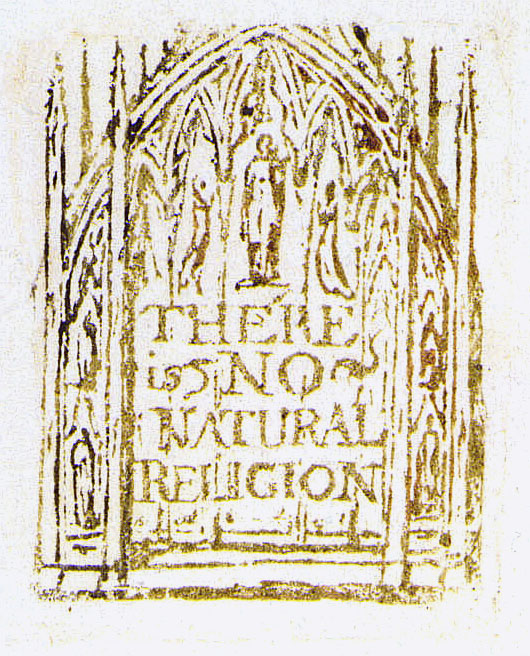
Image from Wikimedia
There is No Natural Religion
Title Page


There is No Natural Religion
, (E 3)
"VII The desire of Man being Infinite the possession is Infinite & himself Infinite
Conclusion, If it were not for the Poetic or Prophetic
character. the Philosophic & Experimental would soon be at the
ratio of all things & stand still, unable to do other than repeat the same dull round over again
Application. He who sees the Infinite in all things sees
God. He who sees the Ratio only sees himself only.

Therefore God becomes as we are, that we may be as he is"

Here is a quote from Athanasius, a 4th century bishop of the Coptic Orthodox Church:
"The Son of God became man so that man might become God." (CCC #460)

The statement by Athanasius became Christian doctrine and is included in the Catholic Church Catechism. Blake's similar statement is considered by some to be a repetition of the doctrine formulated by Athanasius. A closer look will reveal the differences.

First notice that Blake is speaking in the first person, "as we are" and "that we may be". This is personal experience. This doesn't sound like doctrine because it isn't doctrine. The direction that Blake is heading is toward becoming like God through acknowledging that God becomes like us. The action, "becomes", is in the present. The idea that God "becomes" rather than that he simply "be", conforms with Blake's value of active rather than passive. In Blake's second phrase he uses the word "be" instead of become. This indicates that he is talking about the Identity, our Eternal nature which is unchanging, which goes through states and casts off error but remains the essential being.

Annotations to Reynolds, (E 655)
"Reynolds Thinks that Man Learns all that he Knows I say on
the Contrary That Man Brings All that he has or Can have Into the
World with him. Man is Born Like a Garden ready Planted & Sown
This World is too poor to produce one Seed"

Jerusalem , Plate 38, (E 184)
"the Divine-
Humanity, who is the Only General and Universal Form
To which all Lineaments tend & seek with love & sympathy
All broad & general principles belong to benevolence
Who protects minute particulars, every one in their own identity."

Jerusalem , Plate 55, (E204)
"General Good is the plea of the scoundrel hypocrite & flatterer:
For Art & Science cannot exist but in minutely organized Particulars
And not in generalizing Demonstrations of the Rational Power.
The Infinite alone resides in Definite & Determinate Identity
Establishment of Truth depends on destruction of Falshood
continually"

Vision of the Last Judgement , Page 79,(E 355)
"In Eternity one Thing never Changes into
another Thing Each Identity is Eternal...
Eternal Identity is one thing & Corporeal
Vegetation is another thing"

It is interesting to note that in the Athanasius quote that God "became", since the static "I am" represents most traditional thinking about God. Although God acts in the Old Testament he is thought to be unchanging. The third person "man" is used rather than the "we" of Blake's passage. And there is
Athanasius' trinitarian reference when he speaks of "the Son of God", the second person of the trinity. Athanasius specifies "become God" whereas Blake indicates "be as he is". Actually "become God" is more gnostic than Blake's "be as he is".

If Blake were trying to duplicate the thoughts of Athanasius he would have used his words. Instead he uses his own words (slightly different from the original) to change the meaning, as he frequently does when reproducing another's statements. Subtleties, yes, but that's Blake.
.