Blake seeks to provide the Golden String which can lead us through the labyrinth of our experience or his own poetry.

Sunday, September 2, 2012

LIFE'S WORK VI

British Museum
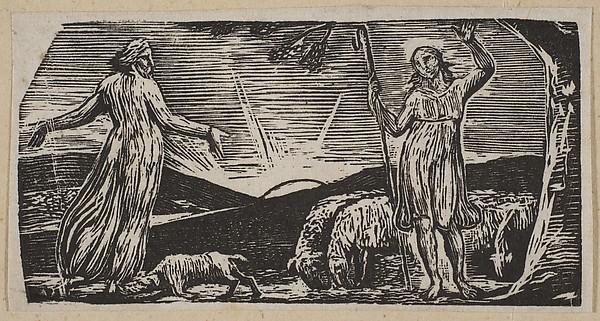
Frontispiece to Second Eclogue
Thornton's Pastorals of Virgil
It is not surprising that Blake took delight in inventing the illustrations for the Second Eclogue of Ambrose Phillips in Thornton's Pastorals of Virgil. Blake found here another opportunity to illustrate the contrary states of mankind which he had portrayed so many times before; but of course in a different setting and a different context. 

An example of opposed positions through which the human psyche passes is explored is SONGS Of INNOCENCE and Of EXPERIENCE, subtitled Shewing the Two Contrary States of the Human Soul. The innocence of the child protected from the harshness of of life is contrasted with the mind which knows the brutal side of nature and society.
 
In Blake's Illustrations to Milton's L'Allegro and Il Penseroso he pictures the contrasting mental states which are light hearted and care free with those which are pensive and reflective. It is the youth who enjoys the world of mirth and pleasure and the older man who finds himself in a state of melancholy and contemplation.

Blake could appreciate the reversed positions of youth and age in Thenot and Colinet in Ambrose's eclogue, for here we see confusion and negativity in the young man and confidence and pleasure in the aged.   

THENOT:
"Yet, tho' with Years my Body downward tend,
As Trees beneath their Fruit in Autumn bend,
My Mind a chearful Temper still retains,"
COLINET:
"Scarce does one smiling Hour my Youth attend:
Tho' few my Days, as my own Follies show,
Yet all those Days are clouded o'er with Woe:
No Gleam of happy Sun-shine does appear
My lowring Skie and wintry Days to chear."

Blake could take pleasure in the role of the older man as patient counsellor and teacher who gave comfort and encouragement to the discouraged youth. At the time he produced the illustrations to the Pastorals of Virgil, Blake was beginning relationships with the younger men to whom Linnell introduced him. Mutually supportive friendships developed in the circle of artists who offered their gifts of innocence and experience, exuberance and melancholy, woe and joy to one another. 

Songs of Innocence & of Experience, Song 54, (E 31)
"The Voice of the Ancient Bard.   

Youth of delight come hither:
And see the opening morn,
Image of truth new born.
Doubt is fled & clouds of reason.
Dark disputes & artful teazing.
Folly is an endless maze,
Tangled roots perplex her ways,

How many have fallen there!
They stumble all night over bones of the dead,
And feel they know not what but care
And wish to lead others, when they should be led."

Friday, August 31, 2012

LIFE'S WORK V


Metropolitan Museum  of Art
Illustrations to Pastorals of Virgil
Thenot Remonstrates With Colinet
Here is a quote about Blake's illustrations to Thornton's Virgil (1821-21) from William Blake, by Martin Butlin, published by the Blake Trust:

"The impact of these exquisite designs is best expressed in the words of Samuel Palmer: 'I sat down with Mr. Blake's Thornton's Virgil woodcuts before me, thinking to give their merits my feeble testimony. I happened to think first of their sentiment. They are visions of little dells, and nooks, and corners of Paradise; models of the exquisitest pitch of intense poetry. I thought of their light and shade, and looking upon them found no word to describe them. Intense depth, solemnity, and vivid brilliancy only coldly and partially describe it. There is in all such a mystic and dreamy glimmer as penetrates and kindles the innermost soul, and gives complete and unreserved delight, unlike the gaudy daylight of this world. They are like all that wonderful artist's works the drawing aside of the earthly curtain, and the glimpse which all the most holy, studious saints and sages have enjoyed, that rest which remaineth to the people of God.' The designs had an over-whelming impact on Palmer's visionary works of the Shoreham period and also on the engravings of Edward Calvert." Page 138


It seems to have been impossible for Blake to be half-hearted about any project in which he engaged or to please any who were not inclined to respect his visionary art.  When John Linnell arranged for Blake to produce some illustrations for Dr Thornton's reprint of his Pastorals of Virgil, Blake learned the technique to woodcutting instead of using his usual engraving technique. We can follow the production process from the original watercolor sketches, through at least one conventional engraving, to the blocks of the woodcuttings, to the proof sheets, and to the prints in the book. Thornton was not satisfied with the original woodcuts but became reconciled to using them when he learned how highly they were respected by other artists. Thornton introduced Blake illustrations with faint praise.

The curator of the British Museum writes:
"Introducing Blake's illustrations to Philips's eclogue Thornton writes that they 'display less of art than genius', although he also boasts that they are by 'the famous Blake'. Certainly, Blake's wood engravings were extremely unconventional: they were also clearly more artistically ambitious than the numerous other illustrations in 'Pastorals of Virgil'".

Dr Thornton would have done well to read from Blake's Descriptive Catalogue to learn that the visionary artist is representing realities unseen by the 'mortal perishing organ of sight' which sees only 'a cloudy vapour or a nothing'. To the artist the imagination is the visionary eye through which spiritual existence is made known. The image he produces conveys the lineaments of the object represented, not the superficial appearance. Unless the viewer sees through his imagination to the underlying spirit which is animated, the picture is nothing but a misrepresentation of nature.

Descriptive Catalogue
, (E 541)

"The connoisseurs and artists who have made objections to
Mr. B.'s mode of representing spirits with real bodies, would do
well to consider that the Venus, the Minerva, the Jupiter, the
Apollo, which they admire in Greek statues, are all of them
representations of spiritual existences of God's immortal, to
the mortal perishing organ of sight; and yet they are embodied
and organized in solid marble.  Mr. B. requires the same latitude
and all is well.  The Prophets describe what they saw in Vision
as real and existing men whom they saw with their imaginative and
immortal organs; the Apostles the same; the clearer the organ the
more distinct the object.  A Spirit and a Vision are not, as the 
modern philosophy supposes, a cloudy vapour or a
nothing: they are organized and minutely articulated beyond all
that the mortal and perishing nature can produce.  He who does
not imagine in stronger and better lineaments, and in stronger
and better light than his perishing mortal eye can see does not
imagine at all.  The painter of this work asserts that all his
imaginations appear to him infinitely more perfect and more
minutely organized than any thing seen by his
mortal eye.  Spirits are organized men: Moderns wish to 
draw figures without lines, and with great and heavy shadows; 
are not shadows more unmeaning than lines, and more heavy? O 
who can doubt this!"
. 

Wednesday, August 29, 2012

LIFE'S WORK IV

National Gallery of Art
Rosenwald Collection

The Pastorals of Virgil, 1821
Proof sheet printed by Blake
Samuel Palmer was only 19 years old when he was introduced to William Blake in 1824 by John Linnell. He remained under the influence of Blake 31 years later when he wrote this letter to Alexander Gilchrist for inclusion in his biography The Life of William Blake. Palmer along with the other 'Ancients' admired Blake's woodcuts for Thornton's publication of The Pastorals of Virgil.

From Samuel Palmer to Alexander Gilchrist:

"Kensington, Aug. 23d, 1855. My Dear Sir,
I regret that the lapse of time has made it difficult to recall many interesting particulars respecting Mr. Blake, of whom I can give you no connected account; nothing more, in fact, than the fragments of memory; but the general impression of what is great remains with us, although its details may be confused; and Blake, once known, could never be forgotten.
His knowledge was various and extensive, and his conversation so nervous and brilliant, that, if recorded at the time, it would now have thrown much light upon his character, and in no way lessened him in the estimation of those who know him only by his works.
In him you saw at once the Maker, the Inventor; one of the
few in any age: a fitting companion for Dante. He was energy itself, and shed around him a kindling influence; an atmosphere of life, full of the ideal. To walk with him in the country was to perceive the soul of beauty through the forms of matter; and the high gloomy buildings between which, from his study window, a glimpse was caught of the Thames and the Surrey shore, assumed a kind grandeur from the man dwelling near them. Those may laugh at this who never knew such an one as Blake; but of him it is the simple truth.
He was a man without a mask; his aim single, his path straightforwards, and his wants few; so he was free, noble, and happy.
His voice and manner were quiet, yet all awake with intellect. Above the tricks of littleness, or the least taint of affectation, with a natural dignity which few would have dared to affront, he was gentle and affectionate, loving to be with little children, and to talk about them. "That is heaven," he said to a friend, leading him to the window, and pointing to a group of them at play.
Declining, like Socrates, whom in many respects he resembled, the common objects of ambition, and pitying the scuffle to obtain them, he thought that no one could be truly great who had not humbled himself " even as a little child." This was a subject he loved to dwell upon, and to illustrate.
His eye was the finest I ever saw: brilliant, but not roving, clear and intent, yet susceptible; it flashed with genius, or melted in tenderness. It could also be terrible. Cunning and falsehood quailed under it, but it was never busy with them. It pierced them, and turned away. Nor was the mouth less expressive; the lips flexible and quivering with feeling. I can yet recal it when, on one occasion, dwelling upon the exquisite beauty of the parable of the Prodigal, he began to repeat a part of it; but at the words, "When he was yet a great way off, his father saw him," could go no further; his voice faltered, and he was in tears.
I can never forget the evening when Mr. Linnell took me to Blake's house, nor the quiet hours passed with him in the examination of antique gems, choice pictures, and Italian prints of the sixteenth century. Those who may have read some strange passages in his Catalogue, written in irritation, and probably in haste, will be surprised to hear, that in conversation he was anything but sectarian or exclusive, finding sources of delight throughout the whole range of art; while, as a critic, he was judicious and discriminating.
No man more admired Albert Diirer; yet, after looking over a number of his designs, he would become a little angry with some of the draperies, as not governed by the forms of the limbs, nor assisting to express their action; contrasting them in this respect with the draped antique, in which it was hard to tell whether he was more delighted with the general design, or with the exquisite finish and the depth of the chiselling; in works of the highest class, no mere adjuncts, but the last development of the design itself.
He united freedom of judgment with reverence for all that is great. He did not look out for the works of the purest ages, but for the purest works of every age and country—Athens or Rhodes, Tuscany or Britain; but no authority or popular consent could influence him against his deliberate judgment. Thus he thought with Fuseli and Flaxman that the Elgin Theseus, however full of antique savour, could not, as ideal form, rank with the very finest relics of antiquity. Nor, on the other hand, did the universal neglect of Fuseli in any degree lessen his admiration of his best works.
He fervently loved the early Christian art, and dwelt with peculiar affection on the memory of Fra Angelico, often speaking of him as an inspired inventor and as a saint; but when he approached Michael Angelo, the Last Supper of Da Vinci, the Torso Belvidere, and some of the inventions preserved in the Antique Gems, all his powers were concentrated in admiration.
When looking at the heads of the apostles in the copy of the Last Supper at the Royal Academy, he remarked of all but Judas,' Every one looks as if he had conquered the natural man.' He was equally ready to admire a contemporary and a rival. Fuseli's picture of Satan building the Bridge over Chaos he ranked with the grandest efforts of imaginative art, and said that we were two centuries behind the civilization which would enable us to estimate his /Egisthus.
He was fond of the works of St. Theresa, and often quoted them with other writers on the interior life. Among his eccentricities will, no doubt, be numbered his preference for ecclesiastical governments. He used to ask how it was that we heard so much of priestcraft, and so little of soldiercraft and lawyercraft.
The Bible, he said, was the book of liberty and Christianity the sole regenerator of nations. In politics a Platonist, he put no trust in demagogues. His ideal home was with Fra Angelico: a little later he might have been a reformer, but after the fashion of Savonarola.
He loved to speak of the years spent by Michael Angelo, without earthly reward, and solely for the love of God, in the building of St. Peter's, and of the wondrous architects of our cathedrals. In Westminster Abbey were his earliest and most sacred recollections. I asked him how he would like to paint on glass, for the great west window, his "Sons of God shouting for Joy," from his designs in the Job. He said, after a pause, "I could do it!" kindling at the thought.
Centuries could not separate him in spirit from the artists who went about our land, pitching their tents by the morass or the forest side, to build those sanctuaries that now lie ruined amidst the fertility which they called into being.
His mind was large enough to contain, along with these things, stores of classic imagery. He delighted in Ovid, and, as a labour of love, had executed a finished picture from the Metamorphoses, after Giulio Romano. This design hung in his room, and, close by his engraving table, Albert Diirer's Melancholy the Mother of Invention, memorable as probably having been seen by Milton, and used in his Penseroso. There are living a few artists, then boys, who may remember the smile of welcome with which he used to rise from that table to receive them.
His poems were variously estimated. They tested rather severely the imaginative capacity of their readers. Flaxman said they were as grand as his designs, and Wordsworth delighted in his Songs 0/ Innocence. To the multitude they were unintelligible. In many parts full of pastoral sweetness, and often flashing with noble thoughts or terrible imagery, we must regret that he should sometimes have suffered fancy to trespass within sacred precincts.
Thrown early among the authors who resorted to Johnson, the book-seller, he rebuked the profanity of Paine, and was no disciple of Priestley; but, too undisciplined and cast upon times and circumstances which yielded him neither guidance nor sympathy, he wanted that balance of the faculties which might have assisted him in matters extraneous to his profession. He saw everything through art, and, in matters beyond its range, exalted it from a witness into a judge.
He had great powers of argument, and on general subjects was a very patient and good-tempered disputant; but materialism was his abhorrence: and if some unhappy man called in question the world of spirits, he would answer him "according to his folly," by putting forth his own views in their most extravagant and startling aspect. This might amuse those who were in the secret, but it left his opponent angry and bewildered.
Such was Blake, as I remember him. He was one of the few to be met with in our passage through life, who are not, in some way or other, "double minded " and inconsistent with themselves; one of the very few who cannot be depressed by neglect, and to whose name rank and station could add no lustre. Moving apart, in a sphere above the attraction of worldly honours, he did not accept greatness, but confer it. He ennobled poverty, and, by his conversation and the influence of his genius, made two small rooms in Fountain Court more attractive than the threshold of princes.
I remain, my dear Sir,
Yours very faithfully,
Samuel Palmer. To Alexander Gilchrist, Esq."
.

Monday, August 27, 2012

LIFE'S WORK III

Library of Congress
Marriage of Heaven & Hell
Plate 10, Copy D


T. S. Eliot captures much of Blake's character and independent nature in this passage. Blake's lack of formal education under the tutelage of orthodox authorities contributed to the confidence he had in his own ability to create his own system based on his own experience. F
rom the chapter Twentieth-Century Criticism, (T. S. Eliot, Selected Essays) in Blake's Poetry and Designs, edited by Mary Lynn Johnson and John E Grant, we read:

"It is important that the artist should be highly educated in his own art; but his education is one that is hindered rather than helped by the ordinary processes of society which constitute education for the ordinary man. For these processes consist largely in the acquisition of impersonal ideas which obscure what we really are and feel, what we really want, and what excites our interest. It is of course not the actual information acquired, but the conformity which the accumulation of knowledge is apt to impose, that is harmful. Tennyson is a very fair example of a poet almost wholly encrusted with opinion, which wholly merged with his environment. Blake, on the other hand, knew what interested him, and he therefore presents only the essential, only, in fact, what can be presented and need not be explained. And because he was not distracted, or frightened, or occupied in anything but exact statements, he understood. He was naked, he saw man naked, and from the centre of his own crystal. To him there was no more reason why Swedenborg should be absurd than Locke. He accepted Swedenborg, and eventually rejected him, for reasons of his own. He approached everything with a mind unclouded by current opinions. There was nothing of the superior person about him. This makes him terrifying."
(Page 508)

Milton, Plate 38 [43], (E 139)
"In the Eastern porch of Satans Universe Milton stood & said
...
Thy purpose & the purpose of thy Priests & of thy Churches
Is to impress on men the fear of death; to teach
Trembling & fear, terror, constriction; abject selfishness
Mine is to teach Men to despise death & to go on
In fearless majesty annihilating Self, laughing to scorn
Thy Laws & terrors, shaking down thy Synagogues as webs
I come to discover before Heavn & Hell the Self righteousness
In all its Hypocritic turpitude, opening to every eye
These wonders of Satans holiness shewing to the Earth
The Idol Virtues of the Natural Heart, & Satans Seat
Explore in all its Selfish Natural Virtue & put off
In Self annihilation all that is not of God alone:
To put off Self & all I have ever & ever Amen"

.

Saturday, August 25, 2012

LIFE'S WORK II

This sketch was inscribed by John Linnell , 'at Hamstead Drawn by Mr Blake from the life. Intended as the Portrait of J. Linnell'. 
For a better view of the picture: right click on image, select open in new window, click to enlarge.
National Gallery of Art, Washington
Rosenwald Collection
1825

Among the younger men who became Blake's friends later in his life, John Linnell (1792-1882) stands out. He was introduced to Blake in 1818 by a son of Blake's good long term friend George Cumberland. The two men, both artists, found that they enjoyed one another's company in spite of the difference of 35 years in their ages. One evidence of the regard they felt for each other is revealed in the copy of The Marriage of Heaven & Hell which Blake produced for Linnell in 1821. According to a statement in the Blake Archive, Blake took particular time and care in coloring and detailing a copy which he had printed thirty years previously. The effort Blake put into it was not reflected in the discount price at which the copy was sold to Linnell. Copy H of Marriage of Heaven & Hell can best be viewed at the Fitzwilliam Museum, Cambridge.

It was to Linnell that Blake entrusted the manuscript of Four Zoas. Blake had worked on the manuscript for about ten years and developed much of his system of thought through writing it. Although Blake discontinued work on the Four Zoas in about 1808, he wanted to see it preserved not lost. Linnell and his descendants fulfilled their obligation and the manuscript resides in the British Library. 


Letters, (E 778)
"To John Linnell Esqre, N 6 Cirencester Place,
Fitzroy Square
[Postmark: 2 July 1826]
My dearest Friend
     This sudden cold weather has cut up all my hopes by the
roots.  Everyone who knows of our intended flight into your
delightful Country concur in saying: "Do not Venture till summer
appears again".  I also feel Myself weaker than I was aware,
being not able as yet to sit up longer than six hours at a
time. & also feel the Cold too much to dare venture beyond my
present precincts.  My heartiest Thanks for your care in my
accomodation & the trouble you will yet have with me.  But I get
better & stronger every day, tho weaker in muscle & bone than I
supposed. As to pleasantness of Prospect it is All pleasant
Prospect at North End.  Mrs Hurd's I should like as well as
any--But think of the Expense & how it may be spared & never mind
appearances
     I intend to bring with me besides our necessary change of
apparel Only My Book of Drawings from Dante & one Plate shut up
in the Book.  All will go very well in the Coach. which at
present would be a rumble I fear I could not go thro.  So that
I conclude another Week must pass before I dare Venture upon what
I ardently desire--the seeing you with your happy Family once
again & that for a longer Period than I had ever hoped in my
health full hours
I am dear Sir
Yours most gratefully
WILLIAM BLAKE"

Thursday, August 23, 2012

LIFE'S WORK

British Museum
Catherine Blake
1762 - 1831
by Frederick Tatham, Septr. 1828


Because Blake was convinced of the value of his work as a record of his visionary experience, he was careful to provide for its preservation. The quantity of his work which survives is testimony to his success. Often in his lifetime his work was sold to people who recognised the spiritual nature of his work and its value to posterity. Much of his work was maintained in his possession and passed to his wife Catherine on his death in August 1827. She continued to sell items during her lifetime but only if she thought her husband would have approved. Frederick Tatham received much of the residue of William's work on Catherine's death. 

Here is a letter by Tatham included in Discussions of William Blake edited by John E. Grant:

"To Francis Harvey, [dealer]
June 8, 1864

Dear Sir,
The MS  you purchased of me was part of the possessions into which I came by legacy from Mrs. Blake, the widow of that extraordinary and excellent man, William Blake, Visionary, Poet and Painter, who had a consummate knowledge of the great writers in all languages...His knowledge was immense, his industry beyond parallel, and his life innocent, simple and laborious, far beyond that of other men. Childlike, indomitable, proud, and humble, he carried out a sort of purpose in his life which seemed only to produce what was invisible to the natural eye, to the despising of things which are seen: he therefore became wild and his theories wanted solidity; but he was the most delightful and interesting man that ever an intellectual lover of art could spend a day with; and he died as he lived. He was much associated with many of the great men of the age in which he lived, and was meek and companionable with them...
Very faithfully yours,
Frederick Tatham "
.

Tuesday, August 21, 2012

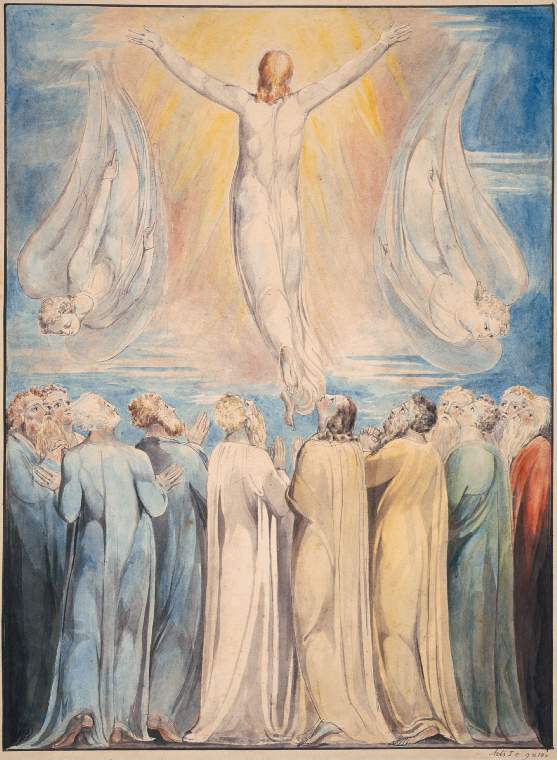
JESUS THE IMAGINATION

Fitzwilliam Museum
The Ascension
From Kathleen Raine's book, Golgonooza, City of Imagination, we can learn more of what Blake meant by 'Jesus the Imagination' and about the function of states in the journey through mortal life. Page 154-6

"But for Blake Jesus is something more specific: he is 'Jesus, the Imagination, the 'supreme state' of humanity which transcends, and releases from, all the states of good and evil through which human souls pass. The presence of Jesus the Imagination is with every man at all times present, born with every birth, accompanying every soul throughout life as the 'saviour' who releases the man from his present state. It is Satan, the Selfhood, who identifies the man with his present state; and who therefore is the Accuser who condemns; the Divine Humanity, Jesus the Imagination, is the ever-present way of release from the states. Imagination is called the 'savior' because the Person of the Divine Humanity is also able to:
'take away the imputation of Sin
By the Creation of States & the deliverance of Individuals
     Evermore Amen
 ...
But many doubted & despaird & imputed Sin & Righteousness       
To Individuals & not to States' Jerusalem, Plate 25, (E 170)
'The Imagination is not a State: it is the Human Existence itself' Milton Plate 33 [36], (E 132)
Both the heavens and the hells Blake saw as alike remote from this state, the heavens of the self-righteous condemning in 'cruel holiness' the hells of the sinners; and he goes on to write:
'Yet they are blameless & Iniquity must be imputed only           
To the State they are enterd into that they may be deliverd:
Satan is the State of Death, & not a Human existence:
But Luvah is named Satan, because he has enterd that State.
A World where Man is by Nature the enemy of Man
Because the Evil is Created into a State. that Men               
May be deliverd time after time evermore.'

- and the passage concludes:

'Learn therefore O Sisters to distinguish the Eternal Human
That walks about among the stones of fire in bliss & woe
Alternate! from those States or Worlds in which the Spirit travels:
This is the only means to Forgiveness of Enemies'  Jerusalem, Plate 49, (E 199) 
Human beings can be forgiven for they are not irrevocably 'evil' but can pass
through many states, and the supreme state is the goal of all.
...
Blake's own words best describe his vision of Jesus the Imagination as 
depicted in his Vision of the Last Judgement:  
'Around the Throne Heaven is opend & the Nature of Eternal Things Displayd All Springing from the Divine Humanity All beams from him, as he himself has said, All dwells in him. He is the Bread & the Wine; he is the Water of Life.' Vision of Last 
Judgement, (E 561)"
.