Blake seeks to provide the Golden String which can lead us through the labyrinth of our experience or his own poetry.

Thursday, November 29, 2012

BLAKE'S MESSAGE XII

The appreciation which Milton Klonsky had for William Blake was for his visionary skills. Klonsky sees that Blake acts as the conduit for the transmission of his visionary experience to his audience through his poetry and graphic images. Blake does not distance himself from the work he produces. He both inserts himself into his poetry and pictures and invites his readers and viewers to participate in the whole artistic, imaginative, visionary process. For Blake it must be so for: "The whole Business of Man Is The Arts & All Things Common." Laocoon, (E 273)
Vision of Last Judgment, (E 560)
"If the Spectator could Enter into these Images in his
Imagination approaching them on the Fiery Chariot of his
Contemplative Thought if he could Enter into Noahs Rainbow or
into his bosom or could make a Friend & Companion of one of these
Images of wonder which always intreats him to leave mortal things
as he must know then would he arise from his Grave then would he
meet the Lord in the Air & then he would be happy   General
Knowledge is Remote Knowledge it is in Particulars that Wisdom
consists & Happiness too.  Both in Art & in Life General Masses
are as Much Art as a Pasteboard Man is Human Every Man has Eyes
Nose & Mouth this Every Idiot knows but he who enters into &
discriminates most minutely the Manners & Intentions  the
Characters in all their branches is the
alone Wise or Sensible Man & on this discrimination All Art is
founded.  I intreat then that the Spectator will attend to the
Hands & Feet to the Lineaments of the Countenances they are all
descriptive of Character & not a line is drawn without intention
& that most discriminate & particular  much less an
Insignificant Blur or Mark>" 
Quoting from Minlton Klonsky's William Blake, The Seer and His Visions on page 27:
"Any work of the imagination, such as a poem or a picture, must necessarily be composed of mind-stuff, but Blake saw the larger creation as well, this very world as no different in kind. The acts that made up the world of the prophets, in the Bible and in the world, spoke through them as thoughts, miming the voice of God.

... 
Side by side with his pantheon of 'Giant Forms' in the prophetic books, Blake also introduced a set of historical personae, such as Milton and Newton and Bacon and Locke, and, even under their proper names, a sub-cast of minor characters whose sole importance was that they once played a part in his own life. All of them act and react with one another, unite with or annihilate one another, shift identities and become one another like the phantoms of a dream, yet a dream within a larger dream, his own expanded into the 6,000-year-old dream of Albion. Mundane events in his own life become symbolic of cosmic events in eternity. Blake himself may appear among his own creations, as in Vala, when he and Catherine, apothesized as Los and Enitharmon, are glimpsed in a domestic scene at work together:

Four Zoas, Night VII, PAGE 98 [90],(E 369)
'And first he drew a line upon the walls of shining heaven    
And Enitharmon tincturd it with beams of blushing love'
Or in Milton, when he becomes Palamabron (one of the many sons of the fourfold Los) and resumes his quarrel with a quondam benefactor, William Hayley, there cast as Satan, whom Blake regarded as 'corporeal friend' but 'spiritual enemy':
Milton, Plate 7,(E 100)
"Then Palamabron reddening like the Moon in an eclipse,        
Spoke saying, You know Satans mildness and his self-imposition,
Seeming a brother, being a tyrant, even thinking himself a brother
While he is murdering the just;"
By his envisioning himself in this way, as the blake-smith and poet Los, we can thus see Blake as he saw himself thro' his own eyes."
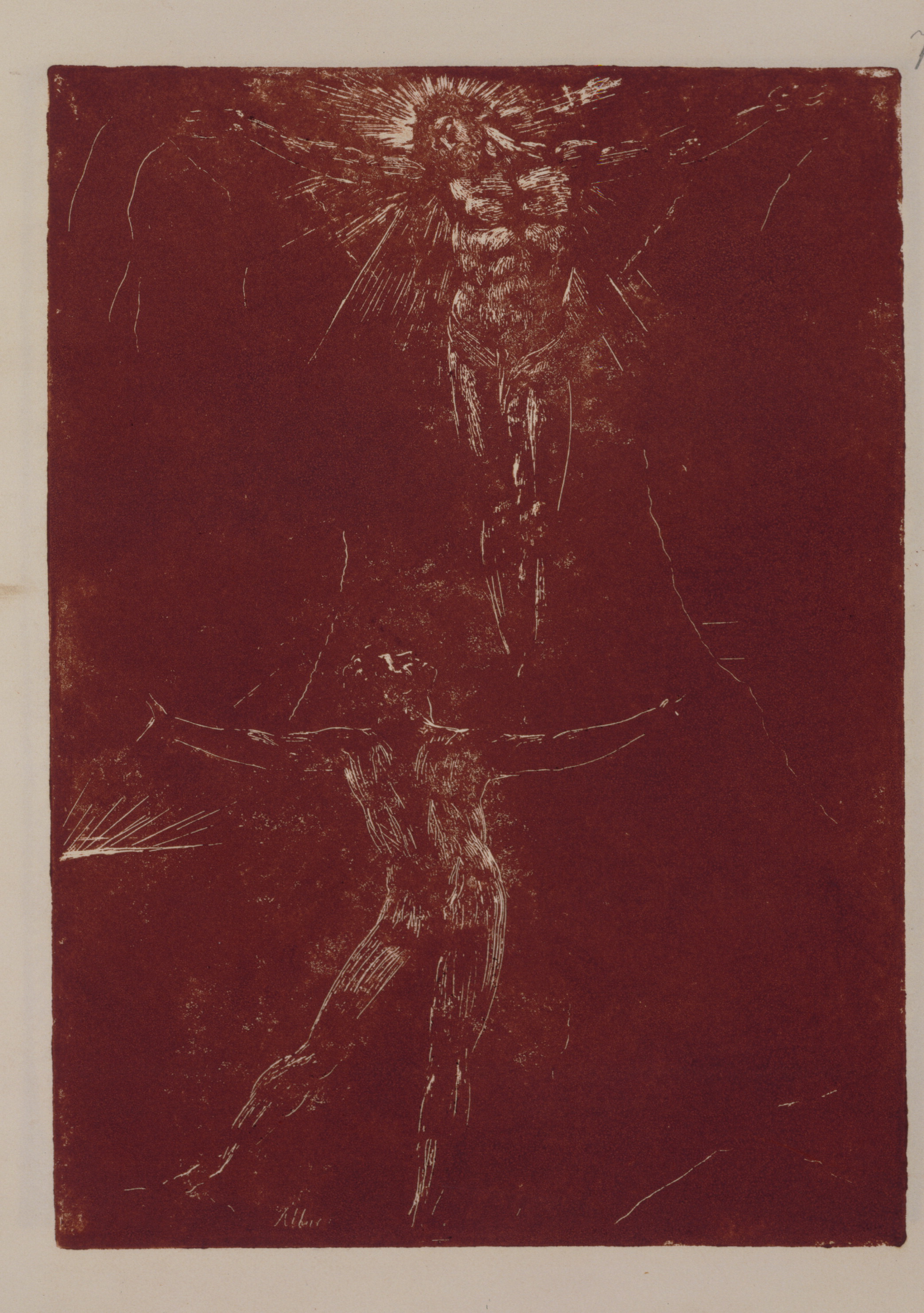
Library Of Congress
Jerusalem

Plate 76 
Continuing on page 28 Klonsky states:
"...Blake as an engraver also combined 'upper and lowers,' relief and intaglio, on copper plates that were etched and then printed in black and white. But which, relief or intaglio, was black, which white? He could, and did engrave them either way, sometimes using black line in relief, etching away the whites, as in the designs for Songs of Innocence, and sometimes using white line on black ground...as in the quicksilvery illustrations for Jerusalem. But the choice, in either case, was as much mystical as aesthetic. For Blake not only believed but also lived and enacted his ideas, reaffirming them within and without in each line he engraved."

Tuesday, November 27, 2012

BLAKE'S MESSAGE XI

June Singer offers us the insights of a Jungian psychoanalyst in her book The Unholy Bible, Blake, Jung and the Collective Unconscious. She recognises Blake's willingness to delve into the darker, more rejected aspects of the relationship of God and man. She explores the dissension man experiences internally as his psychological components struggle to gain dominance within the divided fallen individual. Singer believes that Blake demonstrated methods of bringing unconscious material into consciousness in order to integrate warring aspects into a cohesive whole.

Page 5

"But Blake's entire work might have been forgotten in the years after his death were it not for one poem in Songs of Experience in which the striking image achieved immediate popularity. Almost every English schoolchild knows it by heart, yet its implications stir the most sophisticated to ponder the mystery of the ultimate creative power."


The Tyger

Page 6
"The lasting and overwhelming response to this poem acknowledges the recognition of a central concept in Blake's work. This is the need to become aware of the other side of God, the side not accepted either by social agreement or by orthodox religious practice. Blake says that while he who made the Lamb is worshipped and praised  in all the churches, he who fashioned the Tyger to pierce the darkness of the tangled forest with his perceptive eye, is also God. God of the Lamb is worshipped at prescribed interval, but God of the Tyger is held in fear by day and night, for none may escape him when be pursues. Blake
wrote as though he felt that enough had been said about the symbol of gentleness which is traditionally associated with Jesus. He was more concerned with the fierce and the frightful which threatens innocence and light. And it follows that such a man would address himself boldly also to the darker area of man's life, which is hidden in shadow and must be invaded and explored if man is to approach any degree of self-awareness."  

Page 9
"Always there have been those who could experience these forces as
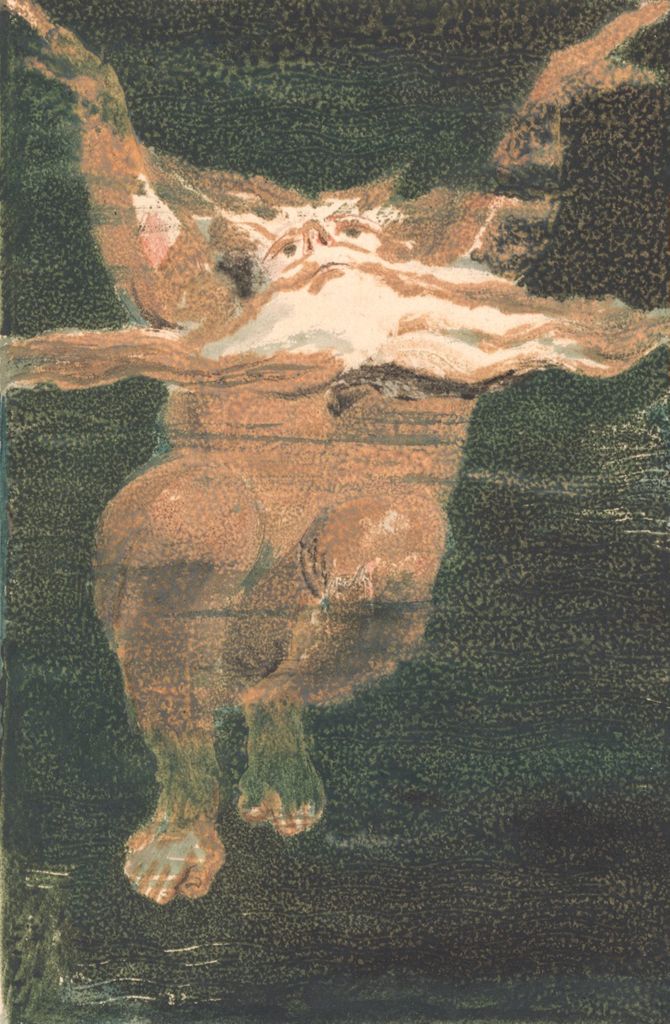
Yale Center for British Art 
Book of Urizen
Plate 5, copy C

tremendous
powers which might threaten to overwhelm them at certain times and at other times infuse them with a creative urge which would drive them to produce original ideas, works of art or new scientific concepts. Blake was fascinated by this extra dimension of psychic life and he felt impelled to write how it manifested in him. Without the detachment of the modern psychologist, he wrote of his own experience more as a participant than as an observer and yet the raw material of the inner drama is all there...Our position enables us to take a step away from Blake and to consider his writing as descriptive of the psychological processes that were going on in him. This is not to imply that those processes are basically different in kind from those which are going on in every man. It is only that, acting on his naive conviction that what he wrote was dictated by an unseen voice and that his paintings were no more the reproductions of what the inner eye had already perceived, Blake threw a brilliant light into a realm that for most men is sheathed in the darkness of disbelief."
.         

Sunday, November 25, 2012

BLAKE'S MESSAGE X

Michael Bedard in his biography of Blake for young people, sees the cycle of Blake's life following a path begun in the security of a happy childhood, and sustained by his confidence in divine guidance. Blake himself in The School Boy, one of the Songs of Experience, argues that the pleasures of a unrestricted childhood provide the foundation for weathering the storms of later life. The ability to hold on to the truth which is the heritage of the stage Blake called innocence provided the fortitude for him to continue his work through the darkest times.  
   
From page 144 of William Blake The Gates of Paradise by Michael Bedard:

"As in art, so in life. Blake's heart went out to the poor and the oppressed, those for whom life was an endless struggle. His own life had its share of bitter disappointment and heartbreak. He came to believe that struggle was the very essence of life, and his work is full of it. What separates Blake's story from many others is that he was sustained throughout his struggle by vision, a vision of unity and harmony and joy that he had tasted in his own life and saw in the the lives of children and the is lowly of the earth. If his life may be said to describe a pattern, it is the very pattern he saw operating in and through all things: a state of initial bliss, followed by a fall into darkness and strife, and then finally, a restoration to unity and peace.

It is the refrain of all his poetry and the sustaining vision of his life. In Songs of Innocence, he celebrated the vision of joy. In Songs of Experience and many of the books that followed, he sang of division, constraint, and darkness. Yet even in times of trouble, he kept the divine vision. He had known bliss, known darkness and strife. In the final years of his life, he would experience a return to the world of light, to the joys of friendship and creative fellowship, and the visionary company of children."

Songs of Innocence & of Experience, Song 53, (E 31)
Wikimedia
Songs of Innocence and of Experience
Plate 53
  
The School Boy 

"I love to rise in a summer morn,
When the birds sing on every tree;
The distant huntsman winds his horn,
And the sky-lark sings with me.
O! what sweet company. 

But to go to school in a summer morn,
O! it drives all joy away;
Under a cruel eye outworn,
The little ones spend the day,
In sighing and dismay.

Ah! then at times I drooping sit,
And spend many an anxious hour.
Nor in my book can I take delight,
Nor sit in learnings bower,
Worn thro' with the dreary shower. 
 
How can the bird that is born for joy,
Sit in a cage and sing.
How can a child when fears annoy,
But droop his tender wing,
And forget his youthful spring.

O! father & mother, if buds are nip'd,
And blossoms blown away,
And if the tender plants are strip'd
Of their joy in the springing day,
By sorrow and cares dismay, 

How shall the summer arise in joy.
Or the summer fruits appear,
Or how shall we gather what griefs destroy
Or bless the mellowing year,
When the blasts of winter appear." 

Friday, November 23, 2012

BLAKE'S MESSAGE IX

Kathleen Raine's studies of William Blake and his sources in the literature of the perennial philosophy were key to unlocking many of the symbols which abound in Blake's work. But her commitment to the thought of Blake did not end with presenting links in Blake to the traditional literature which was excluded by orthodox interpreters, she became with Blake a builder of Golgonnoza. She realised that his message of psychological/spiritual development should not be buried or hidden but was meant to be put to use in transforming individual psyches and the outer world which reflects inner realities.    

On page 4 of Golgonooza City of Imagination Raine calls Blake 'a patriot of the inner worlds' who wages the Mental Fight unceasing:

"Uncomprehended though he was, Blake was not, like Yeats, an esotericist. He addressed his prophetic message 'to the Public' and whether he would be understood he did not stop to question - his vision was, to him, clear beyond all doubt. He was a patriot of the inner worlds, of the England of the Imagination whose 'golden builders' he saw at work in the creation of Golgonooza the city within the brain
(golgos, skull), 'the spiritual fourfold London Eternal'. He saw his nation 'sunk in deadly sleep', victim of 'deadly dreams' of a materialism whose effects in all aspects of national life were destructive and sorrowful, wars, exploitation of human labour, sexual hypocrisy, a 'cruel' morality of condemnation and punitive laws, the denial and oppression of the soul's winged life."

Yale Center for British Art
Blake's Water-Colours for the  

The Poems of Thomas Gray
Milton, Plate 1, (E 95)
    "And did those feet in ancient time,
     Walk upon Englands mountains green:
     And was the holy Lamb of God,
     On Englands pleasant pastures seen!

     And did the Countenance Divine,             
     Shine forth upon our clouded hills?
     And was Jerusalem builded here,
     Among these dark Satanic Mills?

     Bring me my Bow of burning gold:
     Bring me my Arrows of desire:                     
     Bring me my Spear: O clouds unfold!
     Bring me my Chariot of fire!

     I will not cease from Mental Fight,
     Nor shall my Sword sleep in my hand:
     Till we have built Jerusalem,                     
     In Englands green & pleasant Land."
Milton, Plate 12,(E 155) 
"And they builded Golgonooza: terrible eternal labour!

What are those golden builders doing? where was the burying-place
Of soft Ethinthus? near Tyburns fatal Tree? is that
Mild Zions hills most ancient promontory; near mournful
Ever weeping Paddington? is that Calvary and Golgotha?
Becoming a building of pity and compassion? Lo!
The stones are pity, and the bricks, well wrought affections:    
Enameld with love & kindness, & the tiles engraven gold
Labour of merciful hands: the beams & rafters are forgiveness:
The mortar & cement of the work, tears of honesty: the nails,
And the screws & iron braces, are well wrought blandishments,
And well contrived words, firm fixing, never forgotten,         
Always comforting the remembrance: the floors, humility,
The cielings, devotion: the hearths, thanksgiving:
Prepare the furniture O Lambeth in thy pitying looms!
The curtains, woven tears & sighs, wrought into lovely forms
For comfort. there the secret furniture of Jerusalems chamber    
Is wrought: Lambeth! the Bride the Lambs Wife loveth thee:
Thou art one with her & knowest not of self in thy supreme joy.

Go on, builders in hope: tho Jerusalem wanders far away,
Without the gate of Los: among the dark Satanic wheels."

 Raine's understanding of Blake's efforts to foster the spiritual attributes underlying the city in which imagination dwells is expanded on page 107:
"The sole object of all the labours of Golgonnza, 'ever building ever falling', is to provide an earthly habitation for Jerusalem. It is ever in secrecy and obscurity, in human love, in every sense of that word, that foundations of the city are laid...Blake perfectly and eloquently expresses all he felt about what a human city is, in its inner essence, as a building of human souls each individually, and all collectively labouring to embody a vision whose realization will be only when all is done 'on earth as it is in heaven', according to the archetype of the human Imagination. Blake never presented the building of Jerusalem as the work of a few men or outstanding genius or 'originality', but rather of all the city's inhabitants, the 'golden builders.'"


First Corinthians 3

[9] For we are labourers together with God: ye are God's husbandry, ye are God's building.
[10] According to the grace of God which is given unto me, as a wise masterbuilder, I have laid the foundation, and another buildeth thereon. But let every man take heed how he buildeth thereupon.
[11] For other foundation can no man lay than that is laid, which is Jesus Christ.

Video
of Kathleen Raine on the imagination. 

.

Wednesday, November 21, 2012

BLAKE'S MESSAGE VIII

British Museum
Small Book of Designs
To George Wingfield Digby, Blake's message is incorporated in the symbolic style of creation which permeates his art and poetry. Without the language of symbols Blake's message could not be communicated because it originates in the depths of man's psyche. Blake intends for his reader to respond in his own imagination to the message generated by Blake's imagination.

Quote from Page 6 of Digby's
Symbol and Image in William Blake:

"But the purpose of this form of communication is not to make explicit statements. It is to evoke and direct attention to psychological events and states of consciousness by means other than that of the intellectual concept, which is rooted in dualism. Here, the meaning lies implicit in the symbol-image, as it does in any true work of art. Moreover, the pictorial image and the poetic image conveyed by the written word are complementary to one another; in different media they make evocative statements indicative of common meaning.


Now the image or symbol is not an inferior means of expression, nor is it largely subjective or arbitrary, as is far too generally regarded by art critics, art historians, and literary critics. On the contrary, the power of apprehending archetypal symbols and images springs from one of man's most precious faculties, his intuitive faculty. It is on this faculty, above all, that he must rely for perceiving the truth about actual living experience; man can never know the truth about himself, nor find in his relationships with the world that truth or reality which transcends them, unless he develops his power of intuition. The intuitive imagination, which works through symbols, is the very essence of art.


But because the image or symbol speaks not only to man's conscious, thinking side, but also to his unconscious, it is a difficult language. Many people shrink from it with misgiving and fear. Others are so attracted and overwhelmed by it that relationships with other forms of cognition are abandoned, and so a vital balance and sense of discrimination is lost. This language of archetypal symbols and images enlists and stirs both sides of man's nature; and because it speaks to the whole man with the many different voices of his complex being, it has to be experienced to be understood.


The implication of this is that we must first and foremost try to see and feel the living principles about which Blake is speaking in his art. This means that the image or symbol must be taken inside oneself and understood intuitively, for it is only in that way it comes to life. The aim of Blake's art is to open the inner world to all those who care to look. He has extraordinary things to show, because he himself saw so far, and so clearly; also because he could bear to look equally on the ugly, the pretty, the deformed and on the free and beautiful." 


Gates of Paradise, Frontispiece, (E 260)
"The Suns Light when he unfolds it
Depends on the Organ that beholds it"

Jerusalem, Plate 5, (E 147)
"Jerusalem is scatterd abroad like a cloud of smoke thro' non-entity:
Moab & Ammon & Amalek & Canaan & Egypt & Aram
Recieve her little-ones for sacrifices and the delights of cruelty   

Trembling I sit day and night, my friends are astonish'd at me.
Yet they forgive my wanderings, I rest not from my great task!
To open the Eternal Worlds, to open the immortal Eyes
Of Man inwards into the Worlds of Thought: into Eternity
Ever expanding in the Bosom of God. the Human Imagination        
O Saviour pour upon me thy Spirit of meekness & love:
Annihilate the Selfhood in me, be thou all my life!
Guide thou my hand which trembles exceedingly upon the rock of ages,
While I write of the building of Golgonooza, & of the terrors of Entuthon:
Of Hand & Hyle & Coban, of Kwantok, Peachey, Brereton, Slayd & Hutton:
Of the terrible sons & daughters of Albion. and their Generations." 
Thomas Cahill in Sailing the Wine Dark Sea demonstrates his method of using his intuition to gain access to the living past he wants to communicate:
"I tell you these things now because my methods of approaching the past have scarcely changed since childhood and adolescence. I assemble what pieces there are, contrast and compare, and try to remain in their presence till I can begin to see and hear what living men saw and heard and loved, till from these scraps and fragments living men and women begin to emerge and live and move again - and then I try to communicate these sensations to my reader...For me the historian's principle task should be to raise the dead to life."  

The technique of remaining in the presence of Blake's characters and ideas (or taking them into ourselves as Digby says) may yield a wealth of rewards. 

.

Monday, November 19, 2012

BLAKE'S MESSAGE VII

Library of Congress
Milton
Plate 45
John Middleton Murry emphasises the experience of annihilating the Selfhood through Forgiveness as essential to Blake's message. In his biography William Blake, Murry proposes that Blake's own struggles to forgive taught him the process of annihilating the Selfhood. 

Page 238
"Not therefore to annihilate Satan, but to forgive is the way. And Forgiveness is Self-annihilation. The Selfhood cannot exist in the condition of Forgiveness. Unless we understand that, we can understand nothing of Blake's message - nothing at all. It is the final and self-evident law of the spiritual life, and therefore, since the spiritual life is but a quintessence, the law of Life itself. Self-annihilation and Forgiveness are one. When Milton forgives Satan (who is Milton himself in his Selfhood) he can do it only by annihilating the yet more intimate and secret self that rises in him at the knowledge that Satan is himself. At the motion of Forgiveness, there rises in the Soul the sense that 'I forgive'. The Selfhood has found a new Tabernacle, 'a covering for him to do his will. This is the corruption of Forgiveness. 'I forgive is a lie. 'We are forgiven' is the truth. For Forgiveness is imaginative Love. It enters in and takes possession. It annihilates the Self. The Self cannot annihilate the Self. It is annihilated.  

Page 320
"At every crucial moment Blake faced the grim effort of relegating all that he was into the realm of the Selfhood, of thrusting all that was intimate and precious - soul of his soul - into the furnaces of Self-annihilation, in obedience to the command that 'all that can be annihilated must be annihilated'. And what he found unannihilable was the condition of Forgiveness, the experience of Eternity. No matter what he endured, in inward struggle or in disappointment at the hands of men, the Divine Humanity was renewed in him, and he in it. To him the Imagination was existence itself. This alone was real and unconsumable, the experience which gave to all other experiences their reality, and brought to him again and again confirmation of his simple unshakable knowledge that Time was the mercy of Eternity."

Jerusalem, Plate 34 [38], (E 179)
" but mild the Saviour follow'd him,
Displaying the Eternal Vision! the Divine Similitude!
In loves and tears of brothers, sisters, sons, fathers, and friends
Which if Man ceases to behold, he ceases to exist"
Milton, Plate 24 [26], (E 121)
"Los is by mortals nam'd Time Enitharmon is nam'd Space
But they depict him bald & aged who is in eternal youth
All powerful and his locks flourish like the brows of morning    
He is the Spirit of Prophecy the ever apparent Elias
Time is the mercy of Eternity; without Times swiftness
Which is the swiftest of all things: all were eternal torment:
All the Gods of the Kingdoms of Earth labour in Los's Halls.
Every one is a fallen Son of the Spirit of Prophecy             
He is the Fourth Zoa, that stood arou[n]d the Throne Divine." 
Songs and Ballads, (E 476)
"Till I turn from Female Love  
And root up the Infernal Grove 
I shall never worthy be   
To Step into Eternity
 
And to end thy cruel mocks
Annihilate thee on the rocks
And another form create
To be subservient to my Fate

Let us agree to give up Love
And root up the infernal grove                                 
Then shall we return & see
The worlds of happy Eternity

& Throughout all Eternity 
I forgive you you forgive me
As our dear Redeemer said                                   
This the Wine & this the Bread"
. 

Saturday, November 17, 2012

BLAKE'S MESSAGE VI

Milton Percival sees the high value Blake places on the imagination as crucial to his message. Through using the imagination as the essential ingredient of his writing, artistic productions and living,  Blake wove inner and outer, mental and physical, spirit and body into a single production of Eternity. 

On page 286 of William Blake's Circle of Destiny we read:

"When will this mortal world put on immortality? Only when the selfhood puts on imagination.


Meanwhile, the world being what it is, Blake adopted a way of life which many seekers of the good life in a bad world have adopted - the life of art. In this field of activity there is less selfish interference with another, more indulgence of the creative impulse and of the individuality than in any other. And in this way of life what Blake called 'mortal contingencies' can be disregarded, as Mrs Blake well knew. In the Laocoon inscriptions art is put forward as the one and only good way of life; all other ways and all hindrances to that way are disparaged. But the term 'art' is used in its esoteric sense, for Blake declares that Christ and his disciples were all artists. The logical justification of this assertion, if there is one, is that they directed their energies to imaginative ends. But it will not do to overemphasize a group of aphorisms inscribed upon a single plate. Blake is not an esthete. Los, the hero of the prophetic books, who is the real Blake, is not an artist except in the esoteric Blakean sense. He is the very center of the fray, hammering upon his anvil with the energy of Thor himself, breaking down the sterile forms which represent every phase of human activity, breaking them down in the hope of bringing the separated principles together in a fruitful union. He is Blake's dramatization of the good life, lived from within, lived energetically, devoted in all its variety to imaginative ends." 


Milton, Plate 25 [27], (E 121) 
"Loud shout the Sons of Luvah, at the Wine-presses as Los descended
With Rintrah & Palamabron in his fires of resistless fury.

The Wine-press on the Rhine groans loud, but all its central beams
Act more terrific in the central Cities of the Nations
Where Human Thought is crushd beneath the iron hand of Power.    
There Los puts all into the Press, the Opressor & the Opressed
Together, ripe for the Harvest & Vintage & ready for the Loom.

They sang at the Vintage. This is the Last Vintage! & Seed
Shall no more be sown upon Earth, till all the Vintage is over
And all gatherd in, till the Plow has passd over the Nations     
And the Harrow & heavy thundering Roller upon the mountains

And loud the Souls howl round the Porches of Golgonooza
Crying O God deliver us to the Heavens or to the Earths,
That we may preach righteousness & punish the sinner with death
But Los refused, till all the Vintage of Earth was gatherd in.  

And Los stood & cried to the Labourers of the Vintage in voice of awe.

Fellow Labourers! The Great Vintage & Harvest is now upon Earth
The whole extent of the Globe is explored: Every scatterd Atom
Of Human Intellect now is flocking to the sound of the Trumpet
All the Wisdom which was hidden in caves & dens, from ancient    
Time; is now sought out from Animal & Vegetable & Mineral

The Awakener is come. outstretchd over Europe! the Vision of God is fulfilled
The Ancient Man upon the Rock of Albion Awakes,"
 
British Museum
Illustrations to Young's Night Thoughts
When Blake says 'The Awakener is come. outstretchd over Europe! the Vision of God is fulfilled' he indicates an accomplishment not in the past or in the future but in the ever present now; the moment when the 'poets work is done'. Becoming a labourer in the Vintage means exercising ones imagination to link oneself with the eternal, invisible world which intersects with our world of time and space between two beats of the artery.

 
Milton, Plate 29 [31], (E 127)  
"For in this Period the Poets Work is Done: and all the Great
Events of Time start forth & are concievd in such a Period
Within a Moment: a Pulsation of the Artery."
 
Percival views Blake's message optimistically:
"It is Blake's faith as a mystic that Los must eventually triumph. It is not man's destiny to remain forever as he is. Out of endless folly, wisdom must at last be born. Out of the long succession of generative froms, regeneration must a last emerge."  Page 289

.