Blake seeks to provide the Golden String which can lead us through the labyrinth of our experience or his own poetry.

Monday, April 6, 2015

HYMN OF CHRIST

Giclee Prints from Private Collection
Hymn of Christ and the Apostles
1805
Only one incident of hymn singing is recorded in the Gospels. Following the Last Supper Jesus and his disciples sang a hymn before they proceeded to the mount of Olives and the Garden of Gethsemane. Blake pictures two female and four male musicians with Jesus. Judging from the expressions on the faces, each is feeling the sadness occasioned by Jesus's announcement that he expects to be betrayed by one of the twelve disciples. None of his followers is able to understand why Jesus has offered his Body and Blood as he passed the bread and wine. The hymn is a pause between the celebration of the Passover and the drama of the arrest, trial and condemnation of Jesus.

Mark 14 
[22] And as they did eat, Jesus took bread, and blessed, and brake it, and gave to them, and said, Take, eat: this is my body. 
[23] And he took the cup, and when he had given thanks, he gave it to them: and they all drank of it. 
[24] And he said unto them, This is my blood of the new testament, which is shed for many. 
[25] Verily I say unto you, I will drink no more of the fruit of the vine, until that day that I drink it new in the kingdom of God. 
[26] And when they had sung an hymn, they went out into the mount of Olives. [27] And Jesus saith unto them, All ye shall be offended because of me this night: for it is written, I will smite the shepherd, and the sheep shall be scattered. 
[28] But after that I am risen, I will go before you into Galilee.

In the Four Zoas Blake wrote a transitional passage in which music is the metaphor for preparation for the birth of Orc. Blake echoed the interlude of music which introduced the ordeal which Jesus faced as Orc became dominant in his myth.  Orc, the generate form of Luvah, released repressed sexuality and violence as Urizen was 'bound in chains.' There is a pause in the Four Zoas as there is in the Gospel of Mark before the destructive forces take sway. 

Four Zoas, Night V, Page 57, (E 339)
"Los from the furnaces a Space immense & left the cold           
Prince of Light bound in chains of intellect among the furnaces
But all the furnaces were out & the bellows had ceast to blow

He stood trembling & Enitharmon clung around his knees
Their senses unexpansive in one stedfast bulk remain
The night blew cold & Enitharmon shriekd on the dismal wind      
PAGE 58 
Her pale hands cling around her husband & over her weak head
Shadows of Eternal death sit in the leaden air

But the soft pipe the flute the viol organ harp & cymbal
And the sweet sound of silver voices calm the weary couch
Of Enitharmon but her groans drown the immortal harps           
Loud & more loud the living music floats upon the air
Faint & more faint the daylight wanes. The wheels of turning darkness
Began in solemn revolutions. Earth convulsd with rending pangs
Rockd to & fro & cried sore at the groans of Enitharmon  
Still the faint harps & silver voices calm the weary couch      
But from the caves of deepest night ascending in clouds of mist
The winter spread his wide black wings across from pole to pole
Grim frost beneath & terrible snow linkd in a marriage chain
Began a dismal dance. The winds around on pointed rocks
Settled like bats innumerable ready to fly abroad            
The groans of Enitharmon shake the skies the labring Earth
Till from her heart rending his way a terrible Child sprang forth
In thunder smoke & sullen flames & howlings & fury & blood

Soon as his burning Eyes were opend on the Abyss
The horrid trumpets of the deep bellowd with bitter blasts      
The Enormous Demons woke & howld around the new born king    
Crying Luvah King of Love thou art the King of rage & death
Urizen cast deep darkness round him raging Luvah pourd       
The spears of Urizen from Chariots round the Eternal tent
Discord began then yells & cries shook the wide firma[m]ent" 
. 

Saturday, April 4, 2015

CHRIST BAPTISING

Philadelphia Museum
Christ Baptising
1805


Like the picture of Christ Entering Jerusalem, this picture of Christ Baptising is full of incongruities. We see the interior of a fine church with an ornate baptismal font. The baptism of the infant is performed by Jesus as a dove hovers over his head. The children surrounding Jesus appear as diminutive adults.

Rather than representing a particular scene, Blake has represented the concept of baptism by assembling aspects of multiple events involving baptism. The title refers to the passage in the gospel of John in which Jesus and his disciples entered the land of Judea and baptized people as did John. The descent of the dove takes us back to Jesus's own baptism by John following which the Holy Spirit descended upon him like a dove. The scene inside a church can be associated with the baptism of William Blake as an infant. The window in the wall behind Jesus indicates the portal between the natural world and the Eternal world which is opened by baptism     

John 3
[22] After this Jesus and his disciples went into the land of Judea; there he remained with them and baptized.
[23] John also was baptizing at Ae'non near Salim, because there was much water there; and people came and were baptized.
[24] For John had not yet been put in prison.
[25] Now a discussion arose between John's disciples and a Jew over purifying.
[26] And they came to John, and said to him, "Rabbi, he who was with you beyond the Jordan, to whom you bore witness, here he is, baptizing, and all are going to him."
[27] John answered, "No one can receive anything except what is given him from heaven.
[28] You yourselves bear me witness, that I said, I am not the Christ, but I have been sent before him.

The infant William Blake was baptised in a prominent church of the Church of England. Knowing Blake's background as a dissenter and his aversion to religious ritual, one might find the manner of his baptism surprising. St James Piccadilly was a large church. The were seven infants baptised at the service on Dec 11, 1757 when the two week old William was baptised. The elaborate font pictured in Christ Baptising is far less ornate than the font in which he was baptised. 
 
Design of Last Judgment, to Osias Humphery, (E 553)
 " On the Right hand of the Throne of Christ is Baptism On
the left is the Lords Supper the two introducers
into Eternal Life Women with Infants approach the Figure of an
aged Apostle which represents
Baptism & on the left hand the Lords Supper is administerd by
Angels from the hands of another Apostle these
kneel on each side of the Throne which is surrounded by a Glory
many Infants appear in the Glory
representing the Eternal Creation flowing from the Divine
Humanity in Jesus who opens the Scroll of Judgment upon his knees
before the Living & the Dead
     Such is the Design which you my Dear Sir have been the cause
of my producing & which but for you might have slept till the
Last Judgment"

Vision of Last Judgment, (E 561)
"He is the Bread & the Wine he is the Water of
Life accordingly on Each Side of the opening Heaven appears an
Apostle that on the Right 
Represents Baptism that on the Left Represents the Lords Supper
All Life consists of these Two Throwing off Error & Knaves from
our company continually & recieving Truth or Wise Men into our
Company Continually."

Thursday, April 2, 2015

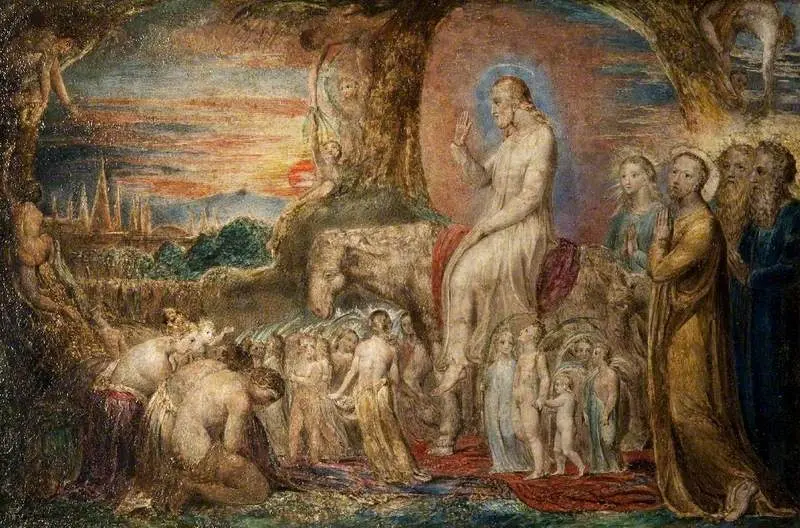
ENTRY INTO JERUSALEM

Arthive.com 
Christ's Entry into Jerusalem
1800
This image by Blake painted in oil on copper for Thomas Butts is out of the ordinary even for Blake. The subject of Jesus entering Jerusalem on Palm Sunday receives a distinctive treatment. Jesus and his party of disciples enjoy a conventional treatment although they display the elongated bodies and reduced sized heads which Blake adopted for a period of time. The crowd gathered around Jesus are definitely unconventional since they are in various degrees of undress. The contrasting sizes of the various figures leads to a confusion of scale and perspective.
 
The 'window' through which Jerusalem is visible is framed by trees which are being climbed by figures of individuals attempting to reach a higher level. Jerusalem is not pictured as the earthly city of Jesus's day but as the heavenly Jerusalem of the vision of John of Patmos.
 
During the period when Blake was reevaluating Classical thought as an influence on his myth and prophecy, he seems to have reconsidered the neoclassical style of art which he had adopted in much of his work. Neoclassicism gained prominence with the enlightenment; Blake looked to replace them both. This picture owes much to Mannerism, a style of the 16th century. According to this National Gallery website Mannerism demonstrated that "excellence in painting demanded refinement, richness of invention, and virtuoso technique, criteria that emphasized the artist’s intellect." Blake found that this technique allowed him to use his intellect and inventiveness to stimulated a fresh view of a Biblical scene which could be opened to vision.

Four Zoas, Night IX, Page 122, (E 391)
"The times revolve the time is coming when all these delights
Shall be renewd & all these Elements that now consume            
Shall reflourish. Then bright Ahania shall awake from death
A glorious Vision to thine Eyes a Self renewing Vision  
The spring. the summer to be thine then Sleep the wintry days
In silken garments spun by her own hands against her funeral
The winter thou shalt plow & lay thy stores into thy barns       
Expecting to recieve Ahania in the spring with joy
Immortal thou. Regenerate She & all the lovely Sex
From her shall learn obedience & prepare for a wintry grave
That spring may see them rise in tenfold joy & sweet delight
Thus shall the male & female live the life of Eternity           
Because the Lamb of God Creates himself a bride & wife
That we his Children evermore may live in Jerusalem
Which now descendeth out of heaven a City yet a Woman
Mother of myriads redeemd & born in her spiritual palaces
By a New Spiritual birth Regenerated from Death" 
. 

Tuesday, March 31, 2015

HUMAN IMAGINATION

Kathleen Raine's segment in the book Jungian Literary Criticism edited by Richard P. Sugg, was written as she looked back on a long and productive life of studying and writing. She acknowledges that her study of Blake was enhanced by the insights developed by Jung's psychology. Her chapter, beginning on Page 167, points out several similarities between the thought of Blake and Jung. As a Blake scholar she titles her article: C. G. Jung: A Debt Acknowledged.

Illustrations to Poems of Thomas Gray
Raine:
"In  retrospect I realize that the shortcoming of my own work on Blake - the tracing of the many sources within the excluded tradition which I have called "the learning of the Imagination" - was that which is inherent in all modern scholarship I did not experience and explore that world imaginatively, as Blake did, and as Jung did, but in terms of academic 'history of ideas' and 'sources' and 'influences': in exploring the writings of Jakob Boehme, the Neoplatonists, alchemists, and the rest, I didn't enter those regions of the imagination as these were inhabited and explored by cabbalists, mystics, and visionaries themselves. True, I wrote of these with the assumption that their view of reality was really the truth itself, not an old cosmology superseded by modern science. These were regions of knowledge likely to be rediscovered with the change of premises now taking place in the West, belatedly and uneasily awakening from three centuries of domination by materialist ideologies. I was even impassioned in my advocacy of the universe of thought opening before me with every volume I studied in those happy days in the North Library, but I made little effort to live my thought. Certainly I made interesting and useful discoveries of some of Blake's sources - mainly Neoplatonic - and insofar a I did, uncovered affinities with regions of experience - I will not say 'schools of thought,' for the affinities are of a deeper and a different kind from what is comprised under the term 'history of ideas' - neglected by orthodoxy.
...
In such inner explorations I was only intermittently and superficially engaged. But Jung understood 'knowledge' - as Boehme and Blake and all mystics, cabbalists, Gnostics, holy men, and indeed true poets and musicians, and all who enter into the realms of the imagination - as the thing itself and not book-learning about those living regions. Jung placed in our hands the key that leads into Blake's 'bosom of God, the Human Imagination.' But many continue to read books and to write them about these realities rather than confronting them and themselves venturing into those regions that Jung, like Blake, invites us to explore. My own work on 'sources' and affinities, whatever its value to students, was no more than a signpost to those seeking that reality itself.
...
The transforming influence on Western Civilization of Christendom has been wonderful indeed, and the flowering of the arts that accompanied the Christian vision testifies to the reality of the vision itself. But being myself in my eightieth year, neither 'art or 'religion' any longer concerns me as ends in themselves but, like the images of dreams, I see them as traces of the passage of the sacred reality itself - of 'Thought's eternal flight.' [Shelley]
Page 176

Jerusalem, Plate 5, (E 147)
"Trembling I sit day and night, my friends are astonish'd at me.
Yet they forgive my wanderings, I rest not from my great task!
To open the Eternal Worlds, to open the immortal Eyes
Of Man inwards into the Worlds of Thought: into Eternity
Ever expanding in the Bosom of God. the Human Imagination        
O Saviour pour upon me thy Spirit of meekness & love:
Annihilate the Selfhood in me, be thou all my life!
Guide thou my hand which trembles exceedingly upon the rock of ages,
While I write of the building of Golgonooza, & of the terrors of Entuthon:
Of Hand & Hyle & Coban, of Kwantok, Peachey, Brereton, Slayd & Hutton:
Of the terrible sons & daughters of Albion. and their Generations."
 
Jerusalem, Plate 98, (E 258)
"every Word & Every Character
Was Human according to the Expansion or Contraction, the Translucence or
Opakeness of Nervous fibres such was the variation of Time & Space
Which vary according as the Organs of Perception vary & they walked
To & fro in Eternity as One Man reflecting each in each & clearly seen
And seeing: according to fitness & order. And I heard Jehovah speak 
Terrific from his Holy Place & saw the Words of the Mutual Covenant Divine
On Chariots of gold & jewels with Living Creatures starry & flaming
With every Colour, Lion, Tyger, Horse, Elephant, Eagle Dove, Fly, Worm,
And the all wondrous Serpent clothed in gems & rich array Humanize
In the Forgiveness of Sins according to the Covenant of Jehovah."
 
Vision of Last Judgment,(E 560)
"If the Spectator could Enter into these Images in his
Imagination approaching them on the Fiery Chariot of his
Contemplative Thought if he could Enter into Noahs Rainbow or
into his bosom or could make a Friend & Companion of one of these
Images of wonder which always intreats him to leave mortal things
as he must know then would he arise from his Grave then would he
meet the Lord in the Air & then he would be happy" 
 
With Illustrations to Gray's Poems, (E 483)  
"To Mrs Ann Flaxman                    
A little Flower grew in a lonely Vale
Its form was lovely but its colours. pale
One standing in the Porches of the Sun
When his Meridian Glories were begun
Leapd from the steps of fire & on the grass      
Alighted where this little flower was
With hands divine he movd the gentle Sod
And took the Flower up in its native Clod
Then planting it upon a Mountains brow
'Tis your own fault if you dont flourish now     

                           WILLIAM BLAKE"  
.

Sunday, March 29, 2015

HOMER'S POETRY

Imagination in the mental realm, and art in the physical realm occupied the pinnacle of human aspiration in the view of Blake. He felt that the finest minds should be devoted to producing works which elevate humanity to achieving the maximum of his potential development. It disturbed Blake that some of the artists and authors who had received the greatest gifts for expressing themselves, had devoted their talents to lesser enterprises. Blake undoubtedly admired Homer but he missed in Homer the ability to be a vehicle through whom God spoke as he spoke through Old and New Testament prophets.
 
The substance for Blake was the dynamic of bringing together of portions of the psyche which had been divided. War is not only outward conflict, but also the unresolved divisions within the mind. If the Greeks elevated war as the appropriate way to resolve conflicting interests, they led mankind to a lower level of consciousness. The higher consciousness draws man into a vision of completeness within himself and with his brother who appears to be different. 
 
Blake showed in the Arlington Tempera the teaching of Homer which was most compatible to his own thinking. It shows how mankind progresses by going through a cycle of falling asleep as he forgets higher truth, and awakening after having learned through experiencing the world of matter. Progress is not made by defeating an enemy but by finding within oneself the ability to incorporate the not-self into the self.

Wikimedia Commons
This freestanding plate was engraved in 1822 the year after Blake painted the Arlington Tempera. Blake withheld unqualified admiration from Homer and Virgil because they did not reject aspects of their cultures which perpetrated war and empire.
ON HOMERS POETRY, (E 269)
"Every Poem must necessarily be a perfect Unity, but why Homers is
peculiarly so, I cannot tell: he has told the story of
Bellerophon & omitted the judgment of Paris which is not only a
part, but a principal part of Homers subject
  But when a Work has Unity it is as much in a Part as in the
Whole. the Torso is as much a Unity as the Laocoon
  As Unity is the cloke of folly so Goodness is the cloke of
knavery  Those who will have Unity exclusively in Homer come out
with a Moral like a sting in the tail: Aristotle says Characters
are either Good or Bad: now Goodness or Badness has nothing to do
with Character. an Apple tree a Pear tree a Horse a Lion, are
Characters but a Good Apple tree or a Bad, is an Apple tree
still: a Horse is not more a Lion for being a Bad Horse. that is
its Character; its Goodness or Badness is another consideration.
  It is the same with the Moral of a whole Poem as with the Moral Goodness
of its parts Unity & Morality, are secondary considerations &
belong to Philosophy & not to Poetry, to Exception & not to Rule,
to Accident & not to Substance. the Ancients calld it eating of
the tree of good & evil.
  The Classics, it is the Classics! & not Goths nor Monks, that
Desolate Europe with Wars.                                                            

ON VIRGIL                                      
Sacred Truth has pronounced that Greece & Rome as Babylon &
Egypt: so far from being parents of Arts & Sciences as they
pretend: were destroyers of all Art.  Homer Virgil & Ovid confirm
this opinion & make us reverence The Word of God, the only light
of antiquity that remains unperverted by War.  Virgil in the
Eneid Book VI. line 848 says Let others study Art: Rome has
somewhat better to do, namely War & Dominion
  Rome & Greece swept Art into their maw & destroyd it     a
Warlike State never can produce Art.  It will Rob & Plunder &
accumulate into one place, & Translate & Copy & Buy & Sell &
Criticise, but not Make.
  Mathematic Form is Eternal in the Reasoning Memory.  Living
Form is Eternal Existence.
  Grecian is Mathematic Form
  Gothic is Living Form" 
Our blog has 23 posts labeled Arlington Tempera. Here is one which may shed some light. 
.

Thursday, March 26, 2015

ANCIENT MODELS

Blake's attitude toward Greek and Roman literature and culture was ambivalent. Kathleen Raine tells us in Blake and Antiquity:
"The first evidence of Blake's reading of Porphyry appears in the Book of Thel, written in 1787, thirty -two years before he painted the Arlington Tempera... But once Blake had set his soul to study in a learned school, with Thomas Taylor and the Platonic philosophers, he quickly became master of a coherent symbolic system which he handled with ever-increasing scope and freedom.
 
Not only did neo-Platonism give him a vocabulary and grammar of symbolic terms; it placed him in the mainstream of European poetic and pictorial symbolism. From his reading of Porphyry and Plotinus he came to recognize in the works of poets already known to him the same symbols, endlessly recreated and re-clothed in beautiful forms. Thus he was able to extend his field of allusion and to introduce themes and images taken from many sources, without destroying the unity of his symbolic structure." (Page 17)
Illustrations to Pilgrim's Progress
Christian and Hopeful Escape Giant Despair

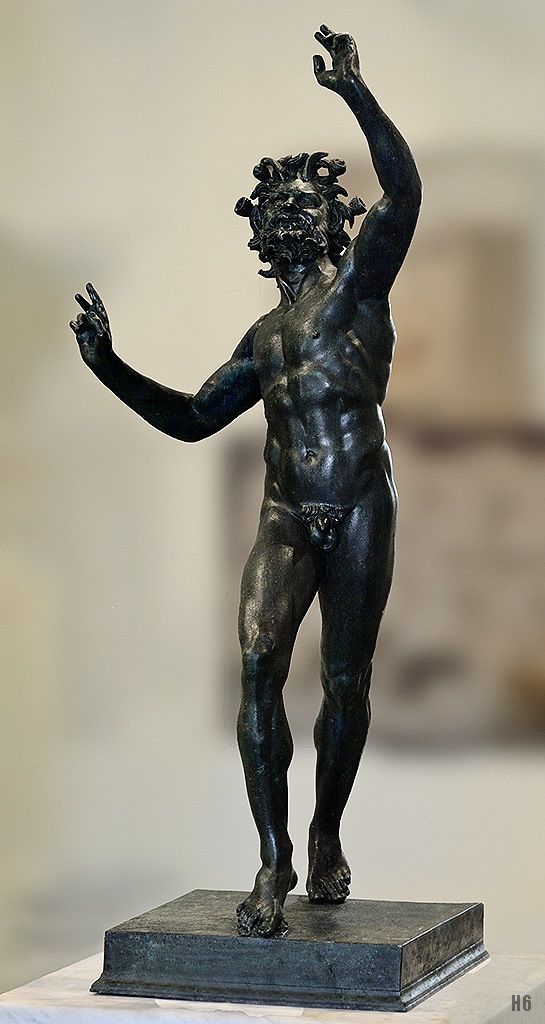
In 1809, describing his large painting of the Ancient Britons which was included his Exhibition at his brother's shop, Blake indicates that his three principle figures are recreations of characters portrayed by the ancients. Although the painting to which Blake referred is lost, we can see how Blake portrayed Apollo, Hercules and the Dancing Fawn by looking at images from antiquity. He referred back to portrayals of Greek gods with which he was familiar and later he projected forward when illustrating authors whom he admired.

Blake sees the characters who people myths as archetypal. His aim is to represent the same archetypal truth which the masters of antiquity displayed. When he places images from the pictorial vocabulary of Greece in his illustrations to Milton's Ode on the Morning of Christ's Nativity, illustrations to Bunyan's Pilgrim's Progress or to Shakespeare's Midsummer Night's Dream, he connects his reader/viewer to a more complete context. However Blake's attitudes to the values demonstrated by the Greek gods and heroes changed over time: his Dancing Fawn (as Puck) doesn't resemble the Ugly Man he described in his Catalogue; his Hercules (as the Giant Despair) is not the Strong Man of his earlier description.

Descriptive Catalogue, (E 544)
 "His opinions, who does not see spiritual agency, is
not worth any man's reading; he who rejects a fact because it is
improbable, must reject all History and retain doubts only.
  It has been said to the Artist, take the Apollo for the
model of your beautiful Man and the Hercules for your strong Man,
and the Dancing Fawn for your Ugly Man.  Now he comes to his
trial.  He knows that what he does is not inferior to the
grandest Antiques.  Superior they cannot be, for human power
cannot go beyond either what he does, or what they have done, it
is the gift of God, it is inspiration and vision.  He had
resolved to emulate those precious remains of antiquity,
he has done so and the result you behold; his ideas of strength
and beauty have not been greatly different.  Poetry as it exists
now on earth, in the various remains of ancient authors, Music as
it exists in old tunes or melodies, Painting and Sculpture as it
exists in the remains of Antiquity and in the works of more
modern genius, is Inspiration, and cannot be surpassed; it is
perfect and eternal.  Milton, Shakspeare, Michael Angelo, Rafael,
the finest specimens of Ancient Sculpture and Painting, and
Architecture, Gothic, Grecian, Hindoo and Egyptian, are the
extent of the human mind.  The human mind cannot go beyond the
gift of God, the Holy Ghost.  To suppose that Art can go beyond
the finest specimens of Art that are now in the world, is not
knowing what Art is; it is being blind to the gifts of the
spirit.
  It will be necessary for the Painter to say
something concerning his ideas of Beauty, Strength and Ugliness.
  The Beauty that is annexed and appended to folly, is a
lamentable accident and error of the mortal and perishing life;
it does but seldom happen; but with this unnatural mixture the
sublime Artist can have nothing to do; it is fit for the
burlesque.  The Beauty proper for sublime art, is lineaments, or
forms and features that are capable of being the receptacles of
intellect; accordingly the Painter has given in his beautiful
man, his own idea of intellectual Beauty.  The face and limbs
that deviates or alters least, from infancy to old age, is the
face and limbs of greatest Beauty and perfection.
  The Ugly likewise, when accompanied and annexed to
imbecility and disease, is a subject for burlesque and not for
historical grandeur; the Artist has imagined his Ugly man; one 
approaching to the
beast in features and form, his forehead small, without frontals; 
his jaws large; his nose high on the ridge, and narrow; his chest 
and the stamina of his make, comparatively little, and his joints 
and his extremities large; his eyes with scarce any whites, 
narrow and cunning, and every thing tending toward what is truly 
Ugly; the incapability of intellect.
  The Artist has considered his strong Man as a receptacle of
Wisdom, a sublime energizer; his features and limbs do not
spindle out into length, without strength, nor are they too large
and unwieldy for his brain and bosom.  Strength consists in
accumulation of power to the principal seat, and from thence a
regular gradation and subordination; strength is compactness, not
extent nor bulk.
  The strong Man acts from conscious superiority, and marches
on in fearless dependance on the divine decrees, raging with the
inspirations of a prophetic mind.  The Beautiful Man acts
from duty, and anxious solicitude for the fates of those for whom
he combats.  The Ugly Man acts from love of carnage, and delight
in the savage barbarities of war, rushing with sportive 
precipitation into the very teeth of the affrighted enemy.
  The Roman Soldiers rolled together in a heap before them:
"Like the rolling thing before the whirlwind;" each shew a
different character, and a different expression of fear, or
revenge, or envy, or blank horror, or amazement, or devout wonder
and unresisting awe.
  The dead and the dying, Britons naked, mingled with armed
Romans, strew the field beneath.  Among these, the last of the
Bards who were capable of attending warlike deeds, is seen
falling, outstretched among the dead and the dying; singing to
his harp in the pains of death."
. 

Tuesday, March 24, 2015

BEAUTIFUL FEET

Recently we heard a friend sing How Beautiful are the Feet from Handel's Messiah. The text is drawn from Isaiah 52 and Romans 10. Handel's text is: "How beautiful are the feet of them that preach the gospel of peace, and bring glad tidings of good things!"
 

Isaiah 52
[1] Awake, awake; put on thy strength, O Zion; put on thy beautiful garments, O Jerusalem, the holy city: for henceforth there shall no more come into thee the uncircumcised and the unclean.
[2] Shake thyself from the dust; arise, and sit down, O Jerusalem: loose thyself from the bands of thy neck, O captive daughter of Zion.
[3] For thus saith the LORD, Ye have sold yourselves for nought; and ye shall be redeemed without money.
[4] For thus saith the Lord GOD, My people went down aforetime into Egypt to sojourn there; and the Assyrian oppressed them without cause.
[5] Now therefore, what have I here, saith the LORD, that my people is taken away for nought? they that rule over them make them to howl, saith the LORD; and my name continually every day is blasphemed.
[6] Therefore my people shall know my name: therefore they shall know in that day that I am he that doth speak: behold, it is I.
[7] How beautiful upon the mountains are the feet of him that bringeth good tidings, that publisheth peace; that bringeth good tidings of good, that publisheth salvation; that saith unto Zion, Thy God reigneth!
[8] Thy watchmen shall lift up the voice; with the voice together shall they sing: for they shall see eye to eye, when the LORD shall bring again Zion.
[9] Break forth into joy, sing together, ye waste places of Jerusalem: for the LORD hath comforted his people, he hath redeemed Jerusalem.
 

Romans 10
[14] How then shall they call on him in whom they have not believed? and how shall they believe in him of whom they have not heard? and how shall they hear without a preacher?
[15] And how shall they preach, except they be sent? as it is written, How beautiful are the feet of them that preach the gospel of peace, and bring glad tidings of good things!
[16] But they have not all obeyed the gospel. For Esaias saith, Lord, who hath believed our report?
[17] So then faith cometh by hearing, and hearing by the word of God.

British Museum
  Songs of Innocence and of Experience
Plate 2, Copy A

These biblical passages would have carried great significance for Blake as he developed the themes which are prominent in them in his own poetry. Notice that Isaiah speaks of Jerusalem as a city and a woman just as Blake does. Blake seems to have associated the feet mentioned in these passages with the good tidings themselves and with the word of God which became known through the gospel of peace.
 

Blake often uses hands and feet to symbolize conditions which would exist if man were able to see the Divine Vision and place himself in service to the Lord. Like the prophet Isaiah and the Apostle Paul, he sees the feet as instruments which allow man to enact in the world the compassionate love which he may feel in his heart, know in his mind and experience as a presence.
 

It would be difficult not to notice that Blake uses feet as visual symbols as well. Rarely does he picture shoes even when his figures are wearing other garments. We get the impression that the Human Form Divine requires the inclusion of naked feet to represent it: feet on which to travel; feet on which man, like his Lord, may walk for a while touching this earth.    
Marriage of Heaven & Hell, Plate 10, (E 37)
"The head Sublime, the heart Pathos, the genitals Beauty, the
     hands & feet Proportion." 

Milton, Plate 1, (E 96)
"We do not 
want either Greek or Roman Models if we are but just & true to
our own Imaginations, those Worlds of Eternity in which we shall
live for ever; in Jesus our Lord.

     And did those feet in ancient time,
     Walk upon Englands mountains green:
     And was the holy Lamb of God,
     On Englands pleasant pastures seen!

     And did the Countenance Divine,             
     Shine forth upon our clouded hills?
     And was Jerusalem builded here,
     Among these dark Satanic Mills?

     Bring me my Bow of burning gold:
     Bring me my Arrows of desire:                      
     Bring me my Spear: O clouds unfold!
     Bring me my Chariot of fire!

     I will not cease from Mental Fight,
     Nor shall my Sword sleep in my hand:
     Till we have built Jerusalem,                     
     In Englands green & pleasant Land."

Jerusalem, Plate 24, (E 170)
"Yet thou wast lovely as the summer cloud upon my hills
When Jerusalem was thy hearts desire in times of youth & love.
Thy Sons came to Jerusalem with gifts, she sent them away
With blessings on their hands & on their feet, blessings of gold,
And pearl & diamond: thy Daughters sang in her Courts:           
They came up to Jerusalem; they walked before Albion
In the Exchanges of London every Nation walkd
And London walkd in every Nation mutual in love & harmony
Albion coverd the whole Earth, England encompassd the Nations,
Mutual each within others bosom in Visions of Regeneration;      
Jerusalem coverd the Atlantic Mountains & the Erythrean,
From bright Japan & China to Hesperia France & England.
Mount Zion lifted his head in every Nation under heaven:
And the Mount of Olives was beheld over the whole Earth:
The footsteps of the Lamb of God were there: but now no more     
No more shall I behold him, he is closd in Luvahs Sepulcher."

Jerusalem, Plate 27, (E 173)
"O Jesus still the Form was thine.      

  And thine the Human Face & thine
The Human Hands & Feet & Breath
  Entering thro' the Gates of Birth
And passing thro' the Gates of Death"
.