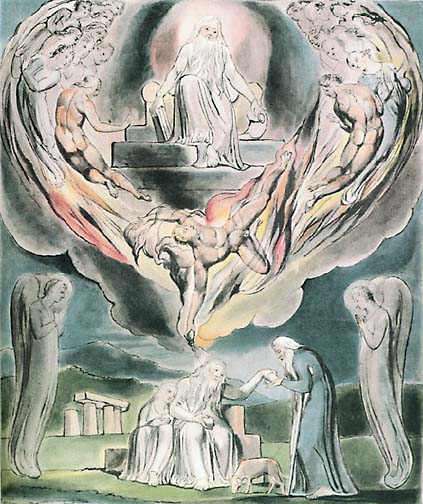
Blake seeks to provide the Golden String which can lead us through the labyrinth of our experience or his own poetry.

Wednesday, February 28, 2018

POETIC MEANING

Finding meaning is not an objective experience. Dissection and analysis destroys the living energy of a work of art. Immediate intuitive response connects with the mind which the artist employed in creating. Blake called this looking not with the eye but looking 'thro' the eye. It is not the surface where the meaning lies; its hidden in the depths where images are formed.

Northrop Frye contributed a chapter Poetry and Design in Blake to the book of essays The Visionary Hand: William Blake's Art and Aesthetics. On page 157 he makes this statement contrasting two levels of discerning Blake's meaning:

"[It] is only when literary critics stand back far enough to see the imagery as one pattern that they are in a position to solve the problem of structure, of genre, and of archetype...The propositional content of Blake's Europe could be expressed somewhat as follows: the root of evil and suffering is the fallen nature of man; this fallen nature is part of physical nature; hence the basis of superstition and tyranny is the deification of physical nature; this definition has polluted Western culture from the sky-gods of Greece and Rome to the gravitational universe of Newton. But its poetic meaning, its total meaning, is given to us by Blake himself in his frontispiece to the poem, the famous picture of the Ancient of Days, the bearded god whose sharp cruel compasses etch the circumference of the human skull and of the spherical universe which is its objective shadow."   
Wikimedia Commons
From Houghton Library of Harvard University
Europe a Prophecy
Frontispiece
Songs and Ballads, Auguries of Innocence, (E 492)
"We are led to Believe a Lie 
When we see not Thro the Eye                                    t
Which was Born in a Night to perish in a Night
When the Soul Slept in Beams of Light" 
 
Milton, Plate 21 [23], (E 115)
"for man cannot know
What passes in his members till periods of Space & Time
Reveal the secrets of Eternity: for more extensive               
Than any other earthly things, are Mans earthly lineaments.

Four Zoas, Night VIII, Page 104, (E 378)
"Los said to Enitharmon Pitying I saw
Pitying the Lamb of God Descended thro Jerusalems gates
To put off Mystery time after time & as a Man
Is born on Earth so was he born of Fair Jerusalem
In mysterys woven mantle & in the Robes of Luvah 

He stood in fair Jerusalem to awake up into Eden
The fallen Man but first to Give his vegetated body 
To be cut off & separated that the Spiritual body may be Reveald"

Vision of Last Judgment, (E 556) 
"it ought to be understood that the Persons
Moses & Abraham are not here meant but the States Signified by
those Names the Individuals being representatives or Visions of
those States as they were reveald to Mortal Man in the Series of
Divine Revelations. as they are written in the Bible these
various States I have seen in my Imagination when distant they
appear as One Man but as you approach they appear
Multitudes of Nations."

Letters, To Hayley (E 759)
"My wife joins me in wishing you a
merry Christmas.  Remembering our happy Christmas at lovely
Felpham, our spirits seem still to hover round our sweet cottage
and round the beautiful Turret.  I have said seem, but
am persuaded that distance is nothing but a phantasy.  We are
often sitting by our cottage fire, and often we think we hear
your voice calling at the gate.  Surely these things are real and
eternal in our eternal mind and can never pass away."
. 

Tuesday, February 27, 2018

Illustrations to Job


First published by Larry on Friday, June 04, 2010

In 1794, near the beginning of Blake's serious career, he came forth with the Gates of Paradise, an emblem book with small pictures and short captions. In it he set forth a cycle of development from babyhood to the end of life. This recurring psycho/spiritual progression set his agenda for years ahead.

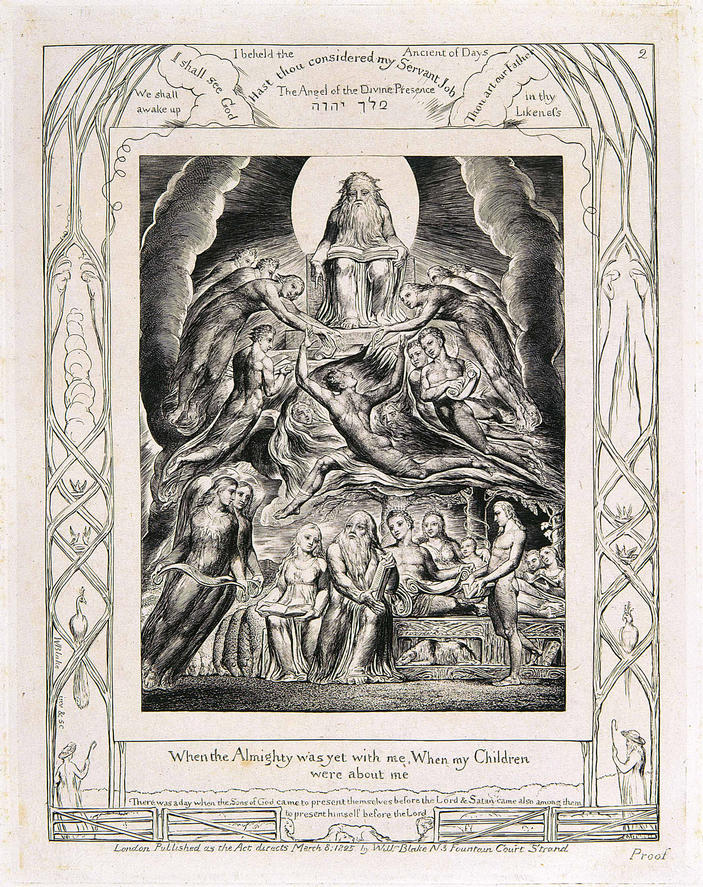
In 1826, near the end of Blake's life his benefactor and friend John Linnell, had Blake make copies for him of  the illustrations to the Book of Job which he had painted for Capt. Butts years before. In consequence Blake created an engraved work called Illustrations of the Book of Job. It has a remarkable consistency with the work done 32 years before for Gates of Paradise.

Job, one of the latest Old Testament books, produced at some time fairly near the advent of the Son, consists of a chapter or two of novelistic material at the beginning and then at the end.  Between the two, the author wrote many pages of poetic material. The casual Bible reader may read the 'novelistic' and let the poetry go but Blake found great meaning in all of the stages traversed by Job in the biblical account.

Wikimedia Commons   Illustrations of the Book of Job
Plate 2
The cover page (in this link) precedes 21 plates illustrating Job, his family and friends, and his adventures. The first thing I noticed in this image was the marked resemblance between Job in the lower layer and Job's God above; from this we may infer that Blake saw Job's image of God as internal, an element of his psyche. (Our experience consists of nothing except our images of reality.)

Blake also concentrated on the prose story but used it in extremely poetic ways. The 21 engraved images make up this work following Job's descent into despair and his ascent to an revised relationship to God and his fellow man. Surrounding the pictures are words from the Book of Job and drawings to reinforce our understanding of Job's condition.

Like so many of Blake's pictorial creations we often see three layers: a God-like or Eternal upper one, a middle one representing the conscious mind, and the lower for the unconscious fountain.

With these plates Blake described the cycle of Life: Albion's, Blake's, mine and yours.

C.G.Jung, a poet masquerading as a Scientist and perhaps the closest thing to Blake that the 20th Century gave us, also found in Job a central mystery, which he tried to fathom, much like Blake had.  The record of Jung's Answer to Job appears in pages 519-650 of a translated work called The Portable Jung.

At 76 Jung found the courage to confess his feelings about Job's God. When he began this he decided that he would treat the psychic fact of God as a person, just as religionists do. Doing this of course, he gave up the guise of a Scientist to speak poetically -- a more direct approach to Truth  reminiscent of the four year old Jung's dream of the gigantic turd falling on the cathedral. In effect Jung denounced the conventional picture of a God as a rewarder of the righteous.

All of this bears on our discussion of the central mystery of Illustrations of the Book of Job.  Here is a scholarly paper on the subject of Blake and Jung.

.

Sunday, February 25, 2018

FUTURITY

"Let it be" (Paul McCartney)
"What will be, will be" (Jay Livingston, Ray Evans)
"We don't know what will happen until it happens" (ellie)
"Heaven is a place where nothing ever happens" (David Byrne, Jerry Harrison)

Wikipedia Commons
The Book of Urizen
Copy G, Plate 22
There is widespread agreement that the human mind is not unified but divided. Blake dealt with the divisions in various ways. First he considered the mind to be capable of perceiving the Eternal through what we think of as intuition or what Blake called Imagination. Using the second division the mind could receive data from the natural of material world through what we think of as the senses. These two divisions resulted from the splitting of the original unified state of the mind which to Blake was the Fall.

The original state of the mind before the Fall, although not divided, was inclusive of multiple activities. Drawing away from the unity the activities became multiple entities within the mind, which Blake called Zoas. As the mind projected the Zoas outward onto what was external, the data received through the senses was perceived as independent entities.  

This brings us to Urizen, one of the four Zoas. He functioned in the undivided mind to provide certainty and faith in the divine scheme. He planted the seeds which would mature into new growth. His was the light which illumined all the activity. He was reason in the unfallen state. However outside of the integrated mental functioning of Eternity, Urizen attempted to replicate his role without the support of the integrated Brotherhood of Eternals. He aimed to take charge by imposing his patterns of thought on others, he formed institutions to replace organic processes of organization, he formulated a system of rules to prevent expressions of intuitive, spontaneous activity.

The synthetic processes through which he imitated Eternal reason, however, led further and further into doubt, despair and alienation. His political organization was tyranny, his religious outlook was Deism or Mystery, his social order was repression. He attempted to preempt Luvah's function into war, Tharmas' function into self-doubt, and Urthona's function into repetition of the same dull round. Urizen feared the outcome of his dark experiment and so gave priority to controlling the future. He attempted to enter the territory of Urthona because as Percival tells us, "This anticipatory view of the future is properly the realm of Urthona, whose imaginative vision must henceforth be troubled by Urizen's doubts and fears."       

Songs of Experience,Song 30,(E 18) 
"Hear the voice of the Bard!
Who Present, Past, & Future sees
Whose ears have heard,
The Holy Word,
That walk'd among the ancient trees."

Milton, Plate 7, (E 100) 
"Then Palamabron reddening like the Moon in an eclipse,        
Spoke saying, You know Satans mildness and his self-imposition,
Seeming a brother, being a tyrant, even thinking himself a brother
While he is murdering the just; prophetic I behold
His future course thro' darkness and despair to eternal death
But we must not be tyrants also! he hath assum'd my place      
For one whole day, under pretence of pity and love to me:
My horses hath he maddend! and my fellow servants injur'd:
How should he, he, know the duties of another? O foolish forbearance 
Would I had told Los, all my heart! but patience O my friends.
All may be well: silent remain, while I call Los and Satan."

Jerusalem, PLATE 15, (E 158)
"I see the Four-fold Man. The Humanity in deadly sleep
And its fallen Emanation. The Spectre & its cruel Shadow.
I see the Past, Present & Future, existing all at once
Before me; O Divine Spirit sustain me on thy wings!
That I may awake Albion from His long & cold repose."

Four Zoas, Night IX, PAGE 120, (E 389)  
"The voices of children in my tents to cries of helpless infants
And all exiled from the face of light & shine of morning
In this dark world a narrow house I wander up & down
I hear Mystery howling in these flames of Consummation
When shall the Man of future times become as in days of old 
O weary life why sit I here & give up all my powers
To indolence to the night of death when indolence & mourning
Sit hovring over my dark threshold. tho I arise look out
And scorn the war within my members yet my heart is weak
And my head faint Yet will I look again unto the morning 
Whence is this sound of rage of Men drinking each others blood
Drunk with the smoking gore & red but not with nourishing wine

The Eternal Man sat on the Rocks & cried with awful voice

O Prince of Light where art thou   I behold thee not as once
In those Eternal fields in clouds of morning stepping forth 
With harps & songs where bright Ahania sang before thy face
And all thy sons & daughters gatherd round my ample table
See you not all this wracking furious confusion
Come forth from slumbers of thy cold abstraction come forth
Arise to Eternal births shake off thy cold repose 
Schoolmaster of souls great opposer of change arise
That the Eternal worlds may see thy face in peace & joy
That thou dread form of Certainty maist sit in town & village
While little children play around thy feet in gentle awe
Fearing thy frown loving thy smile O Urizen Prince of light 

He calld[;] the deep buried his voice & answer none returnd"

Annotations to Lavater, (E 592)
"Lavater:  Whatever is visible is the vessel or veil of the
invisible past, present, future--as man penetrates to this more,
or perceives it less, he raises or depresses his dignity of
being.
Blake: A vision of the Eternal Now--"

Book of Urizen, Plate 4, (E 71)
"4: From the depths of dark solitude. From
The eternal abode in my holiness,
Hidden set apart in my stern counsels
Reserv'd for the days of futurity,
I have sought for a joy without pain,                            

For a solid without fluctuation
Why will you die O Eternals?
Why live in unquenchable burnings?"

Four Zoas, Night I, Page 11, (E 306)
"I see, invisible descend into the Gardens of Vala
Luvah walking on the winds, I see the invisible knife
I see the shower of blood: I see the swords & spears of futurity
Tho in the Brain of Man we live, & in his circling Nerves.       
Tho' this bright world of all our joy is in the Human Brain.
Where Urizen & all his Hosts hang their immortal lamps
Thou neer shalt leave this cold expanse where watry Tharmas mourns

So spoke Los. Scorn & Indignation rose upon Enitharmon"

Four Zoas, Night IV, Page 34, (E 322)
"Urizen saw & envied & his imagination was filled                 
Repining he contemplated the past in his bright sphere
Terrified with his heart & spirit at the visions of futurity
That his dread fancy formd before him in the unformd void"

Four Zoas, Night VI, Page 74, (E 350)
"So he began to dig form[ing] of gold silver & iron      
And brass vast instruments to measure out the immense & fix
The whole into another world better suited to obey
His will where none should dare oppose his will himself being King
Of All & all futurity be bound in his vast chain"

Four Zoas, Night VIII, PAGE 101 (SECOND PORTION), (E 374) 
"To the four winds hopeless of future. All futurity 
Seems teeming with Endless Destruction never to be repelld 
Desperate remorse swallows the present in a quenchless rage

Terrified & astonishd Urizen beheld the battle take a form 
Which he intended not a Shadowy hermaphrodite black & opake
The Soldiers namd it Satan but he was yet unformd & vast
Hermaphroditic it at length became hiding the Male
Within as in a Tabernacle Abominable Deadly"

Four Zoas, Night IX, Page 121, (E 390)
"I alone in misery supreme
Ungratified give all my joy unto this Luvah & Vala    
Then Go O dark futurity I will cast thee forth from these 
Heavens of my brain nor will I look upon futurity more    
I cast futurity away & turn my back upon that void        
Which I have made for lo futurity is in this moment       
Let Orc consume let Tharmas rage let dark Urthona give
All strength to Los & Enitharmon & let Los self-cursd
Rend down this fabric as a wall ruind & family extinct           
Rage Orc Rage Tharmas Urizen no longer curbs your rage

So Urizen spoke he shook his snows from off his Shoulders & arose"

Wednesday, February 21, 2018

DINNER PARTY

Wikimedia Commons
Self Portrait
1802

There seem to be no other first hand accounts of William Blake being in the company of society members and the artistic community than this one by Lady Charlotte Bury. What is impressive to me about this account is Lady Charlotte's ability to recognize in Blake what made him distinctive and worthy of recognition. She knew nothing of Blake before they met at the dinner party and didn't follow his career after their encounter, but she saw that his absence of worldly acumen bespoke of inner radiance, a powerful mind, superior feelings, and beautiful imaginations. 


"Diary illustrative of the times of George the Fourth, interspersed with original letters from the late Queen Caroline, and from various other distinguished persons" 

Bury, Charlotte (Campbell) Lady, 1775-1861
Wikimedia Commons
Notebook, Page 67
Self Portrait

Page 345 -349
"Tuesday, the 20th of January, 1818. I dined at Lady C. L 's [Caroline Lamb]. She had collected a strange party of artists and literati, and one or two fine folks, who were very ill assorted with the rest of the company, and appeared neither to give nor receive pleasure from the society among whom they were mingled. Sir. T. Lawrence, next whom I sat at dinner, is as courtly as ever. His conversation is agreeable, but I never feel as if he was saying 346 what he really thought. He made some reference to the Princess of Wales, and inquired if I had heard lately from her Royal Highness. I replied that I had not; and, to say the truth, I did not feel much induced to talk to him upon the subject ; for I do not think he behaved well to her. After having, at one time of his life, paid her the greatest court, (so much so even as to have given rise to various ill-natured reports at the period of the first secret investigation about the Princess's conduct,) he completely cut her Royal Highness... 

Besides Sir T., there were also present of this profession Mrs. M., the miniature painter, a modest, pleasing person; like the pictures she executes, soft and sweet.Then there was another eccentric little artist, by name Blake; not a regular professional painter, but one of those persons who follow the art for its own sweet sake, and derive their happiness from its pursuit. He appeared to me full of beautiful imaginations and genius; but how far the execution of his designs is equal to the conceptions of his mental vision, I know not, never having seen them. Main d'aeovre is frequently wanting where the mind is most powerful. Mr. Blake appears unlearned in all that concerns this world, and, from what he said, I should fear he was one of those whose feelings are far superior to his situation in life. He looks care-worn and subdued ; but his countenance radiated as be spoke of bis favorite pursuit, and be appeared gratified by talking to a person who comprehended his feelings. I can easily imagine that he seldom meets with any one who, enters into his views ; for they are peculiar, and exalted above the common level of received opinions. I could not help contrasting this humble artist with the great and powerful Sir Thomas Lawrence, and thinking that the one was fully if not more worthy of the distinction and the fame to which the other has attained, but from which he is far removed. Mr. Blake, however, though he may have as much right, from talent and merit, to the advantages of which Sir Thomas is possessed, evidently lacks that worldly wisdom and that grace of manner which make a man gain an eminence in his profession, and succeed in society. Every word he uttered spoke the perfect simplicity of bis mind, and his total ignorance of all worldly matters. He told me that Lady C L had been very kind to him. "Ah !" said be, "there is a deal of kindness in that lady." I agreed with him, and though it was impossible not to laugh at the strange manner in which she had arranged this party, I could not help admiring the goodness of heart and discrimination of talent which had made her patronize this unknown artist. Sir T. Lawrence looked at me several times whilst I was talking with Mr. B., and I saw his lips curl with a sneer, as if he despised me for conversing with so insignificant a person. It was very evident Sir Thomas did not like the company he found himself in, though he was too well-bred and too prudent to hazard a remark upon the subject.
 
The literati were also of various degrees of eminence, beginning with Lord B , and ending with __. The grandees were Lord L , who appreciates talent, and therefore was not so ill assorted with the party as was Mrs. G and Lady C., (who did nothing but yawn the whole evening,) and Mrs. A , who all looked with evident contempt upon the surrounding company. I was much amused by observing this curious assemblage of blues and pinks, and still more so with Lady C L 's remarks, which she whispered every now and then into my ear. Her criticisms were frequently very clever, and many of them very true, but so imprudent, it was difficult to understand how anybody in their senses could hazard such opinions aloud, or relate such stories." 


Miscellaneous Prose, Autograph in Album of William Upcott, (E 698)
     "WILLIAM BLAKE one who is very much delighted with being in
good Company
                                  Born 28 Novr 1757 in London 
                                  & has died several times since
January 16 
  1826
     The above was written & the drawing annexed by the desire of
Mr Leigh how far it is an Autograph is a Question   I do not
think an Artist can write an Autograph especially one who has
Studied in the Florentine & Roman Schools as such an one will
Consider what he is doing   but an Autograph as I understand it, is
Writ helter skelter like a hog upon a rope or a Man who walks
without Considering whether he shall run against a Post or a
House or a Horse or a Man & I am apt to believe that what is done
without meaning is very different from that which a Man Does with
his Thought & Mind & ought not to be Calld by the Same Name.
     I consider the Autograph of Mr Cruikshank which very justly
stands first in the Book & that Beautiful Specimen of Writing by
Mr Comfield & my own; as standing in the same Predicament they
are in some measure Works of Art & not of Nature or Chance
  
     Heaven born the Soul a Heavenward Course must hold 
     For what delights the Sense is False & Weak 
     Beyond the Visible World she soars to Seek 
     Ideal Form, The Universal Mold

 Michael Angelo.  Sonnet as Translated by Mr Wordsworth"


Monday, February 19, 2018

WATER & STONE 2

Philadelphia Museum of Art
Moses striking the Rock
Biblical stories of water being provided to satisfy thirst are found in the Old and New Testaments. Blake painted a picture for Thomas Butts to illustrate Chapter 20 in Numbers in which the Israelites pled with Moses to provide water to save them from perishing in the desert.  When Moses struck the rock with his rod water gushed forth. The children of Israel had forgotten that they were in the wilderness because they had escaped from slavery in Egypt and were seeking a new home. They regretted that commodities were scarce and turned to Moses for a remedy. Moses presented their complaint to God who instructed Moses to strike the rock in the presence of the people. The rock gushed forth water to supply the needs.


In the esoteric tradition water is frequently a symbol of transition. In order to achieve a higher level of consciousness one must first have an inkling that such an order of development may be possible. Before one is prepared to enter a new life one goes through a process of discarding the remnants of the old life. One must bring his empty bucket to the well in the hope that there will be water and that there will be a way to access it.

Jerusalem, Plate 60, (E 210)
"I gave thee liberty and life O lovely Jerusalem                
And thou hast bound me down upon the Stems of Vegetation
I gave thee Sheep-walks upon the Spanish Mountains Jerusalem
I gave thee Priams City and the Isles of Grecia lovely!
I gave thee Hand & Scofield & the Counties of Albion:
They spread forth like a lovely root into the Garden of God:     
They were as Adam before me: united into One Man,
They stood in innocence & their skiey tent reachd over Asia
To Nimrods Tower to Ham & Canaan walking with Mizraim
Upon the Egyptian Nile, with solemn songs to Grecia
And sweet Hesperia even to Great Chaldea & Tesshina              
Following thee as a Shepherd by the Four Rivers of Eden
Why wilt thou rend thyself apart, Jerusalem?
And build this Babylon & sacrifice in secret Groves,
Among the Gods of Asia: among the fountains of pitch & nitre
Therefore thy Mountains are become barren Jerusalem!             
Thy Valleys, Plains of burning sand. thy Rivers: waters of death
Thy Villages die of the Famine and thy Cities
Beg bread from house to house, lovely Jerusalem
Why wilt thou deface thy beauty & the beauty of thy little-ones
To please thy Idols, in the pretended chastities of Uncircumcision    
Thy Sons are lovelier than Egypt or Assyria; wherefore
Dost thou blacken their beauty by a Secluded place of rest.
And a peculiar Tabernacle, to cut the integuments of beauty
Into veils of tears and sorrows O lovely Jerusalem!
They have perswaded thee to this, therefore their end shall come 
And I will lead thee thro the Wilderness in shadow of my cloud
And in my love I will lead thee, lovely Shadow of Sleeping Albion.

This is the Song of the Lamb, sung by Slaves in evening time."

Numbers 20
[1] Then came the children of Israel, even the whole congregation, into the desert of Zin in the first month: and the people abode in Kadesh; and Miriam died there, and was buried there.
[2] And there was no water for the congregation: and they gathered themselves together against Moses and against Aaron.
[3] And the people chode with Moses, and spake, saying, Would God that we had died when our brethren died before the LORD!
[4] And why have ye brought up the congregation of the LORD into this wilderness, that we and our cattle should die there?
[5] And wherefore have ye made us to come up out of Egypt, to bring us in unto this evil place? it is no place of seed, or of figs, or of vines, or of pomegranates; neither is there any water to drink.
[6] And Moses and Aaron went from the presence of the assembly unto the door of the tabernacle of the congregation, and they fell upon their faces: and the glory of the LORD appeared unto them.
[7] And the LORD spake unto Moses, saying,
[8] Take the rod, and gather thou the assembly together, thou, and Aaron thy brother, and speak ye unto the rock before their eyes; and it shall give forth his water, and thou shalt bring forth to them water out of the rock: so thou shalt give the congregation and their beasts drink.
[9] And Moses took the rod from before the LORD, as he commanded him.
[10] And Moses and Aaron gathered the congregation together before the rock, and he said unto them, Hear now, ye rebels; must we fetch you water out of this rock?
[11] And Moses lifted up his hand, and with his rod he smote the rock twice: and the water came out abundantly, and the congregation drank, and their beasts also.
[12] And the LORD spake unto Moses and Aaron, Because ye believed me not, to sanctify me in the eyes of the children of Israel, therefore ye shall not bring this congregation into the land which I have given them.

John 4
[6] Now Jacob's well was there. Jesus therefore, being wearied with his journey, sat thus on the well: and it was about the sixth hour.
[7] There cometh a woman of Samaria to draw water: Jesus saith unto her, Give me to drink.
[8] (For his disciples were gone away unto the city to buy meat.)
[9] Then saith the woman of Samaria unto him, How is it that thou, being a Jew, askest drink of me, which am a woman of Samaria? for the Jews have no dealings with the Samaritans.
[10] Jesus answered and said unto her, If thou knewest the gift of God, and who it is that saith to thee, Give me to drink; thou wouldest have asked of him, and he would have given thee living water.
[11] The woman saith unto him, Sir, thou hast nothing to draw with, and the well is deep: from whence then hast thou that living water?
[12] Art thou greater than our father Jacob, which gave us the well, and drank thereof himself, and his children, and his cattle?
[13] Jesus answered and said unto her, Whosoever drinketh of this water shall thirst again:
[14] But whosoever drinketh of the water that I shall give him shall never thirst; but the water that I shall give him shall be in him a well of water springing up into everlasting life.
[15] The woman saith unto him, Sir, give me this water, that I thirst not, neither come hither to draw.
...
[24] God is a Spirit: and they that worship him must worship him in spirit and in truth.

.

Thursday, February 15, 2018

WATER & STONE

Once years ago when we were visiting the Great Smoky Mountains National Park, we discovered that park service folks has constructed a tub mill near a cabin in a cove surrounded by steep slopes. The settlers in what became the park had scratched out meager livings along the creeks traversing the rugged and rocky terrain. Corn had been one of the crops they were able to grow. Although a portion of the harvest went to producing 'white lightning' there was a need also for meal to feed the 'young'uns'.
 

The  park service had reconstructed a simple mill to replicate one an ingenious farmer had built from the supplies at hand so that he could avoid transporting his corn to be ground at a larger commercial mill with a waterwheel.
 

Later park visitors would be prevented form operating the mill but we were lucky enough to find it unsecured but not in operation. The challenge was to figure out how it worked and set the water from the nearby creek running through the sluice and turning the millstone. Although we properly directed the water, the stone, of course, remained immobile until we gave it a push to overcome inertia.
 

We didn't grind any meal that day but I learned first hand the power of water to move stone, and the need to give the reluctant stone a push so that the water could do it's work.
Illustrations to Dante
Drinking at the River of Light

Religious writers and poets have found water and stone to be appropriate images to convey contrary states of consciousness. Since the stone is hard and inflexible it becomes a symbol for the state of mind which is rigid and unyielding. The fluidity of water which takes the shape of the container makes it symbolic of a mind which is malleable and accepting of new ideas and new modes of thinking. The mind that is prepared to receive expressions of truth in whatever form they come is not rigid or static but moving and yielding. The lesson of the water mill is that stone submits to the force that is incorporated in the energetic movement of the water.

Blake uses the water as symbolic of a liberating force. Those imprisoned by the law, convention, sense based reasoning, blindness to the Divine Vision, fear, or any other devise of Satan can be liberated by washing in the cleansing waters of the river of life. Blake's answer to the dilemma of humanity was accepting the message of Christ which released man from the stone-built prison of the law to the liberty of spiritual consciousness. 
 
Visions of the Daughters of Albion, Plate 3, (E 47)
"Silent I hover all the night, and all day could be silent.
If Theotormon once would turn his loved eyes upon me;            
How can I be defild when I reflect thy image pure?
Sweetest the fruit that the worm feeds on. & the soul prey'd on by woe
The new wash'd lamb ting'd with the village smoke & the bright swan
By the red earth of our immortal river: I bathe my wings.
And I am white and pure to hover round Theotormons breast." 
 
Milton, Plate 40 [46], (E 142)
"The Negation must be destroyd to redeem the Contraries
The Negation is the Spectre; the Reasoning Power in Man
This is a false Body: an Incrustation over my Immortal           
Spirit; a Selfhood, which must be put off & annihilated alway
To cleanse the Face of my Spirit by Self-examination.
PLATE 41 [48]
To bathe in the Waters of Life; to wash off the Not Human
I come in Self-annihilation & the grandeur of Inspiration" 

Four Zoas, Night IX, Page 134, (E 402)
"Rise & look out his chains are loose his dungeon doors are open
And let his wife & children return from the opressors scourge
They look behind at every step & believe it is a dream
Are these the Slaves that groand along the streets of Mystery    
Where are your bonds & task masters are these the prisoners
Where are your chains where are your tears why do you look around
If you are thirsty there is the river go bathe your parched limbs
The good of all the Land is before you for Mystery is no more

Then All the Slaves from every Earth in the wide Universe        
Sing a New Song drowning confusion in its happy notes"

Songs and Ballads, From Notebook, (E 473)
"Why should I care for the men of thames
Or the cheating waves of charterd streams
Or shrink at the little blasts of fear
That the hireling blows into my ear

Tho born on the cheating banks of Thames     
Tho his waters bathed my infant limbs
The Ohio shall wash his stains from me                          t
I was born a slave but I go to be free"  

Annotations to Berkley's Siris, (E 663)
    "The Four Senses are the Four Faces of Man & the Four Rivers
of the Water of Life"

Jerusalem, Plate 74, (E 229)
"The Spectre is the Reasoning Power in Man; & when separated      
From Imagination, and closing itself as in steel, in a Ratio
Of the Things of Memory. It thence frames Laws & Moralities
To destroy Imagination! the Divine Body, by Martyrdoms & Wars

Teach me O Holy Spirit the Testimony of Jesus! let me
Comprehend wonderous things out of the Divine Law" 
.
 

Sunday, February 11, 2018

BLAKE & COWPER

Found on Internet
Engraving by Blake
William Cowper
National Portrait Gallery
Pastel Drawing by Romney
William Cowper


When Blake was spending his three years sojourn in Felpham working along-side William Hayley he was involved in several projects. Hayley was writing a biography of the poet William Cowper who had died in 1800. Blake was recruited to produced engraving to illustrate the three volume book. Cowper, although a successful writer, had suffered from bouts of depression through much of his life. Hayley had befriended Cowper and was anxious to honor his memory by writing his biography.

Cowper seems to have had two opposed aspects of his personality. One was serious and spiritual the other shallow and worldly: the one expressed in the writing of hymns the other in writing trivial, comic poetry. Cowper had been a close associate of the writer of Amazing Grace, John Newton, who had been transformed from the captain of a slave ship to an ordained minister in the Church of England. Together they produced the hymnal Olney Hymns containing 348 hymns written by Newton and Cowper. G. E, Bentley, Jr. expressed the two sides of Cowper in his biography of Blake, The Stranger from Paradise: "Blake clearly loved Cowper the prophet, spending his soul in prophecy. This was dangerous ground for those who loved Cowper for his modest wit and mild spirits."

Hayley wrote to attract readers of the popular lighthearted poetry rather than to attract the enthusiastic religious contingent. Cowper's prestigious family were particularly interested in preventing any signs of mental illness from appearing in the biography including in the portrait of Cowper which Blake engraved from a pastel drawing by George Romney. Blake provided the six illustration which appeared in the biography.

Blake considered that the visionary state was feared by conventional people and confused with mental illness or 'madness.' Blake also understood depression because he had experienced it when he was struggling to discern the path which his life should follow. The internal life which Blake valued so highly and which he recognized in Cowper, was not amenable to proof by outward measurement, however, through it one might experience the healing of the Shepherd's tender care.

Songs of innocence, Night, (E 14)
"The angels most heedful,    
Recieve each mild spirit,
New worlds to inherit.

And there the lions ruddy eyes,
Shall flow with tears of gold:
And pitying the tender cries, 
And walking round the fold:
Saying: wrath by his meekness
And by his health, sickness,
Is driven away,
From our immortal day." 

Satiric Verses and Epigrams, (E 506)                                   
         "William Cowper Esqre                             
For this is being a Friend just in the nick
Not when hes well but waiting till hes sick
He calls you to his help be you not movd                  
Untill by being Sick his wants are provd                  

You see him spend his Soul in Prophecy                  
Do you believe it a Confounded lie
Till some Bookseller & the Public Fame
Proves there is truth in his extravagant claim

For tis atrocious in a Friend you love  
To tell you any thing that he cant prove                
And tis most wicked in a Christian Nation
For any Man to pretend to Inspiration"

Annotations to Spurzheim's Observations on Insanity, (E 663)
 "Cowper came to me & said. O that I
were insane always I will never rest.  Can you not make me truly
insane.  I will never rest till I am so. O that in the bosom of
God I was hid.  You retain health & yet are as mad as any of us
all--over us all--mad as a refuge from unbelief--from Bacon
Newton & Locke"

Letters, To Thomas Butts, (E 716)
"I continue
painting Miniatures & Improve more & more as all my friends tell
me. but my Principal labour at this time is Engraving Plates for
Cowpers Life a Work of Magnitude which Mr Hayley is now
Labouring with all his matchless industry & which will be a most
valuable acquisition to Literature not only on account of Mr
Hayleys composition but also as it will contain Letters of Cowper
to his friends Perhaps or rather Certainly the very best letters
that ever were published"

Letters, To James Blake, (E 726)
"My Heads
of Cowper for Mr H's life of Cowper have pleasd his Relations
exceedingly & in Particular Lady Hesketh & Lord Cowper    to
please Lady H was a doubtful chance who almost adord her Cousin
the poet & thought him all perfection & she writes that she is
quite satisfied with the portraits & charmd by the great Head in
particular tho she never could bear the original Picture"

Letters, To Thomas Butts, (E 730)
 "I ought to tell you that Mr H. is quite agreeable to our
return & that there is all the appearance in the world of our
being fully employd in Engraving for his projected Works
Particularly Cowpers Milton. a Work now on foot by Subscription &
I understand that the Subscription goes on briskly.  This work is
to be a very Elegant one & to consist of All Miltons Poems with
Cowpers Notes and translations by Cowper from Miltons Latin &
Italian Poems.  These works will be ornamented with Engravings
from Designs from Romney.  Flaxman & Yr hble Servt & to be
Engravd also by the last mentiond.  The Profits of the work are
intended to be appropriated to Erect a Monument to the Memory of
Cowper in St Pauls or Westminster Abbey."

Letters, To William Hayley, (E 759)
"Farewell Sweet Rose thou hast got before me into the
Celestial City.  I also have but a few more Mountains to pass.
for I hear the bells ring & the trumpets sound to welcome thy
arrival among Cowpers Glorified Band of Spirits of just Men made
Perfect"