Blake seeks to provide the Golden String which can lead us through the labyrinth of our experience or his own poetry.

Friday, November 30, 2018

Foreword

In the early eighties Larry began studying William Blake's writings. He wrote Ram Horn'd with Gold which he subtitled The Spiritual Autobiography of William Blake edited by Larry Clayton. Because he was unsuccessful in finding a publisher he made it available through the internet. The beauty of publishing on the internet is that constant revision is possible. Creating hyperlinks became Larry's primary interest in his book and it proved to be an unending process. Today's post is the Foreword from what we usually called the Primer.

                                                                 FOREWORD
 "I give you the end of a golden string, Only wind it into a ball,It will lead you in at Heaven's gate Built in Jerusalem's wall." (Plate 77 of Jerusalem)

 Late 18th Century Europe existed in a state of rapid transition from Medievalism to Modernity. The old arrangement of society, a divinely ordained king, a landowning aristocracy, and a marriage of Church and State came increasingly under the attacks of political, economic, and religious progressives. The American Revolution pointed toward the outcome of the struggle. In Europe the decisive event came with the French Revolution and its aftermath.

William Blake lived through those stirring times. His work has great significance as political commentary. Now two centuries later its spiritual dimension has assumed even greater moment. Blake participated passionately in the social and political debates of the day, although few contemporaries heard his voice. It is his place in the spiritual dialogue that exercises the greatest fascination and will probably endure when the other dimensions of his thought have passed into the dust of time. Blake radically redefined the Christian faith and offered to his own and later generations a religious perspective that takes fully into account the corruptions of the past and the psychological sophistication of the future.

 It was during Blake's age that religious faith in Europe began to lose its grip upon the minds of men. His generation saw the final breakdown of the Medieval Synthesis and the triumphant emergence of the Age of Reason. He participated in a decisive battle of the eternal war between conservative religionists and liberal rationalists. Though without the bloodshed of earlier days, it was a conflict in which quarter was neither given nor expected. The battle pitted the community of faith, which in the 18th Century suffered an eclipse, against the rationalists, critical men of great brilliance. But none of the rationalists surpassed the brilliance of William Blake, a critical man of faith; their contribution to modern thought had its day; we are still far from catching up with his.

In the battle between faith and reason Blake occupied a unique middle ground. On one hand he constantly attacked an oppressive politico-religious establishment; on the other he just as steadfastly defended a spiritual orientation against the rationalists. This meant for Blake a lifetime engagement on two fronts. This survey describes and explores the various dimensions of Blake's vision of Christianity. One overriding consideration determined that vision: Blake saw freedom as the primary and ultimate value. The attitudes he expressed toward all institutions, his evaluation of them, the comments he made about them with his poetry and pictures, all these things were determined by the institution's relationship to that supreme value of freedom.

He believed from the depths of his being that coercion in any form is the primary evil. It outweighs and in fact negates any benefit that an established religion may afford. Blake believed that regardless of his professed faith, the leader who uses coercion thereby shows himself to be a follower of the God of this World, the Tempter with whom Jesus dealt in the wilderness.

 As a religious thinker Blake customarily receives the designation of radical Protestant. The seeds of his protest go back far beyond Luther. In his day a more common term was dissenter. Blake protested against and dissented from the authority of the orthodox Christian tradition. We can best understand Blake as a thinker, as a Christian, and as a man in terms of this dissent from orthodoxy. His intellectual life in many ways summarized the history of Christian dissent. His art evoked and drew upon the earlier occurrences of dissent through the centuries.

Blake defined God in terms of vision. Every man has his own vision of God, and no two are exactly alike. Blake spent much of his time and energy describing the superstitious images of God embraced by men in his day as in our own. With his usual extravagant language he was capable of saying something like "their God is a devil". He's referring to their vision, their image of God. Think for a moment about the vision of God of the Inquisitors, or for that matter of Bin Laden. Their God gloried in blood, but not my God, Blake's or yours!

 Jesus was an obvious dissenter from the orthodox tradition into which he was born. He blithely ignored many of the requirements of respectable Judaism. He repeatedly violated the Sabbath. He felt perfectly free to initiate conversation with unfamiliar women, a gigantic taboo; in fact he spent hours with disreputable characters of both sexes. He ate without washing his hands. All these acts seriously violated the laws of his religious tradition.

 In The Marriage of Heaven and Hell Blake claimed that Jesus broke all of the ten commandments and "was all virtue, and acted from impulse, not from rules" (See Chapter Five.) Going beyond mere dissent Jesus attacked the established religious leaders. He called them "whited sepulchers", poked fun at them, and encouraged all sorts of insubordination among their followers. Worst of all he set himself up as an alternative authority. In all these ways he directly challenged the religious leaders and provoked them to bring about his execution as a revolutionist.

 Jesus perceived death as the ultimate authority or power of the world. On behalf of his ideals and with spiritual power he challenged death, and according to the Christian faith he defeated it; he conquered death. In the words of Paul he "abolished death". Blake understood this in a more existential way than do most Christians. One of his primary themes, running from the very beginning of his poetry until the last day of his life, was the redefinition of death in accordance with the Christian gospel.
.
.

Thursday, November 29, 2018

Myth in Blake

I found this in the hardcopy of Larry's Ram Horn'd with Gold. It seems to have been left out of the digital copy which is found in the Primer.


CHAPTER THREE

Myth

Many people have called William Blake unique among English poets as the creator of a complete mythology. A dictionary gives "without foundation in fact" as the 5th meaning of mythical, but this is probably what the term conveys in common parlance. Therefore we must begin our study of Blake's myth by raising our consciousness of the word. 'Logos', myth', 'epic'--these three words have a common root. In literary and theological language myths are statements about the nonmaterial ultimate. Some people of course avoid the nonmaterial considering it without foundation in fact; it's doubtful that any such reader has endured to this point of our study.

Blake considered the nonmaterial to be the real; his art centered around the endeavour to express the reality of the nonmaterial. The meaning of his entire artistic enterprise we may call his myth. His object was to fit all of experience into a total framework of meaning that will inform life. Out object is to grasp that total framework; once we do that, we have a myth of meaning.

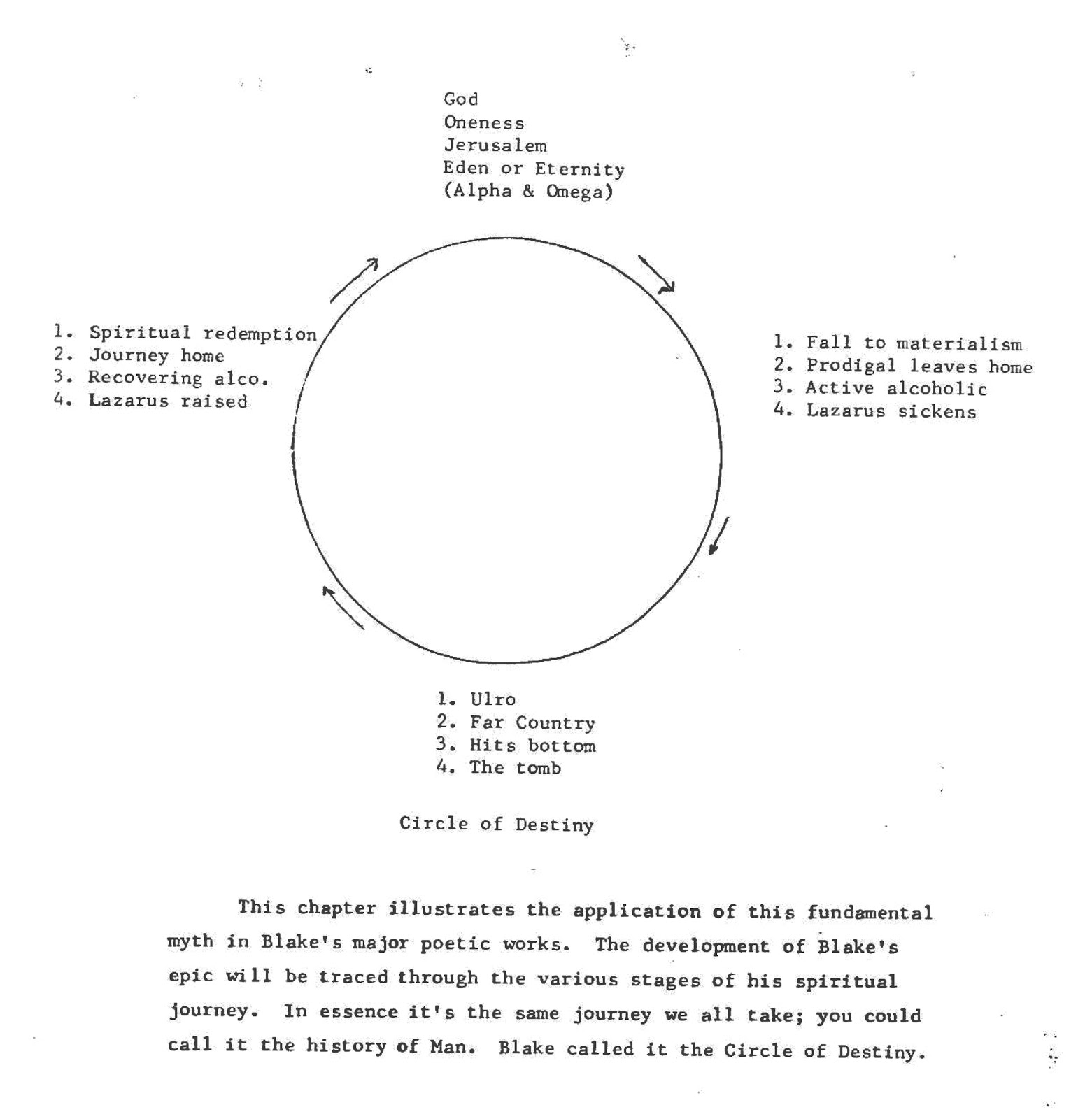
The diagram below schematically represents the shape of Blake's . myth. All his poetic and artistic work fits into this scheme of cosmic/psychic meaning. I have listed only four of an infinite number of possible examples. The first is a general statement of Blake's scheme. With his story of the Prodigal Son Jesus gave us a personal paradigm of the history of the Chosen People and of the Human Race. The career of alcoholism: progressive deterioration until the sufferer hits bottom, followed by recovery, provides a striking modern analogy, although not Blakean per se. Blake did use as a recurring motif the story of Lazarus found in the Gospel of John. But the primary paradigm of this myth is the Incarnation, Crucifixion, Resurrection and Ascension of Jesus Christ. However Blake did not express this, probably did not fully realize it, until 1800.


_____________________

Wednesday, November 28, 2018

Myth in Blake 2

Wikipedia Commons
Small Book of Designs
from Book of Urizen
Plate 1
The following is an excerpt from Larry's book, Ram Horn'd with Gold. 

The Book of Urizen

We find the earliest organized statement of Blake's myth in a medium sized poem written in 1794. The Book of Urizen served as a prototype for The Four Zoas, which was to follow. It contains among other things a parody of Genesis. Blake found the orthodox doctrine of creation unsatisfying, as many people have to this day, so he set out to present an alternative. He followed Paradise Lost and the Gnostics in placing the Fall before Creation.

In his myth the Fall of Man involved a fall in part of the divine nature and led to the creation of a fallen world. Such a Creation Story represents a sophistication of the elemental biblical one. Paradise Lost is an obvious recreation of the Bible story, and The Book of Urizen is a recreation of Paradise Lost, beginning as a simple inversion.

The doctrine of contraries, which we found in Marriage of Heaven and Hell, appears in The Book of Urizen in the form of two Eternals, Urizen and Los. The poem develops their careers in nine chapters. Following closely some of the Gnostic texts Urizen separates from the other Eternals, writes the Book of Brass, and declares himself God, whereupon he is shut out of Eternity and Los appointed his watchman (Chapters 1-3). Los confines Urizen with the limits of time and space and in "seven ages of dismal woe" binds him down into the five shriveled senses of the human body (Chapter 4).

This frightful condition leads Los to pity, which divides his soul and results in the separation of his emanation, Enitharmon. Eternity shudders at this further breakup of Man into the sexual contraries. Even more shocking to the Eternals, Los begets his likeness on his own divided image. The Eternals shut out this fallenness from Eden, and Los becomes blind to Eternity (Chapter 6 - Section 10.) Los binds his son, Orc, with the Chain of Jealousy. Urizen explores his dens, discovers that no one can obey or keep his iron laws for one minute and that life lives upon death.

There in barest outline is The Book of Urizen. Volumes have been written to interpret it. At this point we note that Urizen, Orc (also called Luvah in later works), and Los emerge as the three principles of the psyche. In Jungian terms we would call them Reason, Feeling, and Intuition. With the addition of Tharmas, the body or Instinct, they make up the four Zoas of the complete myth. The Book of Urizen is the earliest sketch of their relationships, which form the primary subject matter of Blake's evolving myth until the critical moment when Jesus became All and Jerusalem his Bride.

Keep in mind that here, as in later writings, Blake's poetry has many levels. We are especially interested in the cosmic and psychological levels, and the most compelling dimension of the psychological is the autobiographical. In The Book of Urizen as in all the prophecies Blake tells us a great deal about himself. He lived intensely in the spiritual realm; this means that visions, motifs, attitudes come and go with great rapidity. The poetry reveals to us the course of his life. At the same time sober reflection on his biography casts light on the dynamic evolution of the myth. The student might spend time with The Book of Urizen before tackling The Four Zoas, for it gives in outline form much of the action of the larger poem. However Urizen is hard to understand, written before the complete vision o Blake's myth had crystallized in his mind; one might question the value to spending much time on this early work.

.

Tuesday, November 27, 2018

Myth in Blake 3

When Larry wrote his unpublished book, Ram Horn'd with Gold, he gave the title Myth to Chapter 3. This summary of The Four Zoas (Blake's first attempt at epic poetry) was included in the hardcopy of Chapter 3 but didn't make it into the digital version which is on line as the Primer.


The Four Zoas

Many a musical masterwork on its initial performance has met a cold reception. In the same way the taste for many foods grows with experience; young children often reject what their parents keenly enjoy; in due course they may develop a taste for what they at first found exotic and repulsive.


4Z is a very exotic masterpiece and most definitely an acquired taste. The reader initially encounters an appalling mass of strange ideas and much that appears to be sheer gibberish. But with perseverance the strange ideas become familiar bit by bit, and the gibberish clarifies into some of the most exalted thought forms of the human mind. To the seasoned reader 42 is a treasure house of imaginative delights. Or call it a mine that releases its gold to the pertinacious. The same could be said of the Bible!


Manuscript
Vala or The Four Zoas
Page 3


Blake wrote the poem over a period of years while his mind and spirit were rapidly developing and changing. It began as the story of Vala, the incarnation of the Female Will. Later it became an account of cosmic and psychic history written in terms of the four Giant Forms--their breakup and struggle for dominion. At Blake's spiritual crisis this seedbed gave birth to Jesus and Jerusalem, his bride. Blake then made an attempt to rewrite 4Z to reflect his new spiritual orientation but after a while he gave up. 4Z was aborted because Blake's world had fundamentally changed, and he was ready to start over. After many years of looking for the New Age he had become a New Man. The New Man wrote 'Milton' and 'Jerusalem' using 4Z as a quarry. 4Z is fascinating in its own right, although unfinished, but most significant as a platform from which to rise to the ethereal glory of the mature poems.


TO BE CONTINUED

.

Monday, November 26, 2018

Myth in Blake 4

Continuing the description of the The Four Zoas from Larry's Ram Horn'd with Gold we learn of the Zoas - Tharmas, Urthona, Urizon and Luvah. When in the Book of Urizen Blake pictured the elements - water, earth, air and fire - he gave us images to associate with the Zoas. 


University of Adalaide
Book of Urizen
Plate 24

The first four nights of this aborted masterpiece recount the fall of each of the four zoas: Tharmas, the body; Luvah, the feelings; Urizen, the mind; and finally Urthona (Los), the imagination or spirit.. These four steps in the fall of Man contain a wealth of rich detail, but one central event Blake described repeatedly in the words of various characters: Urizen and Luvah (Mind and Feeling) struggle for dominion over the sleeping man, Albion. Luvah seizes Urizen's steeds of light and mounts into the sky. Urizen retreats into the north, the rightful place of Urthona, the imagination. These mistakes lead to a long sequence of cataclysmic disasters that condemn mankind to his fallen condition. For six nights we read an almost unrelieved account of the Fall; we read about falling, about fallenness, described in voluminous detail in a hundred ways. Blake felt intensely that we have come a long, long way from the Garden, and he explored with exceeding minuteness every step of the dismal journey, down and out.

We can begin our orientation to the poem by looking closely at what I have called the central event of the Fall. Blake put it in the mouths of several characters and each one has his or her own particular slant. The reader has to decide for himself whose account to believe. This may depend upon the reader as much as it does upon Blake.

The earliest description of the central event comes in the words of Enitharmon, a notoriously untrustworthy character at this point; we may call her the Queen of fallen space. In a conversation with her consort, Los, the prophetic boy, she gives her interpretation of the Fall:

Four Zoas, Night I, Page 1, (E 305)
“Hear! I will sing a Song of Death! it is a Song of Vala!
The Fallen Man takes his repose, Urizen sleeps in the porch,
Luvah & Vala wake & fly up from the Human Heart
Into the brain from thence; upon the pillow Vala slumber'd,
And Luvah seized the Horses of Light & rose into the Chariot of Day
Sweet laughter seized me in my sleep...”

Sunday, November 25, 2018

Myth in Blake 5

Yale Center for British Art
Jerusalem
Plate 19
Always fiercely eclectic, Blake has gathered his symbols here from a number of sources into a new creation: sleeping man equals fallen man living in darkness; this most general symbol fills the New Testament. For example, "Awake thou that sleepest, and Christ shall give thee light". We live by the light of reason (not always Christ's light!). Urizen, the Sun God, must be asleep to allow Luvah, like the Greek adolescent, Phaethon, to seize his Horses of Light and rise into the Chariot of Day. Zeus struck Phaethon down with a thunderbolt in the story in Ovid’s Metamorphoses. Blake used Ovid as a primary source for his borrowings from Greek mythology.


In Night ii we will find Urizen casting Luvah into the furnaces of affliction, where there is much heat but no light. What was once eternal delight has become unmitigated hell.


Luvah and Vala personify the masculine and feminine dimensions of feeling, and séparated from Luvah, Vala becomes the goddess of fallen nature. Luvah's seizure of the sun and Vala's dalliance on the pillow express in different ways the same event. The Prince of Love is bound to get his wings scorched, and the sleeping Albion is rather foolish to allow this to happen; he has lost his head over a part of himself.


Blake used this double event to say many things to us at many levels. Fundamentally Blake is saying that Man has lost his heavenly wholeness (which he calls the Divine Image) and begun to worship the material, a relatively insignificant part of himself. He turns his back upon the Divine Vision in his dream of Vala. The former is Eternal Life and the latter Eternal Death. The dalliance of Albion with Vala leads to the Eternal Death (fallenness) that we read about in the first six nights. Blake described it symbolically, in many ways, for example, "to converse in the wilds of Newton and Locke". We find here Blake's primary dialectic, between eternal vision and fallen materialism.


Other accounts of this decisive event occur at various places throughout the poem. The most definitive is that of Ahania. Her dream relates the central event, the primary fall, to an idolatrous worship; just so Blake evaluated organized religion. Albion's worship of his shadow has two immediate consequences: he breaks out with the boils of Job, a biblical symbol of the Fall of Mankind, and he exiles Luvah and Vala from their rightful place in the psychic economy.

__________________________

There are at least six occurrences of the story which I call the central event of the Fall:

K=Keynes, E=Erdman


Enitharmon's Song of Death     Night i. 261-80 K 271-2 --- (E 305)

Ambassadors from Beulah                    i. 484-559 K277-9 --- (E 311)

Ahania's vision                                      iii. 42-102 K 292-4 --- (E 326)

The Spectre of Urthona (first)              iv. 84-110 K 299-300 --- (E 334)

The Shadow of Enitharmon                vii. 239-64 K 326 --- (E 358)

The Spectre of Urthona (second)       vii. 277-98 K 327 --- (E 359) 
.
.

Saturday, November 24, 2018

Myth in Blake 6

Wikipedia Commons
Song of Los 
Copy E, Plate 4
This central event of the Fall gives the key to the meaning of The Four Zoas. Before we proceed with the outline of the poem, we need to look at one other central fact: the identity of Los, the fourth zoa (in Eternity called Urthona). Whereas the 'central event' gives the key to six thousand years of fallenness, so the identity of Los gives the key to redemption. This becomes clear in the end when we read about Jesus, the Imagination, but from the beginning we should be aware that Los is the fourth who makes Man whole. Blake derived the first three in part from Daniel's three friends who were cast into the fiery furnace by Nebuchadnezzar. Los was the fourth, whom the king saw walking in the furnace "like the Son of God". Like the other zoas Los has a chequered career, but he is always moving toward this ultimately revealed identity. 
 
Near the end of 'Jerusalem' Blake put the finishing touches on Los's identity with these words:
 
Jerusalem, Plate 95, (E 255)
"Therefore the Sons of Eden praise Urthona's Spectre [Los] in songs 
Because he kept the Divine Vision in time of trouble"

And in the following plate:

Jerusalem, Plate 96, (E 255)
"Then Jesus appeared....
And the Divine Appearance was the likeness and similitude of Los"
The clue to this identity appears at the very beginning of The Four Zoas where the poet states his theme:

Four Zoas, Night I, Page 3, (E 301)
"Four Mighty Ones are in every Man; 
a Perfect Unity 
Cannot Exist but from the Universal 
Brotherhood of Eden, 
The Universal Man, to Whom be 
Glory Evermore. Amen.
Los was the fourth immortal starry one, & in the Earth 
Of a bright Universe, Empery attended day & night, 
Days & nights of revolving joy. Urthona was his name
In Eden....... Daughters of Beulah, Sing, 
His fall into Division & his Resurrection to Unity: 
His fall into the Generation of decay & death, & his Regeneration by the Resurrection from the dead."
 
Here Blake has made the antecedent of 'his' deliberately ambiguous: Albion, the Ancient Man, of course, but also los. It is Los's career that we follow most intently. Blake deeply identified with Los, and so do we if we read the poem with imagination.
But "Begin with Tharmas, Parent power dark'ning in the West". Tharmas represents the Body, or in the psychic realm the instinct, and in Eternity he's a glorious shepherd. But "dark'ning in the West" beneath the jealous attack of his emanation, Enion, he sets in motion the Circle of Destiny and sinks into the sea where he becomes an insane old man. From his 'corse' arises the ravening spectre, a most gruesome embodiment of pure egocentricity. A loveless embrace of Enion leads to the birth of Los and Enitharmon, the divided earthly form of Urthona. (Note that all this happens after the 'central event', although in the poem we read about it first.)

This first earthly family displays the ubiquitous dialectic of Blake (and of universal experience); the angelic and demonic processes go on side by side. Enion's intense mother love turns her daughter, Enitharmon, into a teasing and heartless bitch and drives Enion to the abyss where she becomes a disembodied voice of pure consciousness. We hear her voice at the end of Nights i, ii, and viii sounding the purest prophetic judgment on what has transpired. In a real sense Enion is Blake.

When Enitharmon sings her Song of Death (quoted a few pages back), Los strikes her down and then gives his own, more prophetic account of the Fall. Enitharmon retaliates by calling down Urizen. This precipitates the first encounter between these two adversaries in one of the relationships that dominates the poem--and Blake's life as well (See Chapter One). In this initial confrontation Los weakens through his pity or remorse over Enitharmon and joins the Nuptial Feast of Fallenness. In the New Testament the marriage of the Lamb inaugurates the Kingdom of Heaven; this demonic parody of it announces the Kingdom of Satan. Enion responds with her first stirring prophetic utterance, concluding the first night in the earlier draft.
.