Blake seeks to provide the Golden String which can lead us through the labyrinth of our experience or his own poetry.

Monday, October 28, 2019

ILLUSTRATING SHAKESPEARE

Reposted from October 2011.

Othello and Desdemona
Dated about 1780
from Thomas Butts collection
Museum of Fine Arts Boston
acquired 1890

In the collection of the Museum of Fine Arts Boston is a group of Blake's illustrations to Shakespeare which are said to have been painted around 1780. Each picture is a close-up portrait of one or two characters in a play of Shakespeare. The pictures were later in Thomas Butts' collection although the estimated date of production is years before Butts is known to have been purchasing Blake's art.

In 1779 Blake had completed his apprenticeship as an engraver with Basire. He was enrolled in the Royal Academy Schools and was seeking to establish himself as a painter as well as an engraver. The Shakespeare pictures are conventional subjects painted in a conventional style, far from the subject matter and methods of production Blake was to employ as he matured.

Here are more of Blake's illustrations for Shakespeare's plays in the Museum of Fine Arts Boston:
Lear and Cordelia

Cordelia and Sleeping Lear


Lear Grasping a Sword

Falstaff and Prince Hal

Macbeth and Lady Macbeth

Juliet Asleep
.

JACOB'S DREAM

Wikipedia Commons
Jacob's Dream
Blake was fortunate in finding a loyal patron who shared his interest in biblical subjects. After painting fifty temperas for Thomas Butts with biblical themes, Blake began a series of biblical watercolors of surpassing beauty. Jacob's Dream was painted c.1805 and included in the Royal Academy Exhibition that year. 

The Old Testament story tells of Jacob traveling alone through the desert, spending the night and using stones for pillows. He was visited by a memorable dream which concluded with a promise from God that in his seed all the families of the earth be should blessed.   


When Blake painted his watercolor of Jacob's Dream he added images beyond what Jacob reported. Notice that the upper part of the picture is illumined by the sun and the lower by the stars. There are ascending and descending figures as Jacob beheld. Those moving upward are women with children in their care. Descending are women carrying items which are symbolic of God's provisions for man while he is on Earth: bread and wine (elements of Communion), scroll and book (OT and NT scripture), the Arts of poetry (open scroll), painting (compass), music (lyre) and architecture (stair). Although Jacob saw angels, only a few of Blake's figures are pictured as angels.   

Genesis 28
[10] And Jacob went out from Beer-sheba, and went toward Haran.
[11] And he lighted upon a certain place, and tarried there all night, because the sun was set; and he took of the stones of that place, and put them for his pillows, and lay down in that place to sleep.
[12] And he dreamed, and behold a ladder set up on the earth, and the top of it reached to heaven: and behold the angels of God ascending and descending on it.
[13] And, behold, the LORD stood above it, and said, I am the LORD God of Abraham thy father, and the God of Isaac: the land whereon thou liest, to thee will I give it, and to thy seed;
[14] And thy seed shall be as the dust of the earth, and thou shalt spread abroad to the west, and to the east, and to the north, and to the south: and in thee and in thy seed shall all the families of the earth be blessed.
[15] And, behold, I am with thee, and will keep thee in all places whither thou goest, and will bring thee again into this land; for I will not leave thee, until I have done that which I have spoken to thee of.
[16] And Jacob awaked out of his sleep, and he said, Surely the LORD is in this place; and I knew it not.
[17] And he was afraid, and said, How dreadful is this place! this is none other but the house of God, and this is the gate of heaven. 


Milton, Plate 27 [29] (E 125)
"Here are the stars created & the seeds of all things planted
And here the Sun & Moon recieve their fixed destinations

But in Eternity the Four Arts: Poetry, Painting, Music,          
And Architecture which is Science: are the Four Faces of Man.
Not so in Time & Space: there Three are shut out, and only
Science remains thro Mercy: & by means of Science, the Three
Become apparent in time & space, in the Three Professions

Poetry in Religion: Music, Law: Painting, in Physic & Surgery:

That Man may live upon Earth till the time of his awaking,
And from these Three, Science derives every Occupation of Men." 
Vision of Last Judgment, (E 556) 
"beneath the falling figure of Cain is Moses casting his tables of
stone into the Deeps. it ought to be understood that the Persons
Moses & Abraham are not here meant but the States Signified by
those Names the Individuals being representatives or Visions of
those States as they were reveald to Mortal Man in the Series of
Divine Revelations. as they are written in the Bible these
various States I have seen in my Imagination when distant they
appear as One Man but as you approach they appear
Multitudes of Nations.  Abraham hovers above his posterity which
appear as Multitudes of Children ascending from the Earth
surrounded by Stars as it was said As the Stars of Heaven for
Multitude Jacob & his Twelve Sons hover beneath
the feet of Abraham & recieve their children from the Earth   I
have seen when at a distance Multitudes of Men in Harmony appear
like a single Infant sometimes in the Arms of a Female"
.

Thursday, October 24, 2019

BLAKE & JOSEPH

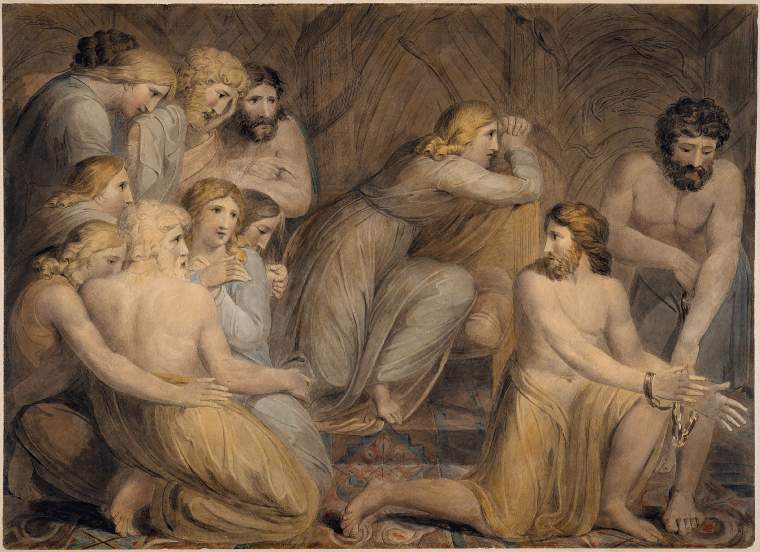
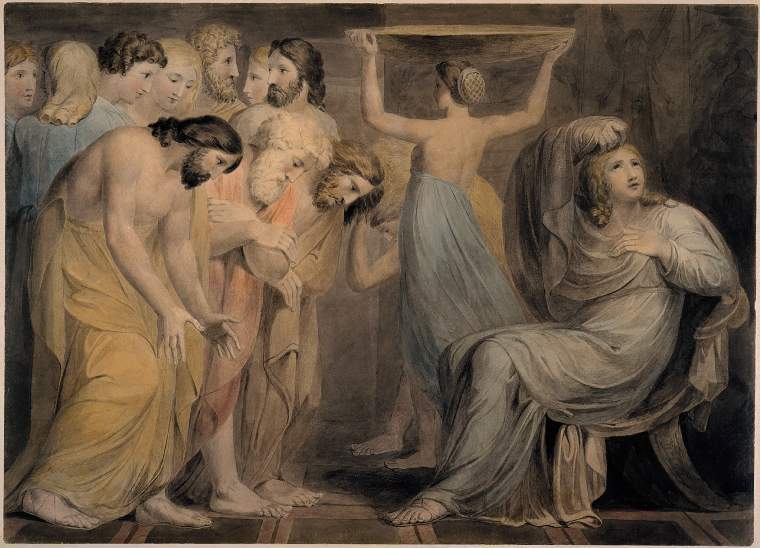
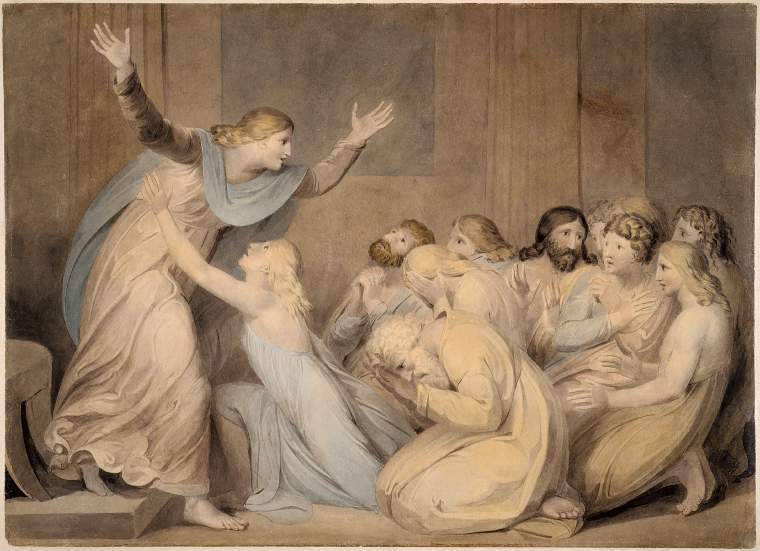
After Blake completed his engraving apprenticeship he aspired to establish himself as a reproductive engraver and as a painter. He enrolled in the Royal Academy which had been formed to encourage and support artists. His acceptance made his eligible to enroll in classes and apply to have his work displayed at the annual Exhibition. His first item which was accepted in 1780 was the watercolor drawing The Death of Earl Godwin. In 1785 he exhibited four History Painting in the style of work encouraged by the Academy. Three of his works shown in that exhibition concerned the biblical story of Joseph and are included in this post.

In Life of William Blake, Volume 1 by Alexander Gilchrist, Anne Gilchrist there is more about the early type of work Blake executed to gain acceptance into the community of artists:

"From 27, Broad Street, Blake in 1785 sent four water-colour drawings or frescos, in his peculiar acceptation of the term, to the Academy-Exhibition... One of Blake's drawings is from Gray, The Bard. 

The others are subjects from the Story of Joseph: Joseph's Brethren bowing before him; Joseph making himself known to them; Joseph ordering Simeon to be bound. The latter series I have seen. The drawings are interesting for their imaginative merit, and as specimens, full of soft tranquil beauty, of Blake's earlier style: a very different one from that of his later and better-known works. Conceived in a dramatic spirit, they are executed in a subdued key, of which extravagance is the last defect to suggest itself. The design is correct and blameless, not to say tame (for Blake), the colour full, harmonious and sober. At the head of the Academy-Catalogues of those days, stands the stereotype notification, 'The pictures &c. marked (*) are to be disposed of.' Blake's are not so marked: let us hope they were disposed of! The three Joseph drawings turned up within the last ten years in their original close rose-wood frames (a far from advantageous setting), at a broker's in Wardour Street, who had purchased them at a furniture-sale in the neighbourhood. They were sent to the International Exhibition of 1862." 

Fitzwilliam Museum
The Story of Joseph
Joseph ordering Simeon to be bound
Genesis 42
[8] And Joseph knew his brethren, but they knew not him.
...
[18] And Joseph said unto them the third day, This do, and live; for I fear God:
[19] If ye be true men, let one of your brethren be bound in the house of your prison: go ye, carry corn for the famine of your houses:
[20] But bring your youngest brother unto me; so shall your words be verified, and ye shall not die. And they did so.
[21] And they said one to another, We are verily guilty concerning our brother, in that we saw the anguish of his soul, when he besought us, and we would not hear; therefore is this distress come upon us.
[22] And Reuben answered them, saying, Spake I not unto you, saying, Do not sin against the child; and ye would not hear? therefore, behold, also his blood is required.
[23] And they knew not that Joseph understood them; for he spake unto them by an interpreter.
[24] And he turned himself about from them, and wept; and returned to them again, and communed with them, and took from them Simeon, and bound him before their eyes.

Fitzwilliam Museum
The Story of Joseph
Joseph's brethren bowing down before him 
Genesis 43 
[25] And they made ready the present against Joseph came at noon: for they heard that they should eat bread there.
[26] And when Joseph came home, they brought him the present which was in their hand into the house, and bowed themselves to him to the earth.
[27] And he asked them of their welfare, and said, Is your father well, the old man of whom ye spake? Is he yet alive?
[28] And they answered, Thy servant our father is in good health, he is yet alive. And they bowed down their heads, and made obeisance.
[29] And he lifted up his eyes, and saw his brother Benjamin, his mother's son, and said, Is this your younger brother, of whom ye spake unto me? And he said, God be gracious unto thee, my son.

Fitzwilliam Museum
The Story of Joseph
Joseph making himself known to his brethren 
Gen.45
[1] Then Joseph could not refrain himself before all them that stood by him; and he cried, Cause every man to go out from me. And there stood no man with him, while Joseph made himself known unto his brethren.
[2] And he wept aloud: and the Egyptians and the house of Pharaoh heard.
[3] And Joseph said unto his brethren, I am Joseph; doth my father yet live? And his brethren could not answer him; for they were troubled at his presence.
[4] And Joseph said unto his brethren, Come near to me, I pray you. And they came near. And he said, I am Joseph your brother, whom ye sold into Egypt.
[5] Now therefore be not grieved, nor angry with yourselves, that ye sold me hither: for God did send me before you to preserve life.
...
[13] And ye shall tell my father of all my glory in Egypt, and of all that ye have seen; and ye shall haste and bring down my father hither.
[14] And he fell upon his brother Benjamin's neck, and wept; and Benjamin wept upon his neck.
[15] Moreover he kissed all his brethren, and wept upon them: and after that his brethren talked with him.
[16] And the fame thereof was heard in Pharaoh's house, saying, Joseph's brethren are come: and it pleased Pharaoh well, and his servants.

.

Tuesday, October 22, 2019

AWAKE YE DEAD

Pollok House
Glasgow Museums
Tempera on canvas
Entombment

This beautiful image is in the collection of the Pollok House of the Glasgow Museums. It is assumed to be one of the biblical temperas which Blake painted for Thomas Butts between 1799–1800. Blake referred to biblical accounts and his own imagination when, in his terminology, he invented this image.

The central standing figure can be identified as Joseph of Arimathea in whose tomb the body of Jesus was laid. Or since the figure holds a jar which may hold spices, the male figure may be Nicodemus whom John reports brought spices and aloe to the tomb in preparation for burial. The standing weeping woman with face covered I assume to be Mary Magdelene. Perhaps Blake was thinking of Mary the Mother of James and Joses, whose presence at the tomb was recorded by Matthew and Mark, when he painted the woman to the left of Joseph in the painting. There are four kneeling women in the foreground including one, perhaps the mother of Jesus, whose face is visible and whose head is covered by a white scarf on which the light shines. There are two men whose faces are visible kneeling at the feet of the body of Jesus. Behind the body are additional kneeling figures with faces hidden.The light appears to originate, not from an exterior source but from Jesus himself wrapped in the linen shroud. Behind the three standing figures is an open window which Blake characteristically used to indicate that death was not the end but an entry into Life Eternal.
Luke 23
[50] And, behold, there was a man named Joseph, a counseller; and he was a good man, and a just:
[51] (The same had not consented to the counsel and deed of them;) he was of Arimathaea, a city of the Jews: who also himself waited for the kingdom of God.
[52] This man went unto Pilate, and begged the body of Jesus.
[53] And he took it down, and wrapped it in linen, and laid it in a sepulchre that was hewn in stone, wherein never man before was laid.
[54] And that day was the preparation, and the sabbath drew on.
[55] And the women also, which came with him from Galilee, followed after, and beheld the sepulchre, and how his body was laid.
[56] And they returned, and prepared spices and ointments; and rested the sabbath day according to the commandment.


John 19
[38] And after this Joseph of Arimathaea, being a disciple of Jesus, but secretly for fear of the Jews, besought Pilate that he might take away the body of Jesus: and Pilate gave him leave. He came therefore, and took the body of Jesus.
[39] And there came also Nicodemus, which at the first came to Jesus by night, and brought a mixture of myrrh and aloes, about an hundred pound weight.
[40] Then took they the body of Jesus, and wound it in linen clothes with the spices, as the manner of the Jews is to bury.
[41] Now in the place where he was crucified there was a garden; and in the garden a new sepulchre, wherein was never man yet laid.
[42] There laid they Jesus therefore because of the Jews' preparation day; for the sepulchre was nigh at hand.
Matthew 27
[54] Now when the centurion, and they that were with him, watching Jesus, saw the earthquake, and those things that were done, they feared greatly, saying, Truly this was the Son of God.
[55] And many women were there beholding afar off, which followed Jesus from Galilee, ministering unto him:
[56] Among which was Mary Magdalene, and Mary the mother of James and Joses, and the mother of Zebedee's children.
[57] When the even was come, there came a rich man of Arimathaea, named Joseph, who also himself was Jesus' disciple:
[58] He went to Pilate, and begged the body of Jesus. Then Pilate commanded the body to be delivered.
[59] And when Joseph had taken the body, he wrapped it in a clean linen cloth,
[60] And laid it in his own new tomb, which he had hewn out in the rock: and he rolled a great stone to the door of the sepulchre, and departed.
[61] And there was Mary Magdalene, and the other Mary, sitting over against the sepulchre.

Mark 15
[40] There were also women looking on afar off: among whom was Mary Magdalene, and Mary the mother of James the less and of Joses, and Salome;
[41] (Who also, when he was in Galilee, followed him, and ministered unto him;) and many other women which came up with him unto Jerusalem.
[42] And now when the even was come, because it was the preparation, that is, the day before the sabbath,
[43] Joseph of Arimathaea, an honourable counseller,  which also waited for the kingdom of God, came, and went in boldly unto Pilate, and craved the body of Jesus.
[44] And Pilate marvelled if he were already dead: and calling unto him the centurion, he asked him whether he had been any while dead.
[45] And when he knew it of the centurion, he gave the body to Joseph.
[46] And he bought fine linen, and took him down, and wrapped him in the linen, and laid him in a sepulchre which was hewn out of a rock, and rolled a stone unto the door of the sepulchre.
[47] And Mary Magdalene and Mary the mother of Joses beheld where he was laid.


Luke.24

[1] Now upon the first day of the week, very early in the morning, they came unto the sepulchre, bringing the spices which they had prepared, and certain others with them.
[2] And they found the stone rolled away from the sepulchre.
[3] And they entered in, and found not the body of the Lord Jesus.
John.20
[1] The first day of the week cometh Mary Magdalene early, when it was yet dark, unto the sepulchre, and seeth the stone taken away from the sepulchre.

Fearful Symmetry, Northrop Frye, Page 401
"A dream is the process of taking a subreality to be real which is induced in us by bodily and mental inertia. But a complete understanding of a dream includes a knowledge that it is one, a knowledge that at once wakes us up. The crucified Christ is the visible form of Man's dream state, and as whatever is completely visible is transparent, that means that the crucified Christ is a prism or lens of reality, that is an eye, which man is slowly trying to open." 


Four Zoas, Night VIII, Page 110, (E 379)
"Thus was the Lamb of God condemnd to Death         
They naild him upon the tree of Mystery weeping over him
And then mocking & then worshipping calling him Lord & King
Sometimes as twelve daughters lovely & sometimes as five
They stood in beaming beauty & sometimes as one even Rahab 
Who is Mystery Babylon the Great the Mother of Harlots    

Jerusalem saw the Body dead upon the Cross She fled away
Saying Is this Eternal Death   Where shall I hide from Death
Pity me Los pity me Urizen & let us build     
A Sepulcher & worship Death in fear while yet we live 
Death! God of All from whom we rise to whom we all return
And Let all Nations of the Earth worship at the Sepulcher 
With Gifts & Spices with lamps rich embossd jewels & gold

Los took the Body from the Cross Jerusalem weeping over
They bore it to the Sepulcher which Los had hewn in the rock 
Of Eternity for himself he hewd it despairing of Life Eternal"

Four Zoas, Night IX, Page 117, (E 386)
               "VALA
          Night the Ninth
               Being
          The Last Judgment

And Los & Enitharmon builded Jerusalem weeping   
Over the Sepulcher & over the Crucified body
Which to their Phantom Eyes appear'd still in the Sepulcher
But Jesus stood beside them in the Spirit Separating
Their Spirit from their body. Terrified at Non Existence 
For such they deemd the death of the body. Los his vegetable hands
Outstretchd his right hand branching out in fibrous Strength
Siezd the Sun. His left hand like dark roots coverd the Moon
And tore them down cracking the heavens across from immense to immense
Then fell the fires of Eternity with loud & shrill 
Sound of Loud Trumpet thundering along from heaven to heaven
A mighty sound articulate Awake ye dead & come
To judgment from the four winds Awake & Come away" 
.

Tuesday, October 15, 2019

EAGLE

British Museum
"The Eagle. Ballad the Second" 
in Hayley's "Designs to a Series of Ballads"
Final verses of Hayley's ballad, The Eagle:
"She lives unhurt—unhurt too lies
    The baby in her clasp;
  And her aerial tyrant dies
    Just strangled in her grasp.

  What triumph swelled in Donald's breast,
    And o'er his features spread.
  When he his living mother prest,
    And held the Eagle dead!

  Angels, who left your realms of bliss.
    And on this parent smil'd,
  Guard every mother brave as this,
    In rescuing her child!"

When Hayley wrote his series of poems for Blake to illustrate, he portrayed the eagle as a sinister bird bent on harming an infant. This was contrary to the symbolic meaning which Blake gave to the eagle. The magnificent bird who dwelt in the heights incorporated genius and imagination to Blake. When Eternal death took hold of Man, the Eagle along with the Lion and the horse participated in the degradation. Although his bright eyes decayed the Eagle continued his watch over the Eternal Man sleeping in the Earth.

Marriage of heaven and Hell, Plate 9, (E 37)
"Proverbs of Hell
When thou seest an Eagle, thou seest a portion of Genius. lift up thy head!"

Four Zoas, Night VIII, Page 113, (E 384)
"O how the horrors of Eternal Death take hold on Man
His faint groans shake the caves & issue thro the desolate rocks 

PAGE 113 [109] 
And the Strong Eagle now with num[m]ing cold blighted of feathers
Once like the pride of the sun now flagging in cold night
Hovers with blasted wings aloft watching with Eager Eye
Till Man shall leave a corruptible body he famishd hears him groan
And now he fixes his strong talons in the pointed rock 
And now he beats the heavy air with his enormous wings
Beside him lies the Lion dead & in his belly worms
Feast on his death till universal death devours all
And the pale horse seeks for the pool to lie him down & die
But finds the pools filled with serpents devouring one another
He droops his head & trembling stands & his bright eyes decay
These are the Visions of My Eyes the Visions of Ahania"

In this image Blake showed an eagle drawing near to the child without malice. The smiling child greeted the eagle as a friend while the mother expressed alarm. The child to Blake was open to imagination, while the woman was closed in her sense based cavern. 


Marriage of Heaven and Hell, PLATE 15, (E 39)
                            "A Memorable Fancy

   I was in a Printing house in Hell & saw the method in which
knowledge is transmitted from generation to generation.
   In the first chamber was a Dragon-Man, clearing away the
rubbish from a caves mouth; within, a number of Dragons were
hollowing the  cave, 
   In the second chamber was a Viper folding round the rock & the 
cave, and others adorning it with gold silver and precious
stones.
   In the third chamber was an Eagle with wings and feathers of air, 
he caused the inside of the cave to be infinite, around were
numbers  of Eagle like men, who built palaces in the immense
cliffs.
   In the fourth chamber were Lions of flaming fire raging around
&  melting the metals into living fluids.
   In the fifth chamber were Unnam'd forms, which cast the metals 
into the expanse.
   There they were reciev'd by Men who occupied the sixth
chamber,  and took the forms of books & were arranged in
libraries."

Visions of Daughters of Albion, Plate 2, (E 47) 
"I cry arise O Theotormon for the village dog
Barks at the breaking day. the nightingale has done lamenting.
The lark does rustle in the ripe corn, and the Eagle returns     
From nightly prey, and lifts his golden beak to the pure east;
Shaking the dust from his immortal pinions to awake
The sun that sleeps too long. Arise my Theotormon I am pure.
Because the night is gone that clos'd me in its deadly black."

Saturday, October 12, 2019

ST MATTHEW

Cleveland Art Museum

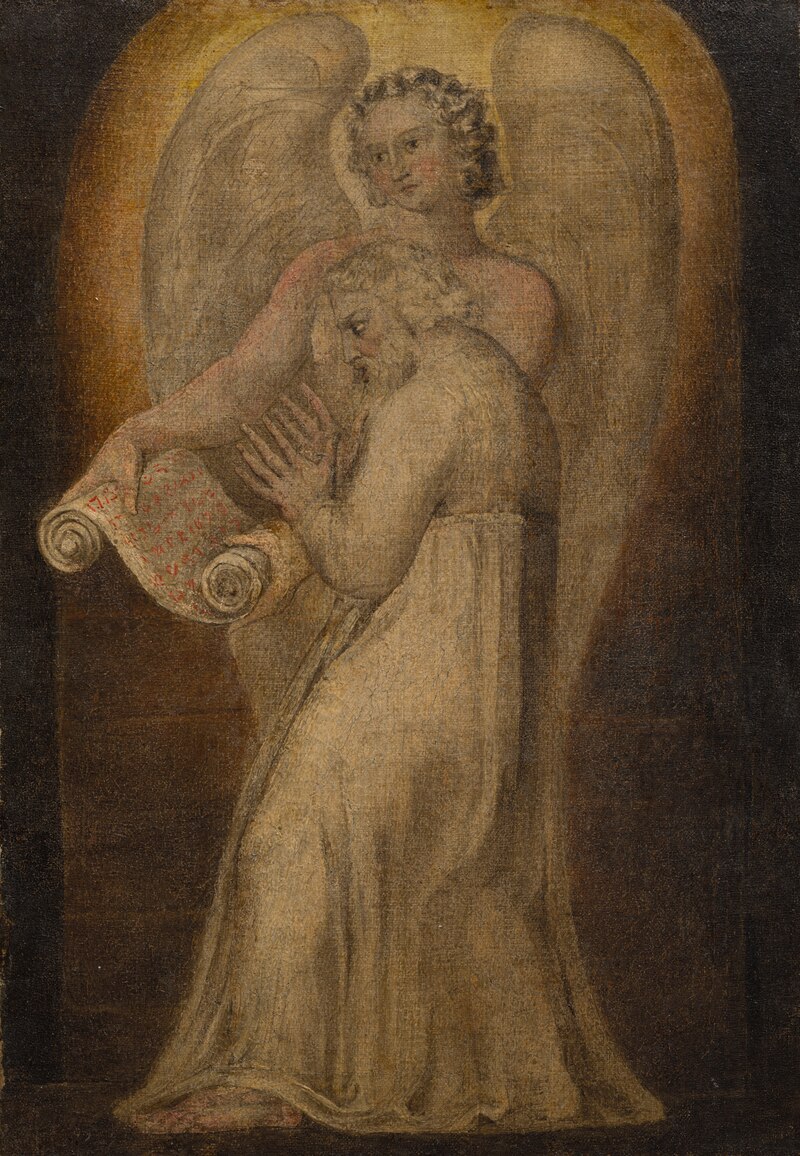
St Matthew and the Angel
Although there is no account in the Bible of the writer of the Gospel of Matthew having received his book by dictation from an angel, artists found this an attractive subject for a painting. When Blake was engaged by Thomas Butts to paint a series of pictures based on the Bible he included his own version of the event perhaps because he was familiar with paintings of the subject by accomplished artists.

A distinctive characteristic of Blake's image is that St Matthew is reading from the completed document rather than writing it from the angel's dictation. The angel simply holds the open scroll with Hebrew characters before Matthew who reacts with astonishment. Blake himself knew how it felt receive dictation from a spiritual source. Such a Spiritual Act had happened to him when he wrote "without Premeditation
& even against my Will."


Cleveland Art Museum description of picture:
"The energy and awe with which the evangelist Saint Matthew responds to the angel presenting the divinely inspired text echoes William Blake’s attitude toward artistic inspiration. From childhood Blake experienced visions that are reflected in the otherworldliness of his work. While Blake was not embraced by the fine art establishment, a small group of patrons believed in his genius and commissioned works in which his unusual visions had free rein."

From article in Cleveland Art Museum's Magazine:
"Saint Matthew was painted for Thomas Butts, for whom Blake made at least 53 paintings of biblical themes between 1799 and 1803. Butts let Blake choose the subject: characteristically, in this case, a departure from traditional depictions of the angel dictating the gospel to Saint Matthew. Instead, Blake’s angel presents the completed text––a scroll with blood-red Hebrewesque letters––to the bewildered evangelist."

Letters, (E 728)
[To] Mr Butts, Grt Marlborough Street
Felpham April 25: 1803 "But none can know the Spiritual Acts of my three years Slumber on the banks of the Ocean unless he has seen them in the Spirit or unless he should read My long Poem descriptive of those Acts for I have in these three years composed an immense number of verses on One Grand Theme Similar to Homers Iliad or Miltons Paradise Lost the Person & Machinery intirely new to the Inhabitants of Earth (some of the Persons Excepted) I have written this Poem from immediate Dictation twelve or sometimes twenty or thirty lines at a time without Premeditation & even against my Will. the Time it has taken in writing was thus renderd Non Existent. & an immense Poem Exists which seems to be the Labour of a long Life all producd without Labour or Study. I mention this to shew you what I think the Grand Reason of my being brought down here"


.

Wednesday, October 9, 2019

Blakean Bible

Wikimedia Commons
Illustrations to Young's Night Thoughts

Under the influence of the Bible and William Blake, Larry wrote these few words many years ago. 

"A free Blakean translation of John 3:16 with a touch of Philippians 2 added might read:

God so forgave the world that he annihilated his transcendent Deity and united himself through a corporeal sepulcher with sinful, materialistic man to lift us up to Eternity.

Here is the ultimate of spiritual authority, and those who meet Jesus begin to exercise it in the way that he did."

John 3
[15] That whosoever believeth in him should not perish, but have eternal life.
[16] For God so loved the world, that he gave his only begotten Son, that whosoever believeth in him should not perish, but have everlasting life.
[17] For God sent not his Son into the world to condemn the world; but that the world through him might be saved.
[18] He that believeth on him is not condemned: but he that believeth not is condemned already, because he hath not believed in the name of the only begotten Son of God.
[19] And this is the condemnation, that light is come into the world, and men loved darkness rather than light, because their deeds were evil.
[20] For every one that doeth evil hateth the light, neither cometh to the light, lest his deeds should be reproved.
[21] But he that doeth truth cometh to the light, that his deeds may be made manifest, that they are wrought in God.
[22] After these things came Jesus and his disciples into the land of Judaea; and there he tarried with them, and baptized.

First John 4
[7] Beloved, let us love one another: for love is of God; and every one that loveth is born of God, and knoweth God.
[8] He that loveth not knoweth not God; for God is love.
[9] In this was manifested the love of God toward us, because that God sent his only begotten Son into the world, that we might live through him.
[10] Herein is love, not that we loved God, but that he loved us, and sent his Son to be the propitiation for our sins.
[11] Beloved, if God so loved us, we ought also to love one another.
[12] No man hath seen God at any time. If we love one another, God dwelleth in us, and his love is perfected in us.
[13] Hereby know we that we dwell in him, and he in us, because he hath given us of his Spirit.


Philippians 2
[1] If there be therefore any consolation in Christ, if any comfort of love, if any fellowship of the Spirit, if any bowels and mercies,
[2] Fulfil ye my joy, that ye be likeminded, having the same love, being of one accord, of one mind.
[3] Let nothing be done through strife or vainglory; but in lowliness of mind let each esteem other better than themselves.
[4] Look not every man on his own things, but every man also on the things of others.
[5] Let this mind be in you, which was also in Christ Jesus:
[6] Who, being in the form of God, thought it not robbery to be equal with God:
[7] But made himself of no reputation, and took upon him the form of a servant, and was made in the likeness of men:
[8] And being found in fashion as a man, he humbled himself, and became obedient unto death, even the death of the cross.
[9] Wherefore God also hath highly exalted him, and given him a name which is above every name:
[10] That at the name of Jesus every knee should bow, of things in heaven, and things in earth, and things under the earth;
[11] And that every tongue should confess that Jesus Christ is Lord, to the glory of God the Father.
[12] Wherefore, my beloved, as ye have always obeyed, not as in my presence only, but now much more in my absence, work out your own salvation with fear and trembling.
[13] For it is God which worketh in you both to will and to do of his good pleasure.

Gates of Paradise, For the Sexes, (E 269)
"13   But when once I did descry 
     The Immortal Man that cannot Die
14   Thro evening shades I haste away 
     To close the Labours of my Day
15   The Door of Death I open found                             
     And the Worm Weaving in the Ground
16   Thou'rt my Mother from the Womb 
     Wife, Sister, Daughter to the Tomb 
     Weaving to Dreams the Sexual strife
     And weeping over the Web of Life" 
.