Blake seeks to provide the Golden String which can lead us through the labyrinth of our experience or his own poetry.

Friday, April 29, 2022

FIRST VISION

First posted Feb 2019
 
British Museum
Small Book of Designs
From Marriage of Heaven and Hell

 Milton Klonsky's book William Blake, The Seer and His Visions, published in 1977, approaches the study of Blake from his own unique position as do each of us. Klonsky was the product of his time and his environment and wrote with the zeal of one immersed in the dawning of a new age.

W. C. Bamberger on the blog named Zoamorphosis tells us that:

"Klonsky was a classic 'Village Intellectual' who set out to know everything interesting there was to know—about drugs, drink, poetry, politics, and most memorably, the great poet artist William Blake. And, further, to combine all this in unexpected ways, give it some topspin, and serve it back with style."

Klonsky began his book with a striking account of his 'first and only' use of LSD. Were it not for the role that Blake's poetry played in that experience it would not have had such a profound impact on Klonsky.
On page 8 of Klonsky's book he relates the consequences of his 'trip' as opening him to a new way of seeing and an alteration of his awareness of time and eternity:  

"My 'trip', I knew, would last from five to six hours...but suppose it were to take fifty years, sixty, a whole lifetime? What then? As if existence itself were a more subtly corrosive kind of acid, consuming and flaying us, almost unawares, from within and without, to whose pangs we gradually become accustomed until the end. It occurred to me then, as I lurched and plodded off the beach, that this is what Blake must have meant when he wrote: 'Time is the mercy of Eternity; without Times swiftness/Which is the swiftest of all things: all were eternal torment':
...
"Looking back now I can recall neither visions nor apparitions, disembodied genii nor spirits out of the vasty deep - unless, perhaps, that of Blake himself, whom I invoked to preside over the scene. What I saw instead ('As the Eye,' said Blake, 'such the Object') was the world as I had always conceived it to be, the only 'real' reality of matter reduced to minuter and minuter particles in a space-time expanding to infinity-eternity, no more no less,  according to the scientific dispensation of Newton & Einstein, but which I had never perceived so 'im-mediativtely' and 'into-it-ively' until then."

These are the passages from Blake which were incorporated in Klonsky's intense LSD experience:

Marriage of Heaven and Hell, Plate 14, (E 39)
 "If the doors of perception were cleansed every thing would
appear  to man as it is: infinite.
   For man has closed himself up, till he sees all things thro'
narrow chinks of his cavern."

Songs of Experience, Introduction, (E 18)
"Turn away no more:
Why wilt thou turn away
The starry floor
The watry shore
Is giv'n thee till the break of day."

Auguries of Innocence, (E 490)
"To see a World in a Grain of Sand
And a Heaven in a Wild Flower
Hold Infinity in the palm of your hand
And Eternity in an hour"

Milton, Plate 17, (E 110) 
"The Mundane Shell, is a vast Concave Earth: an immense
Hardend shadow of all things upon our Vegetated Earth
Enlarg'd into dimension & deform'd into indefinite space,
In Twenty-seven Heavens and all their Hells; with Chaos
And Ancient Night; & Purgatory. It is a cavernous Earth
Of labyrinthine intricacy,"

Milton, Plate 24 [26], (E 121)
"Time is the mercy of Eternity; without Times swiftness
Which is the swiftest of all things: all were eternal torment:"  
                                   _________________
In addition W. C. Bamberger has this to say about Klonsky's  involvement with Blake:
"Blake intoxicates Klonsky, helps him look at the world with sustained energy, and from new perspectives - with the added benefit of avoiding the damaging effects of less literary and artistic drugs."

"Such perception, Klonsky points out, 'must be personal. . .  [Has] to be seen by himself alone. There can be no other eyewitness.'"

Letters, To Rev Trusler, (E 701)
But I
hope that none of my Designs will be destitute of Infinite
Particulars which will present themselves to the Contemplator. 
And tho I call them Mine   I know that they are not Mine being of
the same opinion with Milton when he says That the Muse visits
his Slumbers & awakes & governs his Song when Morn purples The
East. & being also in the predicament of that prophet who says  I
cannot go beyond the command of the Lord to speak good or bad 

Letters, To Thomas Butts, (E 712)
"To my Friend Butts I write
     My first Vision of Light
     On the yellow sands sitting
     The Sun was Emitting
     His Glorious beams
     From Heavens high Streams
     Over Sea over Land
     My Eyes did Expand
     Into regions of air
     Away from all Care
     Into regions of fire
     Remote from Desire
     The Light of the Morning
     Heavens Mountains adorning
     In particles bright
     The jewels of Light
     Distinct shone & clear--
     Amazd & in fear
     I each particle gazed
     Astonishd Amazed
     For each was a Man
     Human formd.  Swift I ran
     For they beckond to me
     Remote by the Sea
     Saying.  Each grain of Sand
     Every Stone on the Land
     Each rock & each hill
     Each fountain & rill
     Each herb & each tree
     Mountain hill Earth & Sea
     Cloud Meteor & Star
     Are Men Seen Afar"  
 

Wednesday, April 27, 2022

WITNESS TO THE LIGHT

Milton, Plate 10 [11], (E 104)
"Every thing in Eternity shines by its own Internal light: but thou
Darkenest every Internal light with the arrows of thy quiver
Bound up in the horns of jealousy to a deadly fading Moon
And Ocalythron binds the Sun into a Jealous Globe
That every thing is fixd Opake without Internal light         

So Los lamented over Satan, who triumphant divided the Nations"

Jerusalem, PLATE 54, (E 203)
"In Great Eternity, every particular Form gives forth or Emanates
Its own peculiar Light, & the Form is the Divine Vision
And the Light is his Garment This is Jerusalem in every Man
A Tent & Tabernacle of Mutual Forgiveness Male & Female Clothings.
And Jerusalem is called Liberty among the Children of Albion" 

Four Zoas, Night V, Page 61,  (E 341)
"His eyes the lights of his large soul contract or else expand
Contracted they behold the secrets of the infinite mountains
The veins of gold & silver & the hidden things of Vala          
Whatever grows from its pure bud or breathes a fragrant soul
Expanded they behold the terrors of the Sun & Moon
The Elemental Planets & the orbs of eccentric fire"

Letters, To Hayley, (E 756)
"Suddenly,
on the day after visiting the Truchsessian Gallery of pictures, I
was again enlightened with the light I enjoyed in my youth, and
which has for exactly twenty years been closed from me as by a
door and by window-shutters.  Consequently I can, with
confidence, promise you ocular demonstration of my altered state
on the plates I am now engraving after Romney, whose spiritual
aid has not a little conduced to my restoration to the light of
Art.

A clear account of seeing not an objective thing but the intrinsic reality which underlies surface appearance is found in Robert Pirsig's novel Lila. Pirsig named the philosophy of Phaedrus Dynamic Quality. The exterior static constructs of the left brain fail to provide the flexible perspective which recognizes goodness as it appears in all its aspects.

Robert Pirsig's second novel: read Lila as pdf 

Passage from the end of chapter 26:

"Once when Phaedrus was standing in one of the galleries of the Boston Museum of Fine Arts, he saw on one wall a huge painting of the Buddha and nearby were some paintings of Christian saints. He noticed again something he had thought about before. Although the Buddhists and Christians had no historic cont act with one another they both painted halos. The halos weren't the same size. The Buddhists painted great big ones, sometimes surrounding the person's whole body, while the Christian ones were smaller and in back of the person's head or over it. It seemed to mean the two religions weren't copying one another or they would have made the halos the same size. But they we re both painting something they were seeing separately, which implied that that 'something' they were  painting had a real, independent existence.

Then as Phaedrus was thinking this he noticed one painting in the corner and thought, There. What the others are just painting symbolically he is actually showing. They're seeing it second-hand. He's seeing it first hand.

It was a painting of Christ with no halo at all. But the clouds in the sky behind his head were slightly lighter near his head than farther away. And the sky near his head was lighter too. That was all. But that was the real illumination, no objective thing at all, just a shift in intensity of light. Phaedru stepped up to the canvas to read the name-plate at the bottom. It was El Greco again.

Our culture immunizes us against giving much importance to all this because the light has no 'objective' reality. That means it's just some 'subjective' and therefore unreal phenomenon. In a Metaphysics of Quality, however, this light is important because it often appears associated with undefined auspiciousness, that is, with Dynamic Quality. It signals a Dynamic intrusion upon a static situation. When there is a letting go of static patterns the light occurs. It is often accompanied by a feeling of relaxation because static patterns have been jarred loose. He thought it was probably the light that infants see when their world is still fresh and whole, before consciousness differentiates it into patterns; a light into which everything fades at death. Accounts of people who have had a 'near death experience' have referred to this 'white light' as something very beautiful and compelling from which they didn't want to return. The light would occur during the breakup of the static patterns of the person's intellect as it returned into the pure Dynamic Quality from which it had emerged in infancy.

During Phaedrus' time of insanity when he had wandered freely outside the limits of cultural reality, this light had been a valued companion, pointing out things to him that he would otherwise have missed, appearing at an event his rational thought had indicated was unimportant, but which he would later discover had been more important than he had known. Other times it had occurred at events he could not figure out the importance of, but which had left him wondering.

He saw it once on a small kitten. After that for a long time the kitten followed him wherever he went and he wondered if the kitten saw it too.

He had seen it once around a tiger in a zoo. The tiger had suddenly looked at him with what seemed like surprise and had come over to the bars for a closer look. Then the illumination began to appear around the tiger's face. That was all. Afterward, that experience associated itself with William Blake's 'Tiger! Tiger! burning bright.'

The eyes had blazed with what seemed to be inner light."


Matthew 17 
[1] And after six days Jesus taketh Peter, James, and John his brother, and bringeth them up into an high mountain apart,
[2] And was transfigured before them: and his face did shine as the sun, and his raiment was white as the light. 
[3] And, behold, there appeared unto them Moses and Elias talking with him. 

Luke 11
[33] No man, when he hath lighted a candle, putteth it in a secret place, neither under a bushel, but on a candlestick, that they which come in may see the light.
[34] The light of the body is the eye: therefore when thine eye is single, thy whole body also is full of light; but when thine eye is evil, thy body also is full of darkness.
[35] Take heed therefore that the light which is in thee be not darkness.
[36] If thy whole body therefore be full of light, having no part dark, the whole shall be full of light, as when the bright shining of a candle doth give thee light.

John 5
[33] Ye sent unto John, and he bare witness unto the truth.
[34] But I receive not testimony from man: but these things I say, that ye might be saved.
[35] He was a burning and a shining light: and ye were willing for a season to rejoice in his light.
[36] But I have greater witness than that of John: for the works which the Father hath given me to finish, the same works that I do, bear witness of me, that the Father hath sent me.

Acts 26
[12] Whereupon as I went to Damascus with authority and commission from the chief priests,
[13] At midday, O king, I saw in the way a light from heaven, above the brightness of the sun, shining round about me and them which journeyed with me.
[14] And when we were all fallen to the earth, I heard a voice speaking unto me, and saying in the Hebrew tongue, Saul, Saul, why persecutest thou me? it is hard for thee to kick against the pricks. 
[15] And I said, Who art thou, Lord? And he said, I am Jesus whom thou persecutest.

John 8
[12] Then spake Jesus again unto them, saying, I am the light of the world: he that followeth me shall not walk in darkness, but shall have the light of life.
 
John 1
[4] In him was life; and the life was the light of men.
[5] And the light shineth in darkness; and the darkness comprehended it not.
[6] There was a man sent from God, whose name was John.
[7] The same came for a witness, to bear witness of the Light, that all men through him might believe.
[8] He was not that Light, but was sent to bear witness of that Light.
[9] That was the true Light, which lighteth every man that cometh into the world.

John 20
[11] But Mary stood without at the sepulchre weeping: and as she wept, she stooped down, and looked into the sepulchre,
[12] And seeth two angels in white sitting, the one at the head, and the other at the feet, where the body of Jesus had lain.
[13] And they say unto her, Woman, why weepest thou? She saith unto them, Because they have taken away my Lord, and I know not where they have laid him.

Tuesday, April 26, 2022

BLAKE & DYLAN II

First posted Oct 2010

Book of Urizen, Plate 22, (E 82)
"The tormented element stretch'd
From the sorrows of Urizen's soul."


When Larry was writing his Blake Book, (Ram Horn'd with Gold) in the seventies and eighties the influence of Bob Dylan was everywhere including under our roof. He wrote a chapter on Blake and Dylan for his book but it was not included in the online version. Since I posted on the influence of Blake's poetry on Dylan's song EVERY GRAIN ON SAND, I'd like to pass along some of what Larry said in the missing chapter:


"In style Dylan closely approaches Blake as a symbolist. Fiercely eclectic like the English poet, he drew with utmost freedom upon his entire experience for the imagery of his lyrics. This means that the listener unversed in Dylan's experience will have the same sort of problems with his lyrics as so many have had with '4Z's' or 'Jerusalem'. Much of it comes through as sheer gibberish to all except the few somewhere in the vicinity of Dylan's mind. It helps to know the sixties Greenwich Village scene, country music, blues and rock as well as Verlaine, Rimbaud and Baudelaire, plus a few other esoteric sources.

"It also helps to know the Bible. Nowhere are Blake and Dylan more alike than in their dependence upon Biblical symbolism. Dylan is fully capable of throwing a wicked curve, when for example, one of his songs embedded in the western ethos where clean hands evoke the gambling man, and suddenly he switches to the imagery of Psalm 24: "His clothes are dirty but his hands are clean". [Example from Michael Gray's book.]

"Whether he knew of Blake's letter to Trusler or not, Dylan certainly put into practice the advice of the "Wisest of the Ancients [who] consider'd what was not too Explicit as the fittest for instruction, because it rouzes the faculties to act". For the intellectually curious the lure of the two men is identical: to find the kernel of meaning in the peculiar wrapping."

It is fascinating to compare the lives of these two poets whose struggles to express their enormous gifts, and to master the psychological conflicts of warring aspects of their minds were played out so publicly in their poetry. As Larry says:
"We should realize that this ['The Wicked Messenger'] like most of Dylan's songs is essentially autobiographical. He shared Blake's perspective on the oneness of the human race. He knew that his (and our) experiences are universal. The song ends appropriately with this message to the messenger: 'If you cannot bring good news, then don't bring any.'" Our two messengers brought their good news even though they often dipped into the deepest and darkest reaches of the psyche to bring it into the light.

Lyrics to Wicked Messenger

Monday, April 25, 2022

BLAKE & DYLAN

First posted Oct 2010
 
An illustration extracted from page 61 of
William Blake, painter and poet
by Richard Garnett

A plaintive song of Bob Dylan's which was evidently written under the influence of William Blake is titled EVERY GRAIN OF SAND. It was written during what is know as Dylan's Christian period. I see in the song echoes of "Auguries of Innocence" and what may be called the "Jerusalem Hymn" from the beginning of Blake's Milton. Dylan writes of the faith and fears experienced as one travels on the spiritual journey in a world of danger and temptation. Blake's images provide an affirmative note of comfort.


Milton,
Plate 1, (E 95)
"And did those feet in ancient time,
Walk upon Englands mountains green:
And was the holy Lamb of God,
On Englands pleasant pastures seen!

And did the Countenance Divine,
Shine forth upon our clouded hills?
And was Jerusalem builded here,
Among these dark Satanic Mills?

Bring me my Bow of burning gold:
Bring me my Arrows of desire:
Bring me my Spear: O clouds unfold!
Bring me my Chariot of fire!

I will not cease from Mental Fight,
Nor shall my Sword sleep in my hand:
Till we have built Jerusalem,
In Englands green & pleasant Land."

[Pickering Manuscript], Blake's Notebook, (E 490)
AUGURIES OF INNOCENCE
"To see a World in a Grain of Sand
And a Heaven in a Wild Flower
Hold Infinity in the palm of your hand
And Eternity in an hour
A Robin Red breast in a Cage
Puts all Heaven in a Rage
A Dove house filld with doves & Pigeons
Shudders Hell thro all its regions
A dog starvd at his Masters Gate
Predicts the ruin of the State"

This poem continues for 132 lines. The final lines were used prominently in the movie "Dead Man".

EVERY GRAIN OF SAND
by Bob Dylan
"In the time of my confession, in the hour of my deepest need
When the pool of tears beneath my feet flood every newborn seed
There’s a dyin’ voice within me reaching out somewhere
Toiling in the danger and in the morals of despair

Don’t have the inclination to look back on any mistake
Like Cain, I now behold this chain of events that I must break
In the fury of the moment I can see the Master’s hand
In every leaf that trembles, in every grain of sand

Oh, the flowers of indulgence and the weeds of yesteryear
Like criminals, they have choked the breath of conscience and good cheer
The sun beat down upon the steps of time to light the way
To ease the pain of idleness and the memory of decay

I gaze into the doorway of temptation’s angry flame
And every time I pass that way I always hear my name
Then onward in my journey I come to understand
That every hair is numbered like every grain of sand

I have gone from rags to riches in the sorrow of the night
In the violence of a summer’s dream, in the chill of a wintry light
In the bitter dance of loneliness fading into space
In the broken mirror of innocence on each forgotten face

I hear the ancient footsteps like the motion of the sea
Sometimes I turn, there’s someone there, other times it’s only me
I am hanging in the balance of the reality of man
Like every sparrow falling, like every grain of sand"

Copyright © 1981 by Special Rider Music

Emmy Lou Harris singing EVERY GRAIN OF SAND


Sunday, April 24, 2022

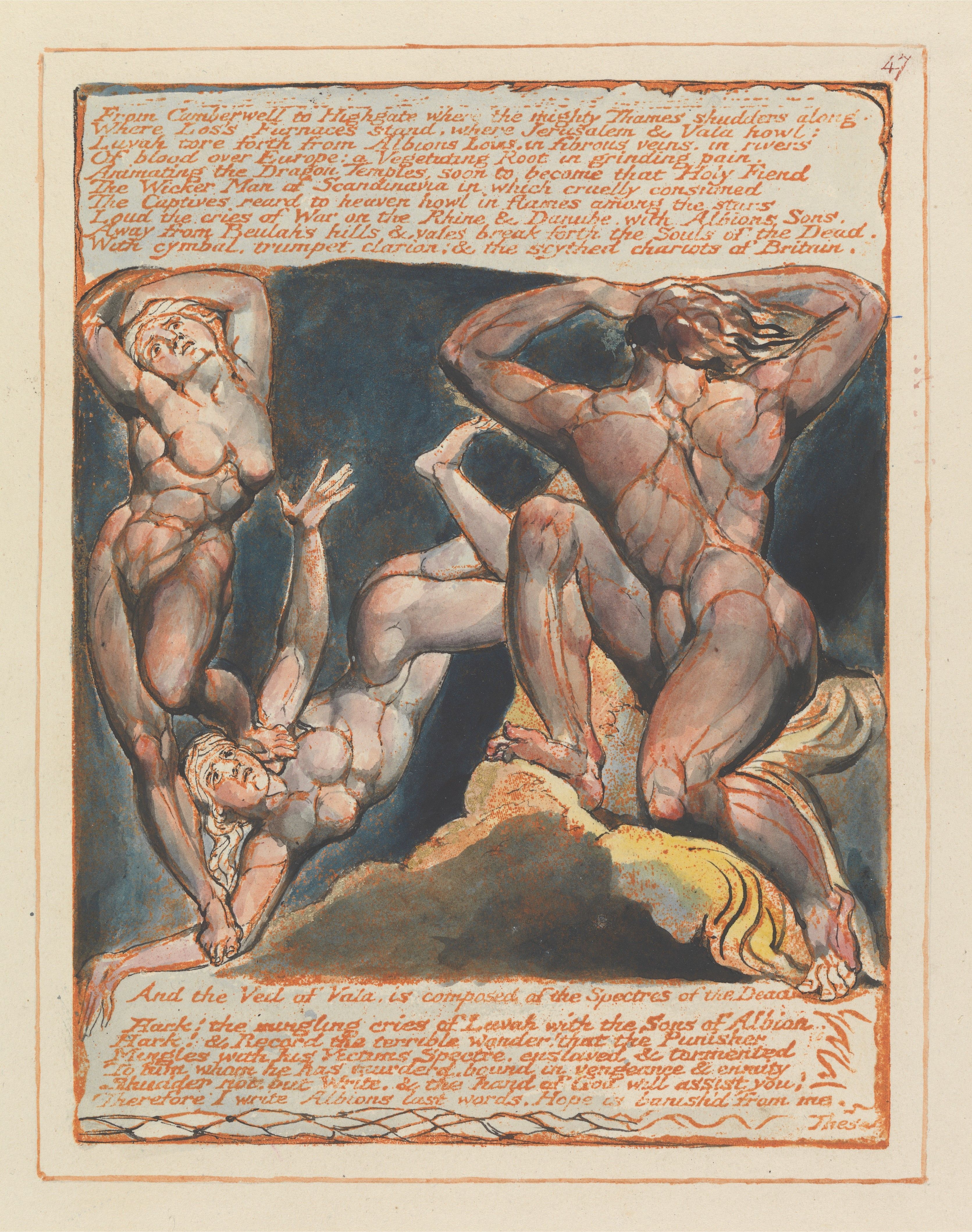
HOPE IS BANISHED

Yale Center for British Art
Jerusalem
Plate 47
 
  Dylan's life is one of the strangest odysseys, the details of which are not known to me, and may never be told. Dylan has always been at one level a very private person. Nevertheless the outline of his spiritual journey (up to now) belongs to the public and is sufficiently clear to relate it to the Blakean circle of destiny which we have studied in this book. 
 
In Blake and in Dylan we see two men who "call no man father", who fundamentally reject all forms of outward authority. Each communes with his own spirit, and this communion leads to the same end, to the encounter with Christ the King. The passage of 200 years has obscured the drama in Blake's case, so much so that his secular students almost completely lost sight of it. But Dylan's conversion is too new to be anything less than a collective trauma. His secular fans were sheerly appalled, confronted with a reality which they had systematically ignored. But Dylan's Christian audience by and large have failed to note the significance of the event, largely through the minuteness of their vision. In the history of Christianity it bears comparison to the Damascus Road, or to the strange warming of John Wesley's heart. 
 
Any number of pages could be devoted to relating Blake and Dylan, but one significant point deserves special emphasis: both men spent their pre-Christian decade celebrating fallenness. Hopefully by now the reader will have some grasp of what I mean by Blake's celebration of fallenness. Examples of this motif in Dylan's work are too numerous to do more than sample. Speaking in general the celebration of fallenness is the acme of the prophet's function. He points out to us what's wrong with our society, and he does this with the kind of language designed to raise things forcibly into our consciousness. 
 
Ezekiel had told Blake that his bizarre pantomimes were aimed at "raising other men into a perception of the infinite". Blake became pretty bizarre in his language at times, and so did Dylan, both for the purpose stated by Ezekiel. A review of Dylan's 1965 album, "Highway 61, Revisited", indicates that the denizens of Desolation Row are about as fouled up as any of Blake's giant forms. 

Here's verse 8 of the song of that name:
"Now at midnight all the agents
And the superhuman crew
Come out and round up everyone
That knows more than they do
Then they bring them to the factory ~
Where the heart attack machine Is strapped across their shoulders
And then the kerosene Is brought down from the castles
By insurance men who go
Check to see that nobody is escaping
To Desolation Row"
 
Jerusalem, Plate 47, (E 196)
[When Albion utterd his last words Hope is banishd from me]                                                   t
From Camberwell to Highgate where the mighty Thames shudders along,
Where Los's Furnaces stand, where Jerusalem & Vala howl:
Luvah tore forth from Albions Loins, in fibrous veins, in rivers
Of blood over Europe: a Vegetating Root in grinding pain.
Animating the Dragon Temples, soon to become that Holy Fiend
The Wicker Man of Scandinavia in which cruelly consumed
The Captives reard to heaven howl in flames among the stars
Loud the cries of War on the Rhine & Danube, with Albions Sons,
Away from Beulahs hills & vales break forth the Souls of the Dead,   
With cymbal, trumpet, clarion; & the scythed chariots of Britain.

And the Veil of Vala, is composed of the Spectres of the Dead

Hark! the mingling cries of Luvah with the Sons of Albion
Hark! & Record the terrible wonder! that the Punisher
Mingles with his Victims Spectre, enslaved and tormented         
To him whom he has murderd, bound in vengeance & enmity
Shudder not, but Write, & the hand of God will assist you!
Therefore I write Albions last words. Hope is banish'd from me."


Saturday, April 23, 2022

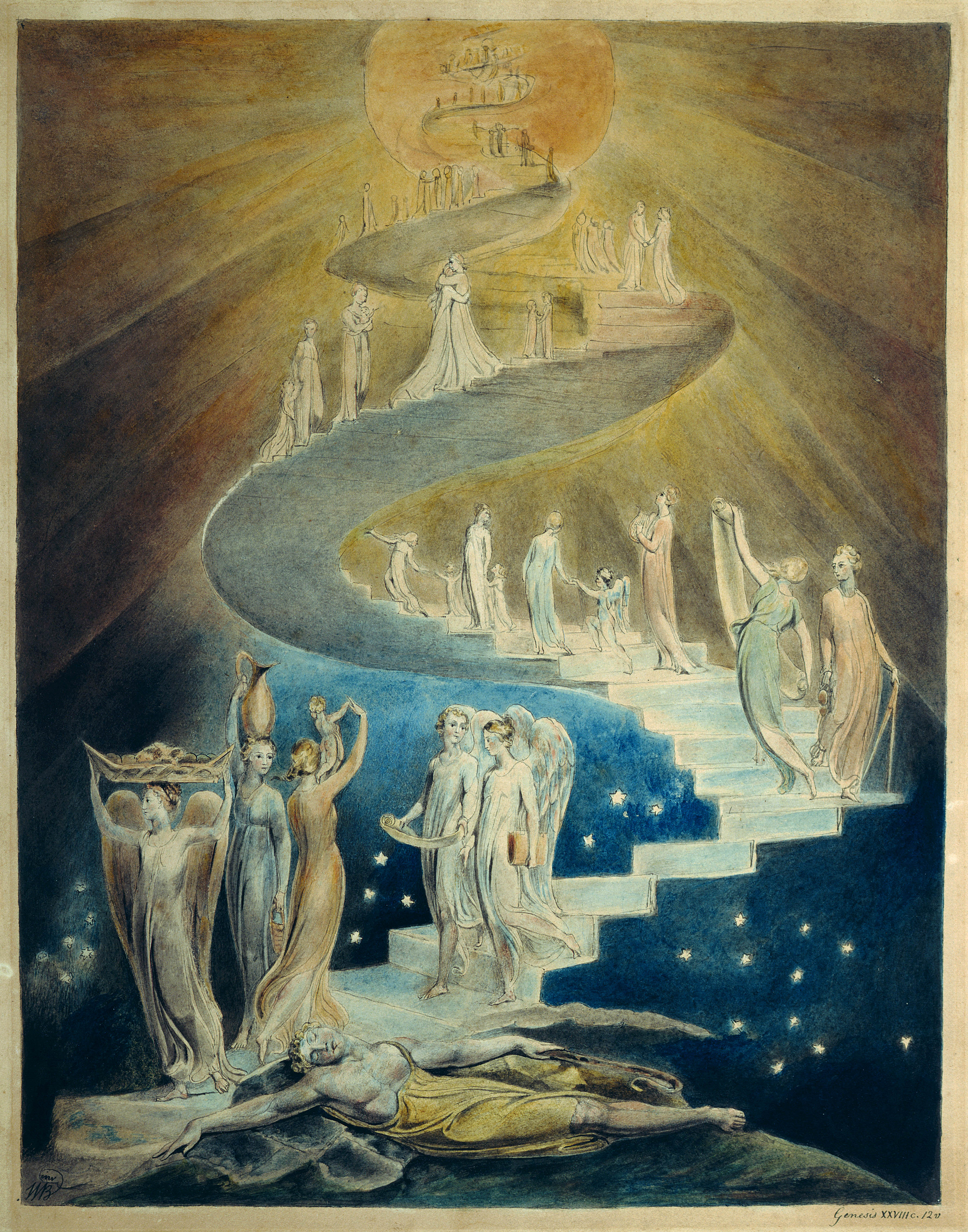
JACOB'S LADDER

Wikipedia Commons
Jacob's Ladder

Genesis 28

[10] And Jacob went out from Beer-sheba, and went toward Haran. 
[11] And he lighted upon a certain place, and tarried there all night, because the sun was set; and he took of the stones of that place, and put them for his pillows, and lay down in that place to sleep.
[12] And he dreamed, and behold a ladder set up on the earth, and the top of it reached to heaven: and behold the angels of God ascending and descending on it.
[13] And, behold, the LORD stood above it, and said, I am the LORD God of Abraham thy father, and the God of Isaac: the land whereon thou liest, to thee will I give it, and to thy seed;
[14] And thy seed shall be as the dust of the earth, and thou shalt spread abroad to the west, and to the east, and to the north, and to the south: and in thee and in thy seed shall all the families of the earth be blessed.
[15] And, behold, I am with thee, and will keep thee in all places whither thou goest, and will bring thee again into this land; for I will not leave thee, until I have done that which I have spoken to thee of.
[16] And Jacob awaked out of his sleep, and he said, Surely the LORD is in this place; and I knew it not.
[17] And he was afraid, and said, How dreadful is this place! this is none other but the house of God, and this is the gate of heaven.
[18] And Jacob rose up early in the morning, and took the stone that he had put for his pillows, and set it up for a pillar, and poured oil upon the top of it.
[19] And he called the name of that place Bethel: but the name of that city was called Luz at the first.
[20] And Jacob vowed a vow, saying, If God will be with me, and will keep me in this way that I go, and will give me bread to eat, and raiment to put on,
[21] So that I come again to my father's house in peace; then shall the LORD be my God:
[22] And this stone, which I have set for a pillar, shall be God's house: and of all that thou shalt give me I will surely give the tenth unto thee. 

The Movement Between Heaven and Earth: William Blake's Image of Jacob's Ladder 

 Conversation with Iain McGilchrist 
 Auguries of Innocence, (E 490)
 "To see a World in a Grain of Sand
And a Heaven in a Wild Flower
Hold Infinity in the palm of your hand
And Eternity in an hour"

The image Blake created of Jacob's Ladder is an invitation to see not with the eye but through the eye. But in seeing through the eye Blake was following in the footsteps of the author of the book of Genesis who provided the account of Jacob's dream. And the author of Genesis was recounting an incident from the experience of Jacob who had traveled the journey and had remembered his dream.

Since Blake read the Bible using his imagination, not with the words but through the words, he knew more about the experience of Jacob than he read in the words of Genesis. Through the visual image which he created Blake was able to convey to Iain McGilchrist aspects of Jacob's dreaming which related to the subject which most interested McGilchrist - the functioning of man's bicameral brain. 

Perhaps all of our experience in this journey through life is an invitation to see more, to simultaneously be of earth and heaven, of time and eternity, and of consciousness of the 'minute particulars' and the total reality.

Jerusalem, Plate 91, (E 251) 
"I have tried to make friends by corporeal gifts but have only    
Made enemies: I never made friends but by spiritual gifts;
By severe contentions of friendship & the burning fire of thought.
He would see the Divinity must see him in his Children
One first, in friendship & love; then a Divine Family, & in the midst
Jesus will appear; so he who wishes to see a Vision; a perfect Whole        
Must see it in its Minute Particulars;"
Auguries of Innocence, (E 492) 
"We are led to Believe a Lie 
When we see not Thro the Eye" 
 

Saturday, April 16, 2022

MAN & TIME

Here is a perspective on Blake included in J. B. Priestley's long study on time from multiple points of view over extended periods. In his book Man & Time, J. B.Priestley postulates three categories of time:

Page 292

"I propose to call these three times  -  time One, time Two and time Three. To follow some therorists and call time Two 'eternity,' a term rich in associations, would only mislead and confuse many readers...So let us make do with times One, Two and Three, remembering that we live in all three of them at once, though we may not enjoy,so to speak, equal portions of them.

As visible creatures on earth we are ruled by time One...Our brains have developed through eons into marvelous instruments of time-One attention.

...Our relation through the brain with time One tends to be practical and economic, good for our matter-handling business, which helps to explain why we are great time-One people and mostly try not to believe in anything else.

..our  minds cannot be entirely contained within time One.

..Now in time Two, where the dreams belong, there is no distinction between the possibilities which are actualized and those which are not..The alternative possibilities, together with the choice between them, cannot exist in time One."

Page 298

"Because imagination appears to be free of the limitations we place on time One, we think of it as being outside Time. It is there, however, that the nothings begin. We might do better if we thought of it belonging to a different Time order, to another time...imaginative creation seems to imply not a second time order, contemplative and detached from action, but a third, in which purpose and action are joined together and there seems to be an almost magical release of creative energy.

If there is a part of the mind or a state of consciousness that is outside of the dominion of time One and time Two but is governed by a time Three, then that is where the imagination has its home and does its work. And it may be that there imagination is not something escaping from reality but is itself reality, while the world we construct from our time-One experience is regarded there is something artificial, abstract, thin, and hollow.

...I prefer another explanation of these dreams...as glimpse of the future already shaped but still pliable, yielding...to will and action...There is an idea not unlike this in Blake's Jerusalem , in which Los (the name is Sol reversed) can be taken as the symbolic figure of Time:

"All things acted on Earth are seen in the bright Sculptures of
Los's Halls & every Age renews its powers from these Works
With every pathetic story possible to happen from Hate or
Wayward Love & every sorrow & distress is carved here
Every Affinity of Parents Marriages & Friendships are here       
In all their various combinations wrought with wondrous Art
All that can happen to Man in his pilgrimage of seventy years"
Jerusalem, Plate 16, (E 161)

Page 300

"we could say that ego and its field of consciousness belong to time One, the unconscious to time Two,the superconscious to time There. But we must remember there are no separate compartments  and exact divisions, and that we live, even here and now, in all three times."

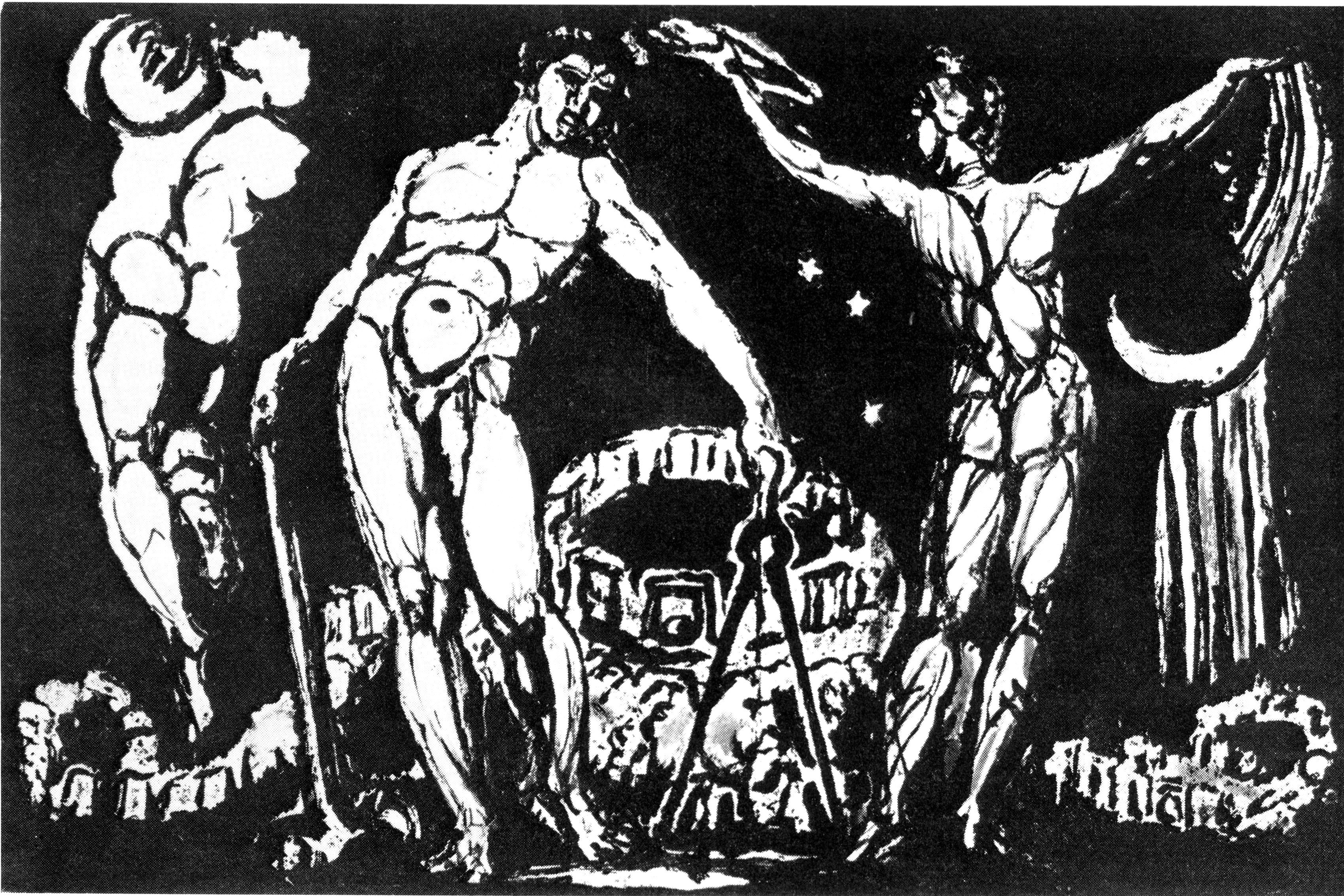
Priestley captioned this picture:

"One of William Blake's drawings for his Jerusalem. In the center, Los stands between life and death. On the right, the moon and the stars preside over the dark entrance to the Serpent Temple (the pathway of experience); on the left the sun of Time is carried back to eternity."  

British Museum
Jerusalem
Plate 100