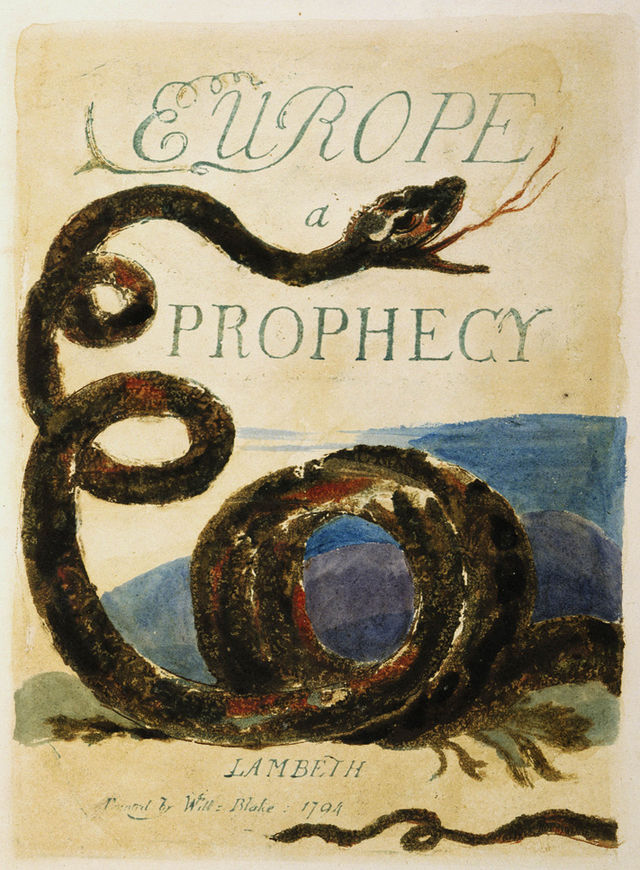
Blake seeks to provide the Golden String which can lead us through the labyrinth of our experience or his own poetry.

Sunday, October 19, 2014

EUROPE PLATE 2

Wikipedia Commons
original in British Museum
Europe
Plate 2, Copy D
The Title Page of Europe presents a menacing serpent which can be seen as the energy of Orc poised to release revolution. The previous image on the Frontispiece represented Urizen as the creator god who circumscribed the limits. Urizen struggles to preserve order by restraining energy.
To Orc the only way the removal of the accumulation of the restrictions which imprison man in the manacles he himself forges can be accomplished, is by the release of his energy. The energy released in the French Revolution revealed the chaos which is so precariously controlled by Urizen.   

Opposed aspects of the serpent as he manifests in progressive stages of development is presented by Northrup Frye in Fearful Symmetry:
 

"Orc or human imagination trying to burst out of the body, is often described as a serpent bound on the tree of mystery, dependent upon it, yet struggling to get free.
... The energy of Orc which broke away from Egypt was perverted into the Sinaitic moral code, and this is symbolized by the nailing of Orc in the form of a serpent to a tree.
...
It is this serpent, man's Selfhood or desire to assert rather than create that stands between man and Paradise: the cherub with the flaming sword who guards the tree of life therefore is the demonic 'serpent'.
...
The fallen serpent is a worm 'seventy inches long,' lasting for 'sixty winters'; the demonic serpent or Covering Cherub is a dragon. The former is the helplessness of the victim; the latter the ferocity of the tyrant. But the dragon, in the Bible and elsewhere, is a symbol for something far worse than Satan, the 'Limit of Opacity': he is a symbol of the chaos which underlies it, waiting to burst in and overwhelm the entire cosmos...The creation of  the fallen world is an 'act of Mercy' because the stability and permanence of the dead organic world forms a barrier between our weak struggling lives and the total annihilation of all beings in chaos." (Page 136-8)


Europe,  Plate 10, (E 63)
"The ever-varying spiral ascents to the heavens of heavens
Were bended downward; and the nostrils golden gates shut
Turn'd outward, barr'd and petrify'd against the infinite.       

Thought chang'd the infinite to a serpent; that which pitieth:   
To a devouring flame; and man fled from its face and hid
In forests of night; then all the eternal forests were divided
Into earths rolling in circles of space, that like an ocean rush'd
And overwhelmed all except this finite wall of flesh.            
Then was the serpent temple form'd, image of infinite
Shut up in finite revolutions, and man became an Angel;
Heaven a mighty circle turning; God a tyrant crown'd."    
British Museum
Europe

reverse 
Plate 2, Copy D
On the reverse side of Plate 2 is an inscription from the same source as was noted in the post Europe Plate 1. The poem inscribed on the plate is from the novel The Mysteries of Udolpho published in 1794. The poem, The Pilgrim, by Ann Radcliff the novel's author, is apropos for directing our attention to Plate 3, the Preludium, and setting the scene for a journey into unknown territory.  


THE PILGRIM
 Slow o'er the Apennine, with bleeding feet,
A patient Pilgrim wound his lonely way,
To deck the Lady of Loretto's seat
With all the little wealth his zeal could pay.
From mountain-tops cold died the ev'ning ray,
And, stretch'd in twilight, slept the vale below;
And now the last, last purple streaks of day
Along the melancholy West fade slow.
High o'er his head, the restless pines complain,
As on their summit rolls the breeze of night;
Beneath, the hoarse stream chides the rocks in vain:
The Pilgrim pauses on the dizzy height.
Then to the vale his cautious step he prest,
For there a hermit's cross was dimly seen,
Cresting the rock, and there his limbs might rest,
Cheer'd in the good man's cave, by faggot's sheen,
On leafy beds, nor guile his sleep molest.
Unhappy Luke! he trusts a treacherous clue!
Behind the cliff the lurking robber stood;
No friendly moon his giant shadow threw
Athwart the road, to save the Pilgrim's blood;
On as he went a vesper-hymn he sang,
The hymn, that nightly sooth'd him to repose.
Fierce on his harmless prey the ruffian sprang!
The Pilgrim bleeds to death, his eye-lids close,
Yet his meek spirit knew no vengeful care,
But, dying, for his murd'rer breath'd---a sainted pray'r!" 

Friday, October 17, 2014

EUROPE PLATE 1

British Museum
Europe, Plate 1
Frontispiece with inscription
David Erdman on page 220 of Prophet Against Empire gives information on the inscriptions found on Copy D of Europe, a Prophecy which is in the British Museum. This copy was owned by Blake's friend Ozias Humphery, but the inscription are thought to have been written by another of Blake's friends and fellow artists, George Cumberland. Erdman states, "Either because he understood Europe very well, or because he was coached by Blake himself, his friend George Cumberland added explanatory glosses to a copy now in the British Museum, mostly in the form of quotations from Blake's household volume, Bysshe's anthology."

We are acquainted with 'Bysshe's anthology' as noted in the post Enjoyment.

Written on the Frontispiece are words from Paradise Lost. Here is a longer section of Milton's poem with the inscription in bold.

Paradise Lost, Book VII

"On heav’nly ground they stood, and from the shore
They view’d the vast immeasurable Abyss
Outrageous as a Sea, dark, wasteful, wilde,
Up from the bottom turn’d by furious windes
And surging waves, as Mountains to assault
Heav’ns highth, and with the Center mix the Pole.

Silence, ye troubl’d waves, and thou Deep, peace,
Said then th’ Omnific Word, your discord end:

Nor staid, but on the Wings of Cherubim
Uplifted, in Paternal Glorie rode
Farr into Chaos, and the World unborn;
For Chaos heard his voice: him all his Traine
Follow’d in bright procession to behold
Creation, and the wonders of his might.
Then staid the fervid Wheeles, and in his hand
He took the golden Compasses, prepar’d
In Gods Eternal store, to circumscribe
This Universe, and all created things:
One foot he center’d, and the other turn’d
Round through the vast profunditie obscure,
And said, thus farr extend, thus farr thy bounds,
This be thy just Circumference, O World."

John Milton

In his chapter in Blake's Visionary Forms Dramatic, Michael J Tolley comments on the Frontispiece to Europe:

"Rich in allusion, simple in outline, grand in sublime tradition of painting, the frontispiece, envisioning the creator as a windswept old man who kneels in a sun that breaks through clouds to set his compasses on the void beneath, expresses a fundamental protest against the theodicy of Blake's time. While the design stands independent of Europe in conception, it is fittingly placed to introduce this poem, and may even have germinated its basic idea. To the right of the pencil sketch on page 96 of the Notebook are the words 'who shall bind / the Infinite,' a crucial phrase in the Europe Preludium. This Notebook sketch is in close association with others used in Europe; it is dated by Keynes as pre-1793. Whether or not Blake had Europe already in mind when he drew the sketch, his application to it of a key question from the poem shows how ironically he viewed the creator's attempted circumscription of the unbounded abyss.
...
Blake's way of showing men that the Miltonic-Newtonic creator their reason accepts as God is only a projection of their guilty fears[,] was to labor with loving care [on] a definitive image of this creator as Urizen. Once clearly seen, he believed, this image must be rejected as blasphemous error." 
.

Wednesday, October 15, 2014

ENJOYMENT

During the time that Blake was most reproachful  about the treatment he has received at the hands of Cromek for cheating him out of the earnings he should have received for engraving his designs of Blair's The Grave, he made a unique entry into his notebook.


British Museum
Blake's Notebook
Page 88

British Museum
Blake's Notebook
Page 89

 Miscellaneous Prose, Memoranda from Notebook,  PAGE 88, (E 696)
          "South Molton Street
     Sunday August . 18O7  My Wife was told by a Spirit to look
for her fortune by opening by chance a book which she had in her
hand it was Bysshes Art of Poetry.  She opend the following
          I saw 'em kindle with Desire
          While with soft sighs they blew the fire
          Saw the approaches of their joy
          He growing more fierce & she less coy
          Saw how they mingled melting rays
          Exchanging Love a thousand ways
          Kind was the force on every side      
          Her new desire she could not hide
          Nor would the shepherd be denied
          The blessed minute he pursud
          Till she transported in his arms
          Yields to the Conqueror all her charms
          His panting breast to hers now joind
          They feast on raptures unconfind
          Vast & luxuriant such as prove
          The immortality of Love
          For who but a Divinity
          Could mingle souls to that degree 
          And melt them into Extasy
          Now like the Phoenix both expire 
          While from the ashes of their fire 
          Spring up a new & soft desire 
          Like charmers thrice they did invoke 
          The God & thrice new Vigor took
                                       BEHN

I was so well pleased with her Luck that I thought I would try my
Own & opend the following
          As when the winds their airy quarrel try
          Justling from every quarter of the Sky
          This way & that the Mountain oak they bear    
          His boughs they shatter & his branches tear
PAGE 89
          With leaves & falling mast they spread the Ground
          The hollow Valleys Eccho [the] to the Sound
          Unmovd the royal plant their fury mocks
          Or shaken clings more closely to the rocks
          For as he shoots his lowring head on high     
          So deep in earth his fixd foundations lie
                                             DRYDENS VIRGIL" 
The book in which they found these verses which affirmed and comforted them was a popular work by Edward Bysshe which was first published in 1702 and revised several times. The Art of English Poetry contains sections on writing poetry, quotes from numerous poets arranged by themes, and a rhyming dictionary.

In this electronic copy of the 1737 edition you can locate the passage Catherine selected: Vol i, Page 139. William's selection is included on Page 9 in Vol ii of the 1762 edition.

This is the poem Blake wrote in the notebook following the poetry he copied from The Art of English Poetry.


British Museum
Blake's Notebook
Page 4
Songs & Ballads, From Notebook, (E 481)
"I rose up at the dawn of day
Get thee away get thee away
Prayst thou for Riches away away
This is the Throne of Mammon grey

Said I this sure is very odd                                     
I took it to be the Throne of God
For every Thing besides I have
It is only for Riches that I can crave

I have Mental Joy & Mental Health
And Mental Friends & Mental wealth          
Ive a Wife I love & that loves me
Ive all But Riches Bodily
                
I am in Gods presence night & day           
And he never turns his face away
The accuser of sins by my side does stand                      
And he holds my money bag in his hand

For my worldly things God makes him pay     
And hed pay for more if to him I would pray
And so you may do the worst you can do
Be assurd Mr Devil I wont pray to you                         
                
Then If for Riches I must not Pray
God knows I little of Prayers need say
So as a Church is known by its Steeple      
If I pray it must be for other People   

He says if I do not worship him for a God                     
I shall eat coarser food & go worse shod
So as I dont value such things as these
You must do Mr Devil just as God please"
. 

Monday, October 13, 2014

MISERIES

Yale Center for British Art Europe a Prophecy
Plague, Plate 13
Yale Center for British Art Europe a Prophecy
Famine, Plate 8
Yale Center for British Art Europe a Prophecy
Terror, Plate 17
Yale Center for British Art Europe a Prophecy
Blight, Plate 10
Yale Center for British Art Europe a Prophecy
Imprisonment, Plate 15
These five plates from Europe do not illustrate the text but reveal "a litany of the miseries of the Fallen world and, in historical terms, of the Ancien Regime: Plague, Famine, Terror, Blight, and Imprisonment," as stated by David Bindman on Page 106 in William Blake: His Art and Times. 


You can learn here more about conditions during the Ancien Regime which preceded the French Revolution. Resistance to the regime became too widespread to avoid revolution: 

Kropotkin, P. (1927). The Great French Revolution, 1789-1793 (N. F. Dryhurst, Trans.) New York: Vanguard Printings. (Original work published 1909)
THE SPIRIT OF REVOLT: THE RIOTS
"If there had been only their few attempts at resistance France might have waited many years for the overthrow of royal despotism. Fortunately a thousand circumstances impelled the masses to revolt. And in spite of the fact that after every outbreak there were summary hangings, wholesale arrests and even torture for those arrested, the people did revolt, pressed on one side by their desperate misery' and spurred on the other by those vague hopes of which the old woman spoke to Arthur Young. They rose in numbers against the governors of provinces, tax-collectors, salt-tax agents and even against the troops, and by so doing completely disorganised the governmental machine. From 1788 the peasant risings became so general that it was impossible to provide for the expenses of the State, and Louis XVI., after having refused for fourteen years to convoke the representatives of the nation, lest his kingly authority should suffer, at last found himself compelled to convoke, first the two Assemblies of Notables, and finally the States-General."

by William Blake, (E 385)
                       THE
                 FRENCH REVOLUTION.  
                      A POEM,
                  IN SEVEN BOOKS.

                  BOOK THE FIRST.

           LONDON: Printed for J. Johnson, No 72,
              St Paul's Church-yard. MDCCXCI.
                 (Price One Shilling.)
...
"From my window I see the old mountains of France, like aged men, fading away.

Troubled, leaning on Necker, descends the King, to his chamber of council; shady mountains
In fear utter voices of thunder; the woods of France embosom the sound;
Clouds of wisdom prophetic reply, and roll over the palace roof heavy,
Forty men: each conversing with woes in the infinite shadows of his soul,
Like our ancient fathers in regions of twilight, walk, gathering round the King;
Again the loud voice of France cries to the morning, the morning prophecies to its clouds."

Saturday, October 11, 2014

DEADLY SLEEP

British Museum
Large Book of Designs
excerpted from "Visions of the Daughters of Albion"
THE PROPHETIC BOOKS OF WILLIAM BLAKE 
JERUSALEM 
EDITED BY E. R. D. MACLAGAN AND A. G. B. RUSSELL 
1904

Introduction
"Man is at once the stage and the protagonist in the drama 
with which Blake is concerned, the Fourfold Man, called sym- 
bolically by the name of Albion, " our ancestor, in whose sleep or 
Chaos creation began,"; and his state depends on the union and 
agreement of the four elements that are met in him. Beside the 
Humanity, or central personality of the individual, stand the Spectre, 
the reasoning power, and the Emanation (a word sometimes abridged 
into Eon,) the emotional and imaginative life, with the Shadow, 
which seems to be desire, restrained and become passive, " till it is 
only the shadow of desire." When these are united, and especially 
when the Spectre and the Emanation, contraries in whose inter- 
action all other contraries are involved, are balanced and at peace, 
Man is in the state of salvation, which Boehme called temperature ; 
when Spectre and Emanation have parted, Man is in a fallen state, 
and can only be redeemed by their reconciliation. This fall into 
divison, and resurrection into unity, is the main subject of "Jeru- 
salem " and indeed of most of the Prophetical books ; for the part- 

ix 

ing of Reason and Imagination is the great tragedy, through which 
the Spectre becomes cold and the Emanation weak, the Shadow 
turns cruel, and the Humanity is overcome by deadly sleep (15, 6). 
A sleep, too, full of dreams, in which Man wavers between evil 
and good, drawn alternately by the male Spectre and the female 
Emanation, and so called by Blake hermaphroditic: a sleep from 
which only Christ, the Divine Imagination, can save the fallen 
Man, by reuniting him with Jerusalem, his Emanation, and saving 
him from the dominion of his Spectre, the great selfhood, called 
Satan." 

Four Zoas, Night I, Page 11, (E 825) 
[deleted lines]
"Refusing to behold the Divine image which all behold
          And live thereby. he is sunk down into a deadly sleep
          But we immortal in our own strength survive by stern debate
          Till we have drawn the Lamb of God into a mortal form
          And that he must be born is certain for One must be All

          And comprehend within himself all things both small & great
          We therefore for whose sake all things aspire to be & live
          Will so recieve the Divine Image that amongst the Reprobate
          He may be devoted to Destruction from his mothers womb" 
. 

Thursday, October 9, 2014

AWFUL VISION

Library of Congress Jerusalem
Plate 54, Copy I
 
Blake rarely speaks in his own voice. On Plate 25 of Jerusalem, speaking in the first person, he allows us to directly share his 'awful vision.' Albion is divided fourfold: into his Humanity, his Emanation, his Spectre and his Shadow. This is the nature of Albion's sleep: that his Humanity allows his Emanation, Spectre and Shadow to run rampant devastating the nation in 'terrors and scourges', in tyrannic works, in 'deadly fear.' 
 
Blake endures the 'awful vision' until it is resolved beyond the chaos. Albion will sleep; he will remain in his status of internal contentions, and outward turmoil until the Divine Hand provides the denouement by sending an infant into the manger at Bethlehem. 


Jerusalem, plate 25, (E 158)
"such is my awful Vision.   

I see the Four-fold Man. The Humanity in deadly sleep
And its fallen Emanation. The Spectre & its cruel Shadow.
I see the Past, Present & Future, existing all at once
Before me; O Divine Spirit sustain me on thy wings!
That I may awake Albion from His long & cold repose.             
For Bacon & Newton sheathd in dismal steel, their terrors hang
Like iron scourges over Albion, Reasonings like vast Serpents
Infold around my limbs, bruising my minute articulations

I turn my eyes to the Schools & Universities of Europe
And there behold the Loom of Locke whose Woof rages dire  
Washd by the Water-wheels of Newton. black the cloth
In heavy wreathes folds over every Nation; cruel Works
Of many Wheels I View, wheel without wheel, with cogs tyrannic
Moving by compulsion each other: not as those in Eden: which
Wheel within Wheel in freedom revolve in harmony & peace. 

I see in deadly fear in London Los raging round his Anvil
Of death: forming an Ax of gold: the Four Sons of Los
Stand round him cutting the Fibres from Albions hills
That Albions Sons may roll apart over the Nations
While Reuben enroots his brethren in the narrow Canaanite    
From the Limit Noah to the Limit Abram in whose Loins
Reuben in his Twelve-fold majesty & beauty shall take refuge
As Abraham flees from Chaldea shaking his goary locks
But first Albion must sleep, divided from the Nations

I see Albion sitting upon his Rock in the first Winter           
And thence I see the Chaos of Satan & the World of Adam
When the Divine Hand went forth on Albion in the mid Winter
And at the place of Death when Albion sat in Eternal Death
Among the Furnaces of Los in the Valley of the Son of Hinnom"
. 

Tuesday, October 7, 2014

ESSENTIAL TEACHINGS

British Museum
Illustrations to Young's Night Thoughts 
In order to emphasize some of the Essential Teachings of Blake which may have been skipped in my haphazard way of blogging, I wrote a series of seventeen posts which incorporate many of the most important of Blake's ideas.
 
   DIVINE VISION
VEGETABLE GLASS
GOOD & EVIL
HEGEMONY OF REASON
IMAGINATION
SIN & VENGEANCE
FOURFOLD HUMAN
SELF-ANNIHILATION
AWAKE FROM SLEEP
FORGIVING
INTERNAL GOD
CREATION OF STATES
CONSCIOUSNESS
SPIRITUAL CAUSES

MAN'S JOURNEY
ERROR & TRUTH
WILLING SACRIFICE
 
  These are transformative ideas. It is the opportunity of the individual's essential identity to undergo experience in order for the seed within him to germinate and grow into a tree. Blake has discerned aspects of the process which man goes through as he strives toward psychological wholeness and spiritual enlightenment. Blake gives us the benefit of his intense struggles along his journey in order that we may be willing to contemplate our own potential for altering our ability to perceive.
Vision of Last Judgment,(E 559)
"If the Spectator could Enter into these Images in his
Imagination approaching them on the Fiery Chariot of his
Contemplative Thought if he could Enter into Noahs Rainbow or
into his bosom or could make a Friend & Companion of one of these
Images of wonder which always intreats him to leave mortal things
as he must know then would he arise from his Grave then would he
meet the Lord in the Air & then he would be happy   General
Knowledge is Remote Knowledge it is in Particulars that Wisdom
consists & Happiness too."
Kay and Roger Easson, in Milton: A Poem by William Blake, emphasize Blake's role as a teacher:

"To read William Blake's illuminated books is to participate in a spiritual education. To read Blake's Milton is to discover the nature of that spiritual education concurrently with the education itself. Although Milton is incredibly beautiful in its combination of word and illustration and although its complexity stimulates intellectual scrutiny, it is a prophecy and like all prophecy, it provides spiritual instruction. William Blake is a spiritual teacher, a prophet who, having 'discover'd the infinite in every thing' is committed to 'raising other men into a perception of the infinite' (The Marriage of Heaven and Hell). And, Milton is the book in which Blake teaches how 'all the Lord's people' can become prophets. In Milton Blake defines the spiritual journey which renews prophecy in every moment of  human time." (Page 135)
Marriage of Heaven & Hell, Plate 16, (E 42)
"The man
who never alters his opinion is like standing water, & breeds
reptiles of the mind." 
Jerusalem, Plate 91, (E 251)
"Los beheld undaunted furious

His heavd Hammer; he swung it round & at one blow,
In unpitying ruin driving down the pyramids of pride
Smiting the Spectre on his Anvil & the integuments of his Eye
And Ear unbinding in dire pain, with many blows,            
Of strict severity self-subduing, & with many tears labouring.

Then he sent forth the Spectre all his pyramids were grains
Of sand & his pillars: dust on the flys wing: & his starry
Heavens; a moth of gold & silver mocking his anxious grasp
Thus Los alterd his Spectre & every Ratio of his Reason       
He alterd time after time, with dire pain & many tears
Till he had completely divided him into a separate space.

Terrified Los sat to behold trembling & weeping & howling
I care not whether a Man is Good or Evil; all that I care
Is whether he is a Wise Man or a Fool. Go! put off Holiness    
And put on Intellect: or my thundrous Hammer shall drive thee
To wrath which thou condemnest: till thou obey my voice

So Los terrified cries: trembling & weeping & howling! Beholding"

Four Zoas, Page 49, (E 333)
"The Spectre of Urthona seeing Enitharmon writhd    
His cloudy form in jealous fear & muttering thunders hoarse      
And casting round thick glooms. thus utterd his fierce pangs of heart

Tharmas I know thee. how are we alterd our beauty decayd
But still I know thee tho in this horrible ruin whelmd
Thou once the mildest son of heaven art now become a Rage
A terror to all living things. think not that I am ignorant      
That thou art risen from the dead or that my power forgot"

Songs & Ballads, (E 485)
The Mental Traveller 
...
"And to Allay his freezing Age
The Poor Man takes her in his arms
The Cottage fades before his Sight
The Garden & its lovely Charms    

The Guests are scatterd thro' the land
For the Eye altering alters all
The Senses roll themselves in fear
And the flat Earth becomes a Ball

The Stars Sun Moon all shrink away  
A desart vast without a bound
And nothing left to eat or drink
And a dark desart all around"

Descriptive Catalogue, (E 532)
"Of Chaucer's characters, as described in his Canterbury
Tales, some of the names or titles are altered by time, but the
characters themselves for ever remain unaltered, and 
consequently they are the

physiognomies or lineaments of universal human life, beyond which
Nature never steps.  Names alter, things never alter.I have
known multitudes of those who would have been monks in the age of
monkery, who in this deistical age are deists.  As Newton
numbered the stars, and as Linneus numbered the plants, so
Chaucer numbered the classes of men."
.