Blake seeks to provide the Golden String which can lead us through the labyrinth of our experience or his own poetry.

Tuesday, September 1, 2015

WAITING WITH PATIENCE [87]

George Rosso's first chapter of Blake's Prophetic Workshop investigates the perspectives that respected critics of the Four Zoas have published since Ellis and Yates first included the Four Zoas in The Works of William Blake in 1793. Each critic discerned different virtues and flaws, successes and failures, intents and influences. Rosso can't totally agree with any of his predecessors. In this statement he concludes that Blake's technique, which engenders confusion about his means and meaning, is integral to what he wants his reader to gain from his poem. The interaction between the reader and the text is intended to lead to an individual event of recognition.  

From Blake's Prophetic Workshop, Page 46:
"The poem's substantial achievement lies primarily in the way its experimental composite form delivers its powerful content. Blake's 'epic' exceeds the boundaries of its difficult, problematic structure because it treats both as meaning and as a means to individual and social liberation. I do not, I believe, simply invert formalistic assumptions about unity. Nor do I hedge the problem of formal incoherence. I try various critical approaches that direct attention to the contexts, both intrinsic and extrinsic, that readers must engage to participate in Blake's visionary epic theater.
 
Content and form need not perfectly align for a work to have impact. If a work lacks formal perfection, it can create an impact through sheer power. Its impact can reside in the force that links content and form, reverberating beyond the confines of artistic structure. I agree with Erdman that history is the force that disrupts the narrative structure of The Four Zoas, but I do not devalue the poem for this disruption. I think, rather, that the link between content and form can become a 'call' toward the social situation in which the work is created and received. I call this the kerygmatic meaning of the narrative."

ON HOMERS POETRY, (E 269)                  
"Every Poem must necessarily be a perfect Unity, but why Homers is
peculiarly so, I cannot tell: he has told the story of
Bellerophon & omitted the judgment of Paris which is not only a
part, but a principal part of Homers subject
  But when a Work has Unity it is as much in a Part as in the
Whole. the Torso is as much a Unity as the Laocoon
  As Unity is the cloke of folly so Goodness is the cloke of
knavery  Those who will have Unity exclusively in Homer come out
with a Moral like a sting in the tail: Aristotle says Characters
are either Good or Bad: now Goodness or Badness has nothing to do
with Character. an Apple tree a Pear tree a Horse a Lion, are
Characters but a Good Apple tree or a Bad, is an Apple tree
still: a Horse is not more a Lion for being a Bad Horse. that is
its Character; its Goodness or Badness is another consideration.
  It is the same with the Moral of a whole Poem as with the Moral 
Goodness
of its parts Unity & Morality, are secondary considerations &
belong to Philosophy & not to Poetry, to Exception & not to Rule,
to Accident & not to Substance. the Ancients calld it eating of
the tree of good & evil.
  The Classics, it is the Classics! & not Goths nor Monks, that
Desolate Europe with Wars."                                                        

British Library
Four Zoas Manuscript
Page 95
Four Zoas, Night VII, PAGE 87 [95] (FIRST PORTION)
"For far & wide she [Vala] stretchd thro all the worlds of Urizens journey
And was Ajoind to Beulah as the Polypus to the Rock
Mourning the daughters of Beulah saw nor could they have sustaind
The horrid sight of death & torment   But the Eternal Promise
They wrote on all their tombs & pillars & on every Urn     
These words   If ye will believe your Brother shall rise again
In golden letters ornamented with sweet labours of Love
Waiting with Patience for the fulfilment of the Promise Divine

And all the Songs of Beulah sounded comfortable notes
Not suffring doubt to rise up from the Clouds of the Shadowy Female 
Then myriads of the Dead burst thro the bottoms of their tombs
Descending on the shadowy females clouds in Spectrous terror
Beyond the Limit of Translucence on the Lake of Udan Adan
These they namd Satans & in the Aggregate they namd them Satan"
. 

Saturday, August 29, 2015

4Z'S MANUSCRIPT [113]

The resource of the Four Zoas manuscript which is made available in the British Library is invaluable. The library has published online the manuscript of William Blake's Four Zoas. Although the text of the Four Zoas has been available through several sources including Erdman's The Complete Poetry and Prose of William Blake, it had been difficult to locate more than a few images before the British Library created their website. Clearly stated on the website is that this material in the public domain, making it available for study and enjoyment for all who wish to use it.

This is the manuscript on which Blake began to work in 1795 judging from the date on the title page. The reader can view the labor which Blake put into composing, revising and correcting his work as he tried to keep up with his own creative impulses which led him farther and farther from his original intent. Although he could never complete this piece of work, he could never discard it either. Near the end of his life he put the manuscript into the hands of John Linnell, his great friend and supporter in his later years.

Learn more from Erdman's Textural Notes on the Four Zoas (E 817).

A British Library Note:
Blake abandoned Vala, and resumed it as The Four Zoas after a period of depression. While the early parts deal with intellectual judgement and spiritual despair, the later stages of the poem hold out more hope. The work was abandoned in its manuscript form by 1807, and only rediscovered and published by the poet William Yeats and writer Edwin Ellis in 1893. - See more at: http://www.bl.uk/collection-items/manuscript-of-william-blakes-the-four-zoas#sthash.qbl277CN.dpuf
"Blake abandoned Vala, and resumed it as The Four Zoas after a period of depression. While the early parts deal with intellectual judgement and spiritual despair, the later stages of the poem hold out more hope. The work was abandoned in its manuscript form by 1807, and only rediscovered and published by the poet William Yeats and writer Edwin Ellis in 1893." 

Although you can view 72 images from the Four Zoas, there is no additional text available on this site. The page numbers which are used for identification in Erdman's The Complete Poetry and Prose of William Blake do not appear with the pictures. The total number of pages in Blake's manuscript is 133 so what is provided is not complete. Part of the material not included is Night I (pages 1-22). I have not found it easy to navigate this website but the effort is productive.

To read Blake's writing you probably need to enlarge the image: right click on image, select view image, enlarge by clicking on picture. Unfortunately you lose your place in manuscript when you look at enlargements.
National Gallery Victoria
Edward Young's Night Thoughts
Night the Fourth Title Page, Page 71

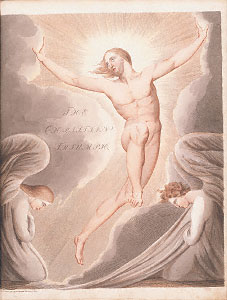
The study of the Four Zoas which I began on May 5 with the post God & Man is far from complete because I covered less than 50 of Blake's 133 pages. I add another manuscript image today and text to enhance it. This full page image is placed following Page 113. The picture is one of those reused from Edward Young's Night Thoughts. Blake created this engraving for the title page of Night the Fourth, giving it the title The Christian Triumph. We are spectators as Jesus puts 'off the dark Satanic body' by parting 'the clothing of blood' from the 'integuments woven' - the spiritual body fit for Eternity.


Four Zoas, Night VIII, Page 104, (E 378) 
"He stood in fair Jerusalem to awake up into Eden
The fallen Man but first to Give his vegetated body  
To be cut off & separated that the Spiritual body 
may be Reveald"
British Library
Four Zoas Manuscript
Page 114

Four Zoas, Night VIII, PAGE 104 (FIRST PORTION), (E 376) 
"And Enitharmon namd the Female Jerusalem the holy
Wondring she saw the Lamb of God within Jerusalems Veil
The divine Vision seen within the inmost deep recess
Of fair Jerusalems bosom in a gently beaming fire

Then sang the Sons of Eden round the Lamb of God & said 
Glory Glory Glory to the holy Lamb of God
Who now beginneth to put off the dark Satanic body
Now we behold redemption Now we know that life Eternal
Depends alone upon the Universal hand & not in us
Is aught but death In individual weakness sorrow & pain  

PAGE 113 (FIRST PORTION) 
We behold with wonder Enitharmons Looms & Los's Forges   
And the Spindles of Tirzah & Rahab and the Mills of Satan & Beelzeboul
In Golgonooza Los's anvils stand & his Furnaces rage 
Ten thousand demons labour at the forges Creating Continually
The times & spaces of Mortal Life the Sun the Moon the Stars 
In periods of Pulsative furor beating into wedges & bars
Then drawing into wires the terrific Passions & Affections
Of Spectrous dead. Thence to the Looms of Cathedron conveyd
The Daughters of Enitharmon weave the ovarium & the integument
In soft silk drawn from their own bowels in lascivious delight 
With songs of sweetest cadence to the turning spindle & reel
Lulling the weeping spectres of the dead. Clothing their limbs
With gifts & gold of Eden. Astonishd stupefied with delight
The terrors put on their sweet clothing on the banks of Arnon 
Whence they plunge into the river of space for a period till 
The dread Sleep of Ulro is past. But Satan Og & Sihon    
Build Mills of resistless wheels to unwind the soft threads & reveal
Naked of their clothing the poor spectres before the accusing heavens
While Rahab & Tirzah far different mantles prepare webs of torture
Mantles of despair girdles of bitter compunction shoes of indolence
Veils of ignorance covering from head to feet with a cold web

We look down into Ulro we behold the Wonders of the Grave
Eastward of Golgonooza stands the Lake of Udan Adan In
Entuthon Benithon a Lake not of Waters but of Spaces  
Perturbd black & deadly on its Islands & its Margins 
The Mills of Satan and Beelzeboul stand round the roots of Urizens tree
For this Lake is formd from the tears & sighs & death sweat of the Victims
Of Urizens laws. to irrigate the roots of the tree of Mystery
They unweave the soft threads then they weave them anew in the forms
Of dark death & despair & none from Eternity to Eternity could Escape
But thou O Universal Humanity who is One Man blessed for Ever
Recievest the Integuments woven Rahab beholds the Lamb of God
She smites with her knife of flint She destroys her own work
Times upon times thinking to destroy the Lamb blessed for Ever
He puts off the clothing of blood he redeems the spectres from their bonds
He awakes the sleepers in Ulro the Daughters of Beulah praise him
They anoint his feet with ointment they wipe them with the hair of their head"
. 

Thursday, August 27, 2015

SECRETS OF ETERNITY [83]

Milton O Percival, on Page 33 of William Blake's Circle of Destiny, makes this statement about Vala who assumes many identities in the Four Zoas: 
"At the outset of her career and in her true nature Vala represents the gentle feminine emotions. As such she is the ideal which possessed Urizen when, in the early prophetic books, he came back from his 'dark contemplation' bearing his laws of mercy, pity, peace - the ideal which in the Four Zoas Luvah left in Albion's brain. As such she is the 'lily of Havilah,' the pure and the good, with which Albion falls in love."

"However it is one thing to arrive at mercy and pity spontaneously and quite another to make these virtues an abstract and rational ideal. Vala, who in her spontaneity was loved for her gentle purity, proves a jealous mistress."


Book of Urizen, Plate 4, (E 72)
6. Here alone I in books formd of metals
Have written the secrets of wisdom                            
The secrets of dark contemplation
By fightings and conflicts dire,
With terrible monsters Sin-bred:
Which the bosoms of all inhabit;
Seven deadly Sins of the soul.  

7. Lo! I unfold my darkness: and on
This rock, place with strong hand the Book
Of eternal brass, written in my solitude.

8. Laws of peace, of love, of unity:
Of pity, compassion, forgiveness.                                
Let each chuse one habitation:
His ancient infinite mansion:
One command, one joy, one desire,
One curse, one weight, one measure
One King, one God, one Law." 

Since Blake's original conception of the Four Zoas was a tale of Vala, we find her as a motivating force as the poem develops. Blake does not want his reader to focus on a single cause of the disintegration of the unified psyche, but Vala plays a significant role in the breakdown. As a character in the Four Zoas, Vala first appears on Page 10. We learn here of the dislocation of Luvah and Vala from the heart, where emotions properly reside, to the brain where man is expected to do his thinking. The distortion of emotional expression, when it acts as if it were in charge of making rational decisions, produces misunderstandings and disasters.

On page 10 of the Four Zoas Blake associated Vala with the Zoa Luvah whose emanation she is. Here we see the movement from the heart made by Luvah and Vala, as precipitating the well known incident of Luvah seizing Urizen's horses of light while Vala's passivity resided in the brain.


Four Zoas, Night I, PAGE 1O, (E 305) 
"But Enitharmon answerd with a dropping tear & frowning  
Dark as a dewy morning when the crimson light appears   
To make us happy let them weary their immortal powers   
While we draw in their sweet delights while we return them scorn
On scorn to feed our discontent; for if we grateful prove
They will withhold sweet love, whose food is thorns & bitter roots.
We hear the warlike clarions we view the turning spheres 
Yet Thou in indolence reposest holding me in bonds
Hear! I will sing a Song of Death! it is a Song of Vala! 
The Fallen Man takes his repose: Urizen sleeps in the porch
Luvah and Vala woke & flew up from the Human Heart 
Into the Brain; from thence upon the pillow Vala slumber'd.
And Luvah siez'd the Horses of Light, & rose into the Chariot of Day
Sweet laughter siezd me in my sleep! silent & close I laughd 
For in the visions of Vala I walkd with the mighty Fallen One
I heard his voice among the branches, & among sweet flowers." 
The fall of Albion in the version on page 83 is attributed to Albion's succumbing to the attractiveness and loveliness of the exterior, feminine, passive appearance of Vala in Beulah, the territory of Luvah.


British Library
Four Zoas Manuscript
Page 83
 
Four Zoas, Night VII, Page 82, (E 358)
"The Shadow of Enitharmon answerd Art thou terrible Shade
Set over this sweet boy of mine to guard him lest he rend
PAGE 83 
His mother to the winds of heaven Intoxicated with
The fruit of this delightful tree. I cannot flee away
From thy embrace else be assurd so horrible a form
Should never in my arms repose. now listen I will tell
Thee Secrets of Eternity which neer before unlockd 
My golden lips nor took the bar from Enitharmons breast
Among the Flowers of Beulah walkd the Eternal Man & Saw
Vala the lilly of the desart. melting in high noon
Upon her bosom in sweet bliss he fainted   Wonder siezd
All heaven they saw him dark. they built a golden wall  
Round Beulah   There he reveld in delight among the Flowers
Vala was pregnant & brought forth Urizen Prince of Light 
First born of Generation. Then behold a wonder to the Eyes
Of the now fallen Man a double form Vala appeard. A Male
And female shuddring pale the Fallen Man recoild    
From the Enormity & calld them Luvah & Vala. turning down
The vales to find his way back into Heaven but found none
For his frail eyes were faded & his ears heavy & dull

Urizen grew up in the plains of Beulah   Many Sons
And many daughters flourishd round the holy Tent of Man     
Till he forgot Eternity delighted in his sweet joy
Among his family his flocks & herds & tents & pastures

But Luvah close conferrd with Urizen in darksom night
To bind the father & enslave the brethren Nought he knew
Of sweet Eternity the blood flowd round the holy tent & rivn   
From its hinges uttering its final groan all Beulah fell"

When Beulah falls the return to Eden is rerouted through Generation where man encounters the obstacles of experience. 

.

Tuesday, August 25, 2015

BATTLE TOOK FORM [Title]

British Library
Four Zoas Manuscript
Page1


Four Zoas, Title Page, (E 300) 
                    "THE FOUR ZOAS

          The torments of Love & Jealousy in 
                The Death and Judgement
               of Albion the Ancient Man

                 by William Blake 1797"
It seems that Blake did not originate the idea that he would write about Four Zoas and then develop his poetry around them. He began publishing his illuminated books in 1789 with the Book of Thel and Songs of Innocence. In about 1790 he began Marriage of Heaven and Hell (which he completed 2 years later.) In the books written between 1793 and 1795 there first appear personifications of contending factions within man. We learn of the activities of Urizen and Los, of Enitharmon and Ahania, of Orc and the Shadowy Female but the word Zoas does not appear.

The characters associated with the Zoas appeared in this order:
Urthona - 1792 - Marriage of Heaven and Hell
Enitharmon 1793 - America
Orc - 1793 - America
Los - 1794 - Europe
Shadowy Female - 1794 - Europe
Los and Urizen first appear as contending forces in the Book of Urizen - 1794
Ahania - 1795 - Book of Ahania
Tharmas - after 1797 - Four Zoas

Sometime during the time that Blake was composing Vala he integrated the entities he had created earlier into an organizing system to which he gave the name Zoas. He added a preliminary Night I to Vala around a new character, Tharmas, and renamed his poem the Four Zoas. The revised title page is the first appearance in Blake's poetry of Four Zoas. Outside of the Four Zoas the first reference is in the following passage from Milton.   

Milton, Plate  PLATE 35 [39], (E 135)
"So spake Ololon in reminiscence astonishd, but they
Could not behold Golgonooza without passing the Polypus
A wondrous journey not passable by Immortal feet, & none         
But the Divine Saviour can pass it without annihilation.
For Golgonooza cannot be seen till having passd the Polypus
It is viewed on all sides round by a Four-fold Vision
Or till you become Mortal & Vegetable in Sexuality
Then you behold its mighty Spires & Domes of ivory & gold        

And Ololon examined all the Couches of the Dead.
Even of Los & Enitharmon & all the Sons of Albion
And his Four Zoas terrified & on the verge of Death
In midst of these was Miltons Couch, & when they saw Eight
Immortal Starry-Ones, guarding the Couch in flaming fires        
They thunderous utterd all a universal groan falling down
Prostrate before the Starry Eight asking with tears forgiveness
Confessing their crime with humiliation and sorrow."
There are six references to Zoas in Milton, thirteen in Jerusalem, for a total of twenty mentions of the term in one form or another.

  George Anthony Rosso, Jr. in Blake's Prophetic Workshop comments on the significance of the Four Zoas in the development of Blake's body of work:

"The Four Zoas is also where Blake works out his mature epic vision, expanding his scope from the Lambeth to the epic prophecies. It is where he becomes the most original and daring of Romantic poets, experimenting with the nature and limits of narrative, reaching some dead ends, but exploring regions untrod in literature. It is the imaginative space which Blake seeks to induce what he calls prophetic or expanded vision, challenging readers to engage in intellectual battle, thereby helping to transform a divided world into a community." (Page 11)
.

Sunday, August 23, 2015

ETERNAL MAN IS RISEN [126]

British Library
Four Zoas Manuscript
Page 126
Four Zoas
, Night IX, PAGE 126, (E 395)
"And now fierce Orc had quite consumd himself in Mental flames Expending all his energy against the fuel of fire The Regenerate Man stoopd his head over the Universe & in His holy hands recievd the flaming Demon & Demoness of Smoke And gave them to Urizens hands the Immortal frownd Saying Luvah & Vala henceforth you are Servants obey & live You shall forget your former state return O Love in peace Into your place the place of seed not in the brain or heart If Gods combine against Man Setting their Dominion above The Human form Divine. Thrown down from their high Station In the Eternal heavens of Human Imagination: buried beneath In dark Oblivion with incessant pangs ages on ages In Enmity & war first weakend then in stern repentance They must renew their brightness & their disorganizd functions Again reorganize till they resume the image of the human Cooperating in the bliss of Man obeying his Will Servants to the infinite & Eternal of the Human form Luvah & Vala descended & enterd the Gates of Dark Urthona And walkd from the hands of Urizen in the shadows of Valas Garden Where the impressions of Despair & Hope for ever vegetate In flowers in fruits in fishes birds & beasts & clouds & waters The land of doubts & shadows sweet delusions unformd hopes They saw no more the terrible confusion of the wracking universe They heard not saw not felt not all the terrible confusion For in their orbed senses within closd up they wanderd at will And those upon the Couches viewd them in the dreams of Beulah As they reposd from the terrible wide universal harvest Invisible Luvah in bright clouds hoverd over Valas head And thus their ancient golden age renewd for Luvah spoke With voice mild from his golden Cloud upon the breath of morning Come forth O Vala from the grass & from the silent Dew Rise from the dews of death for the Eternal Man is Risen"


This page concerning the restoration of Luvah and Vala was not included in Blake's Poetry and Designs which selected a limited number of passages from each of the  Nine Nights. I have followed their selection which included Night I in its entirety and a few pages from the other eight Nights. Frye, however, calls attention to Page 126 as including Blake's own description of his intended thesis.
 
Northrop Frye, Fearful Symmetry, Page 270:
"The theme of the Four Zoas is, first the loss of the identity of divine and human natures which brought about the Fall and and created the physical universe; second the struggle to regain this identity in the fallen world which was completed by Jesus; and, third, the apocalypse. This thesis is given most concisely in the following passage:

If Gods combine against Man Setting their Dominion above
The Human form Divine. Thrown down from their high Station       
In the Eternal heavens of Human Imagination: buried beneath 
In dark Oblivion with incessant pangs ages on ages
In Enmity & war first weakend then in stern repentance
They must renew their brightness & their disorganizd functions
Again reorganize till they resume the image of the human    
Cooperating in the bliss of Man obeying his Will
Servants to the infinite & Eternal of the Human form
From the point of view of this poem, therefore, the essential barrier between man and his divine inheritance is the belief in a nonhuman God founded on the fallen vision of an objective nature. This is what Blake means by "Religion.
...
Page 278
"The Plan of the Four Zoas is not difficult to follow. Night I deals with the fall of Tharmas and the end of the Golden Age; Night II with the fall of Luvah and the end of the Silver age; Night III with the fall of Urizen and the end of the Brazen Age; Night IV with the beginning of the Iron Age or humanity in its present form six thousand years ago and the establishment of fallen life (Adam) and death (Satan). Then comes the tracing of the Orc cycle, under the symbols of the birth and binding of Orc in Night V, Urizen's exploration of his dens in Night VI, the crucifixion of Orc and the triumph of moral virtue in Night VII. In Night VII, however, a double cricis takes place, one an imaginative advance, symbolized by the mingling of Los and the Spectre of Urthona, the other a consolidation of error symbolized by the birth of Rahab from the Spectre of Urthona and another character called the Shadow of Enitharmon. In Night VIII this antithesis sharpens into its final form, in the Incarnation of Christ and the epiphany of Antichrist respectively. Night IX deals with the apocalypse."

Nearing the end of the Apocalypse in the Book of Revelation, John writes:
 

Revelation 22
[1] And he shewed me a pure river of water of life, clear as crystal, proceeding out of the throne of God and of the Lamb.
[2] In the midst of the street of it, and on either side of the river, was there the tree of life, which bare twelve manner of fruits, and yielded her fruit every month: and the leaves of the tree were for the healing of the nations.
[3] And there shall be no more curse: but the throne of God and of the Lamb shall be in it; and his servants shall serve him:
[4] And they shall see his face; and his name shall be in their foreheads.
[5] And there shall be no night there; and they need no candle, neither light of the sun; for the Lord God giveth them light: and they shall reign for ever and ever.
[6] And he said unto me, These sayings are faithful and true: and the Lord God of the holy prophets sent his angel to shew unto his servants the things which must shortly be done.
[7] Behold, I come quickly: blessed is he that keepeth the sayings of the prophecy of this book.


In the Apocalypse described by John of Patmos and by Blake, the principles which guide Eternity transform man's earthly experience.
.

Wednesday, August 19, 2015

WORK OF URTHONA [138]


British Library
Four Zoas Manuscript
Page 138
Four Zoas, Night IX, PAGE 138, (E 406) 
"Then Dark Urthona took the Corn out of the Stores of Urizen
He ground it in his rumbling Mills Terrible the distress
Of all the Nations of Earth ground in the Mills of Urthona
In his hand Tharmas takes the Storms. he turns the whirlwind Loose
Upon the wheels the stormy seas howl at his dread command        
And Eddying fierce rejoice in the fierce agitation of the wheels
Of Dark Urthona Thunders Earthquakes Fires Water floods
Rejoice to one another loud their voices shake the Abyss
Their dread forms tending the dire mills The grey hoar frost was there
And his pale wife the aged Snow they watch over the fires        
They build the Ovens of Urthona Nature in darkness groans
And Men are bound to sullen contemplations in the night
Restless they turn on beds of sorrow. in their inmost brain
Feeling the crushing Wheels they rise they write the bitter words
Of Stern Philosophy & knead the bread of knowledge with tears & groans

Such are the works of Dark Urthona Tharmas sifted the corn
Urthona made the Bread of Ages & he placed it
In golden & in silver baskets in heavens of precious stone
And then took his repose in Winter in the night of Time

The Sun has left his blackness & has found a fresher morning     
And the mild moon rejoices in the clear & cloudless night  
And Man walks forth from midst of the fires the evil is all consumd
His eyes behold the Angelic spheres arising night & day
The stars consumd like a lamp blown out & in their stead behold
The Expanding Eyes of Man behold the depths of wondrous worlds 
One Earth one sea beneath nor Erring Globes wander but Stars
Of fire rise up nightly from the Ocean & one Sun
Each morning like a New born Man issues with songs & Joy
Calling the Plowman to his Labour & the Shepherd to his rest
He walks upon the Eternal Mountains raising his heavenly voice   
Conversing with the Animal forms of wisdom night & day
That risen from the Sea of fire renewd walk oer the Earth

For Tharmas brought his flocks upon the hills & in the Vales
Around the Eternal Mans bright tent the little Children play
Among the wooly flocks The hammer of Urthona sounds              
In the deep caves beneath his limbs renewd his Lions roar
Around the Furnaces & in Evening sport upon the plains
They raise their faces from the Earth conversing with the Man
How is it we have walkd thro fires & yet are not consumd 
How is it that all things are changd even as in ancient times"
As Blake is reaching the conclusion of the Four the fireworks are over. The wheat has been separated from the chaff: truth from error. The Zoas are in their rightful places satisfied to do their work and appreciative of the work done by their brother Zoas. Urthona is here the oldest brother, older than Tharmas: man's consciousness of his spiritual nature is more fundamental than his consciousness of himself as a body. 
 
The processes of the human brain are served by the forces of nature not the reverse as was the case when nature dictated to man and mediated reality from outer to inner. The working of Urizen is to supply grain to the mills of Urthona from which he will make the Bread of Life. Man will no longer be fed on the bread made by Urizen - bitter words or stern philosophy. 
 
The spiritual wisdom of Urthona will be served to mankind as he works, and loves and grows wise and beautiful. Each individual will be transformed by his restored ability to perceive the infinite in all things.  
. 
.

Monday, August 17, 2015

WHAT HAVE I DONE [123]


Four Zoas, Night IX, PAGE 123, (E 392)
"And all the marks remain of the Slaves scourge & tyrants Crown
And of the Priests oergorged Abdomen & of the merchants thin
Sinewy deception & of the warriors ou[t]braving & thoughtlessness
In lineaments too extended & in bones too strait & long

They shew their wounds they accuse they sieze the opressor howlings began
On the golden palace Songs & joy on the desart the Cold babe
Stands in the furious air he cries the children of six thousand years
Who died in infancy rage furious a mighty multitude rage furious
Naked & pale standing on the expecting air to be deliverd
Rend limb from limb the Warrior & the tyrant reuniting in pain   
The furious wind still rends around they flee in sluggish effort

They beg they intreat in vain now they Listend not to intreaty
They view the flames red rolling on thro the wide universe
From the dark jaws of death beneath & desolate shores remote
These covering Vaults of heaven & these trembling globes of Earth
One Planet calls to another & one star enquires of another   
What flames are these coming from the South what noise what dreadful rout
As of a battle in the heavens hark heard you not the trumpet
As of fierce battle while they spoke the flames come on intense roaring

They see him whom they have piercd they wail because of him  
They magnify themselves no more against Jerusalem Nor
Against her little ones the innocent accused before the Judges
Shines with immortal Glory trembling the judge springs from his throne
Hiding his face in the dust beneath the prisoners feet & saying
Brother of Jesus what have I done intreat thy lord for me   

Perhaps I may be forgiven While he speaks the flames roll on
And after the flames appears the Cloud of the Son of Man
Descending from Jerusalem with power and great Glory
All nations look up to the Cloud & behold him who was Crucified

The Prisoner answers you scourgd my father to death before my face    
While I stood bound with cords & heavy chains, Your hipocrisy
Shall now avail you nought. So speaking he dashd him with his foot

The Cloud is Blood dazling upon the heavens & in the cloud
Above upon its volumes is beheld a throne & a pavement 
Of precious stones. surrounded by twenty four venerable patriarchs  
And these again surrounded by four Wonders of the Almighty 
Incomprehensible. pervading all amidst & round about
Fourfold each in the other reflected they are named Life's in Eternity.
Four Starry Universes going forward from Eternity to Eternity
And the Falln Man who was arisen upon the Rock of Ages
PAGE 124
Beheld the Vision of God & he arose up from the Rock
And Urizen arose up with him walking thro the flames
Still to the Rock in vain they strove to Enter the Consummation
Together for the Redeemd Man could not enter the Consummation" 
"Before even redeemed Man can enter into his own unity again, the whole cosmos must be delivered by a great harvest and vintage, as in Revelation. But Blake's is the most active of revelations, and the Zoas or living principles of humanity must themselves work the rejuvenation." (Harold Bloom, Blake's Apocalypse, Page 272)

Although decisive steps have been taken to return mankind to perfect unity with God, there is still work to be done. The stage of development of which Blake writes on Page 123 is analogous to what was known in early Christianity as the 'Harrowing of Hell' which is based on scriptural references in First Peter: 

1 Peter 3
[18] For Christ also hath once suffered for sins, the just for the unjust, that he might bring us to God, being put to death in the flesh, but quickened by the Spirit:
[19] By which also he went and preached unto the spirits in prison;
1 Peter 4
[5] Who shall give account to him that is ready to judge the quick and the dead.
[6] For for this cause was the gospel preached also to them that are dead, that they might be judged according to men in the flesh, but live according to God in the spirit.

We find on this page of the Four Zoas the words 'They see him whom they have piercd,' a reference to the Crucifixion as describe in John 19 with the words:

[33] But when they came to Jesus, and saw that he was dead already, they brake not his legs:
[34] But one of the soldiers with a spear pierced his side, and forthwith came there out blood and water.

The phrase 'dashd him with his foot,' refers us to Psalms 91 and to the temptation of Jesus in the gospels including in Luke 4:

[10] For it is written, He shall give his angels charge over thee, to keep thee:
[11] And in their hands they shall bear thee up, lest at any time thou dash thy foot against a stone.

Events reminiscent of the Book of Revelation proceed on a grand scale but Blake is aware of the enormous work involved on preparing for the consummation:  

Revelations 14
[13] And I heard a voice from heaven saying unto me, Write, Blessed are the dead which die in the Lord from henceforth: Yea, saith the Spirit, that they may rest from their labours; and their works do follow them.
[14] And I looked, and behold a white cloud, and upon the cloud one sat like unto the Son of man, having on his head a golden crown, and in his hand a sharp sickle.
[15] And another angel came out of the temple, crying with a loud voice to him that sat on the cloud, Thrust in thy sickle, and reap: for the time is come for thee to reap; for the harvest of the earth is ripe.
[16] And he that sat on the cloud thrust in his sickle on the earth; and the earth was reaped.
[17] And another angel came out of the temple which is in heaven, he also having a sharp sickle.
[18] And another angel came out from the altar, which had power over fire; and cried with a loud cry to him that had the sharp sickle, saying, Thrust in thy sharp sickle, and gather the clusters of the vine of the earth; for her grapes are fully ripe.
[19] And the angel thrust in his sickle into the earth, and gathered the vine of the earth, and cast it into the great winepress of the wrath of God.
[20] And the winepress was trodden without the city, and blood came out of the winepress, even unto the horse bridles, by the space of a thousand and six hundred furlongs.

Mary Lynn Johnson and Brian Wilkie in Blake's Four Zoas: Design of a Dream indicate that we can't expect a smooth process when we are considering modifications in the cosmos: 
 

"The pace of regeneration in Night IX is not steady; new life develops fitfully, through sudden energetic advances punctuated by halts and sometimes by slight regressions which dramatize two points: that salvation demands persistent effort and that it is itself a transfigured strife." (Page 221) 
.